LiA project outline: Marketing and Fundraising strategy for CAP
Background
In the UK, it is estimated that 1 in 13 children have experienced some form of trauma before the age of 18 (Lewis et al.). The impacts of adverse childhood experiences (ACEs) have profound psychological impacts, reaching beyond the moment of the experience, into all aspects of an individual’s life. ACE’s increase the likelihood of anxiety, depression, internalising disorders and suicidality in later life (Salhe 2021).
Studies have shown the importance of the environment in which an individual lives in sustaining mental health recovery (Tew et al. 2012). Unfortunately, for many people in Cambridgeshire, their socioeconomic context makes it difficult for them to sustain the type of environment conducive to mental health recovery.
The Cambridge Acorn Project aims to provide support in constructing the type of environment where children and their families are able to recover from traumatic events, and build a life where they can thrive. The project offers panoramic support, incorporating therapeutic support, advocacy, support with engaging with education, social prescribing and much more in order to help children to thrive. Childhood is a time of opportunity and growth, and CAP prevents traumatic experiences and financial hardship from stealing these opportunities from children.
Project objectives
Within the charity sector, funding is often a challenge, especially when trying to provide specialist support which requires the employment of highly-trained professionals. Therefore, fundraising and marketing of charities, such as the Cambridge Acorn Project is paramount in continuing their mission.
My role builds on my knowledge of mental health that I have gained in my first year of studying my psychology degree, and affords me an opportunity to communicate these concepts in a way that aids my local community.
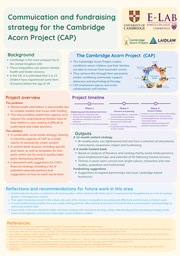
There are two strands to my project: the first is in social media marketing, creating a recognisable social media presence which effectively communicates the CAP values of social justice, helping children thrive and walking alongside families. The second focuses on financial strategy, analysing existing fundraising revenue streams and suggesting areas for growth through corporate partnerships.
SMART goals for the next six weeks
- A sustainable social media strategy, bearing in mind the capacity of CAP as a small charity to consistently create content.
- A content bank of posts, including specific post ideas, as well as templates for text-posts which can be used to quickly make posts during busy periods
- A document with suggestions for CAP’s financial strategy, including a list of potential corporate partners and suggestions on how to reach out to them.
- A journal of reflections on my personal approach to problem solving and understanding issues within organisations

My name is Rosalind and I'm a first year student in psychology at the University of Cambridge. I am particularly interested in the interection between physical and mental health and how psychological and neurological processes can impact somatic functions. Another major interest of mine is the maintenance of mental health recovery, and how post-acute care in communities and systems can support the longevity of recovery and prevent relapse.