Project Overview
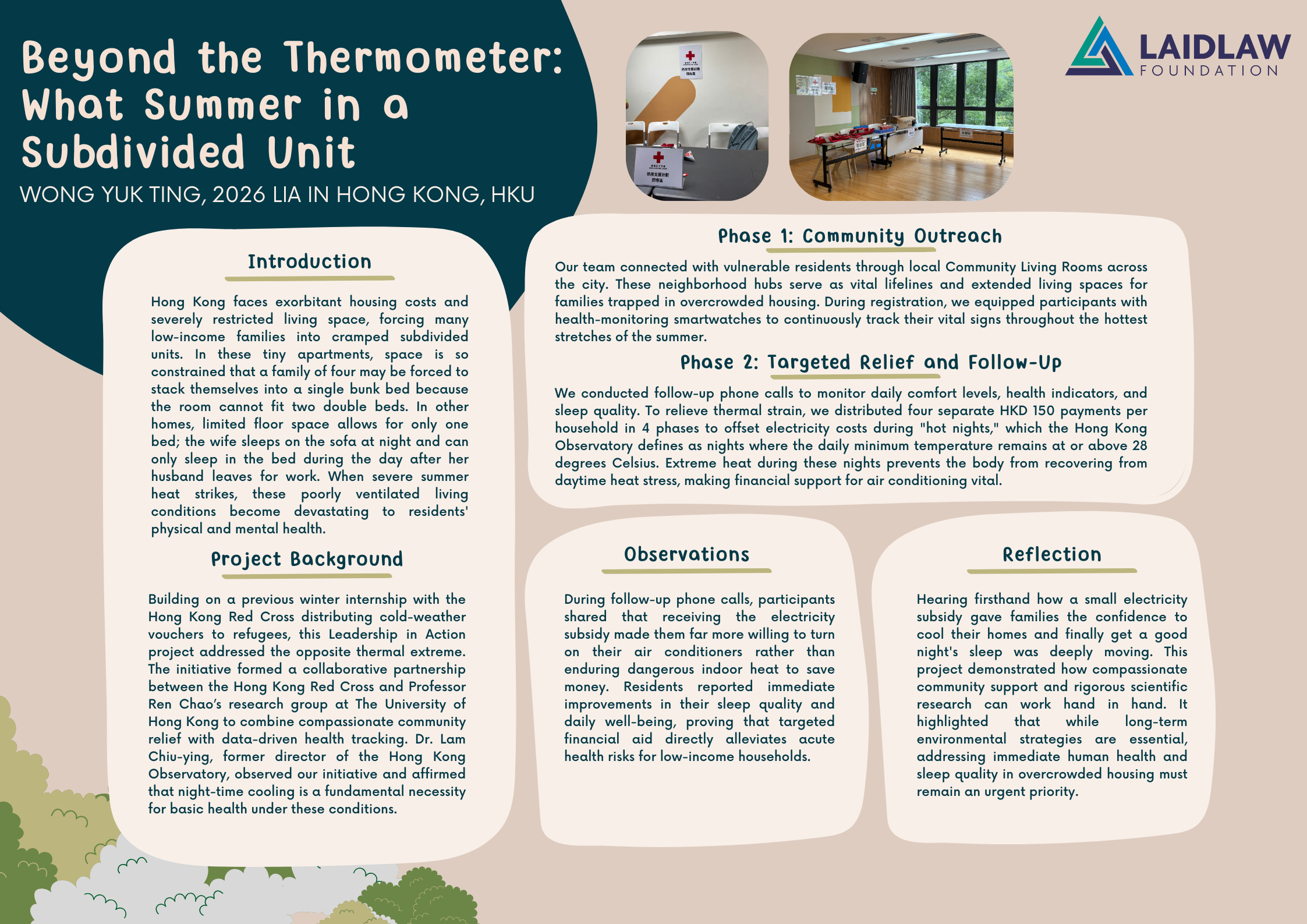
The primary goal of this Leadership in Action project was to mitigate acute health risks for low-income families living in Hong Kong's cramped, poorly ventilated subdivided units during severe summer heat waves. By bridging direct humanitarian relief with empirical health tracking, the project sought to demonstrate how targeted financial aid and scientific research can come together to promote health equity and establish night-time indoor cooling as a fundamental human necessity. In partnership with the Hong Kong Red Cross and Professor Ren Chao’s research group at The University of Hong Kong, the initiative aimed to engage vulnerable households through local Community Living Rooms, equip residents with health-monitoring smartwatches to track vital signs during severe heat waves, and conduct regular follow-up phone check-ins to evaluate sleep quality, physiological stress, and daily comfort levels. To relieve thermal strain, the project directly subsidized air conditioning electricity costs by disbursing four separate payments of HKD 150 per household during "hot nights," defined by the Hong Kong Observatory as nights where daily minimum temperatures remain at or above 28 degrees Celsius.
Outcomes and Impact
The initiative delivered tangible community impact by removing the financial barrier to air conditioning, enabling participating families to cool their homes during peak heat nights and significantly improving their sleep quality and overall well-being. Concurrently, the project gathered critical empirical research data on how extreme indoor heat affects human health in high-density urban housing. The initiative was recognized by Dr. Lam Chiu-ying, former director of the Hong Kong Observatory, who affirmed that night-time cooling in subdivided units is an essential health necessity under extreme weather conditions. On a personal level, this experience developed key leadership capabilities in collaborative community outreach, multi-stakeholder project coordination, and data-driven humanitarian action.