Leading Responsibly in a Changing World

Before beginning my Laidlaw research, I often understood research as a process of finding answers. I chose a question, collected evidence, analyzed it, and eventually reached a conclusion. Studying the Gei Wais of Mai Po Wetland made me realize that research can also be a process of understanding responsibility: responsibility to the people whose knowledge we represent, to the places we study, and to the future communities who will inherit the decisions made today.
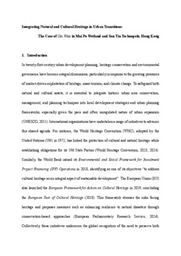
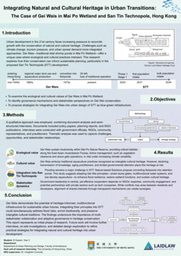
My research focused on an overlooked intersection between natural and cultural heritage. Gei Wais are traditional intertidal shrimp ponds introduced to the northwestern New Territories in the mid-1940s. Today, the remaining Gei Wais in Mai Po have important ecological functions, while the traditional practice itself is recognized as an element of Hong Kong’s intangible cultural heritage. Their significance therefore cannot be fully understood through either an environmental or a cultural lens alone.
This complexity became the foundation of my reflection on ethical leadership.
The first lesson I learned was that ethical leadership begins with recognizing that there is rarely only one legitimate perspective.
As I explored the future of Gei Wais, I encountered different priorities surrounding the same landscape. Conservation practitioners emphasize biodiversity and wetland management. Heritage perspectives highlight traditional knowledge and cultural continuity. Urban planners must consider development, infrastructure, and climate resilience. Communities and practitioners who have lived or worked with these landscapes possess forms of knowledge that cannot simply be replaced by academic research.
My research therefore required me to listen before drawing conclusions. The methodology combined documentary research with semi-structured interviews involving stakeholders from different professional and social backgrounds. This process made me more conscious of the responsibility involved in representing someone else’s perspective.
Ethical leadership, I came to understand, is not necessarily about making the decision yourself. Sometimes it is about creating the conditions for better decisions to be made.
This became particularly apparent when I examined the future of Gei Wais within the development of San Tin Technopole. The area faces significant challenges related to urbanization and flooding, while the remaining wetland landscapes carry ecological and cultural value. My research explored whether Gei Wai principles could be adapted into multifunctional blue-green infrastructure that could contribute to flood mitigation, ecological restoration, urban sustainability, and cultural preservation simultaneously.
What interested me most was not the idea of finding a perfect solution, but the possibility of finding shared interests. A conservation organization, a planner, a local community, and a developer may begin with very different objectives. Yet they may still find common ground around resilience, environmental quality, cultural identity, or the long-term sustainability of a place. My research ultimately highlighted the importance of multi-stakeholder collaboration and inclusive governance in making such connections possible.
This experience also changed how I understand global citizenship.
Being a global citizen does not necessarily mean working on an issue that crosses national borders. It can begin with learning to recognize that a local place is connected to much larger questions. The Gei Wais of Mai Po are a very local landscape, but the challenges they represent—rapid urbanization, climate change, biodiversity loss, cultural heritage preservation, and inclusive governance—are shared by cities around the world.
Studying this small landscape therefore taught me to think beyond its physical boundaries. How can cities grow without treating nature and heritage as obstacles to development? How can traditional knowledge contribute to contemporary climate resilience? How can communities participate meaningfully in decisions about places that carry both ecological and cultural meaning? These questions extend far beyond Hong Kong.
Perhaps the most important lesson from my first year of Laidlaw is that ethical leadership is closely connected to how we handle complexity. It requires curiosity without assuming that we already know the answer, ambition without losing sight of those affected by our decisions, and confidence without forgetting the value of other forms of knowledge.
My Laidlaw journey is still continuing, and my Leadership in Action experience will come in the following year. But research has already changed the way I see my role as a student. I no longer see research simply as producing knowledge. I see it as a responsibility to listen carefully, connect perspectives thoughtfully, and contribute knowledge that can help people make more inclusive and sustainable decisions.
For me, that is where ethical leadership and global citizenship begin: not with having all the answers, but with being willing to understand the complexity of the world we share—and taking responsibility for what we do with that understanding.