Leadership in Action plan: collaboration with Street Law Hong Kong
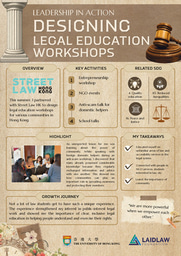
My forthcoming Leadership in Action project, in partnership with Street Law Hong Kong, will focus on legal education and accessibility. Although my research project, “Chinese Cremation: policy, society, and taboos,” looks backward and the LiA project forward, both converge on the same question: how can legal and cultural institutions become more inclusive for communities that are routinely overlooked?
The Leadership in Action component, which I will undertake over the summer, pushes my thinking from analysis toward future intervention. Working with Street Law Hong Kong, I aim to help refine the Flip Courtroom workshop, originally co-designed with Deaf Classroom HK. This workshop invites legal practitioners and students to experience the judicial process from the perspective of deaf individuals. My intended contribution is to make that simulation feel more authentic —so participants can genuinely grasp the barriers deaf people face. Alongside this, I will also help develop a separate workshop on entrepreneurship for young students, designed to raise their awareness of common legal pitfalls.
Through these planned activities, I have set three goals for myself: to understand the specific struggles of deaf communities and young learners, to contribute my own ideas to the final workshop designs, and to educate myself on unfamiliar legal fields and accessibility services.
The summer work will show me whether small, practical changes can begin to dismantle social or judicial barriers. Abstract conversations about legal accessibility often feel overwhelming, but when broken into concrete steps and immersive simulations, they become more manageable. I suspect this will teach me an important lesson about ethical leadership: real change rarely comes from issuing commands from above. It comes from giving others the tools and confidence to act on their own. The scholarship has given me time to reflect on this principle before I even step into the workshop.
Collaboration will likely be another major theme once my LiA project begins. Neither project is something I can do alone. Working with historians, deaf advocacy groups, legal educators, and students will mean constantly encountering expertise and viewpoints different from my own. I am already learning to speak up without dominating and to accept challenges without defensiveness. Navigating conversations about disability and access—especially across different legal and cultural contexts—forces me to listen carefully, choose my words thoughtfully, and regularly question my own assumptions.
Through my previous experiences in the Laidlaw Scholars journey, I have learnt that leadership is not about authority or position, it’s about responsibility. As I move into the summer and then continue my academic and professional journey, I plan to keep building on this foundation—blending research, advocacy, and collaboration to help build legal and cultural spaces where inclusion is not a special effort, but a standard practice.