Global Citizenship and Ethical Leadership journey
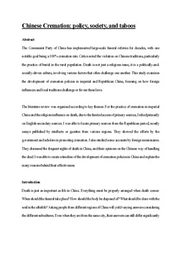
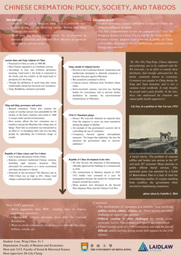
The Laidlaw Scholarship has fundamentally altered how I think about leadership, research, and my obligations as a global citizen. My research, “Chinese Cremation: policy, society, and taboos,” traced the modern history of cremation in China, examining law, policy, and deep cultural taboos.
My research stood apart from my daily legal study because I approached it through a historical and cultural lens. Rather than focusing solely on statutes or judicial decisions, I investigated how shifting political priorities, social norms, and long-held taboos have shaped China's funerary policies. What made this especially meaningful was my personal connection to the subject. I had witnessed these tensions within my own family, yet I had never before brought that experience into my academic work. Integrating the personal with the legal gave me a perspective rarely found in a typical law classroom. The literature review taught me to see systems—not isolated rules—as the backbone of society. Policy, I realized, does not operate in a vacuum; it collides with cultural rules, tradition, and community memory.
These experiences have deepened what I mean by global citizenship. Participating in cultural, legal, and civic life matters deeply. Yet access to that participation remains profoundly uneven across societies. Closing these gaps demands leaders who are willing to question inherited structures and who know how to build inclusive environments through collaboration. Whether through research that surfaces hidden histories or through grassroots workshops that equip people to act, leadership in law and policy can advance broader struggles for equity and inclusion. Presenting my findings at the 2025 Laidlaw Conference in Durham was a highlight—meeting like-minded young people from around the world and exchanging ideas in a global network reminded me that these challenges are shared, not isolated.
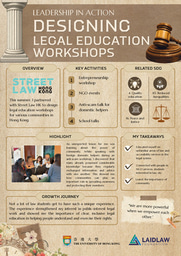
As a student who has already seen how family experience can differ from legal procedure, I have also grown more confident in advocating for accessibility within professional environments. I have deliberately set out to learn about areas of law I had never studied before, as well as the support services available within the judicial system. This inspired me to collaborate with Street Law Hong Kong for my upcoming Leadership-in-Action project, a legal education organization.
Looking back, the single most valuable lesson I take from the Laidlaw Scholarship so far is this: leadership has little to do with authority or position. It is about responsibility. Responsibility means spotting barriers that others easily overlook—whether a taboo around death or an assumption buried in a century-old policy. It means listening to the people who live with those barriers every day. And it means working patiently to create conditions where more people can fully belong. As I continue my academic and professional journey, I plan to keep building on this foundation—blending research, advocacy, and collaboration to help build legal and cultural spaces where inclusion is not a special effort, but a standard practice.
Last but not least, I would like to extend my sincere thanks to my supervisor, Professor Lily Chang, and Rachel Chua, for their mentorship and support.