If you spend enough time thinking even the hardest problems will eventually become simple and elegant
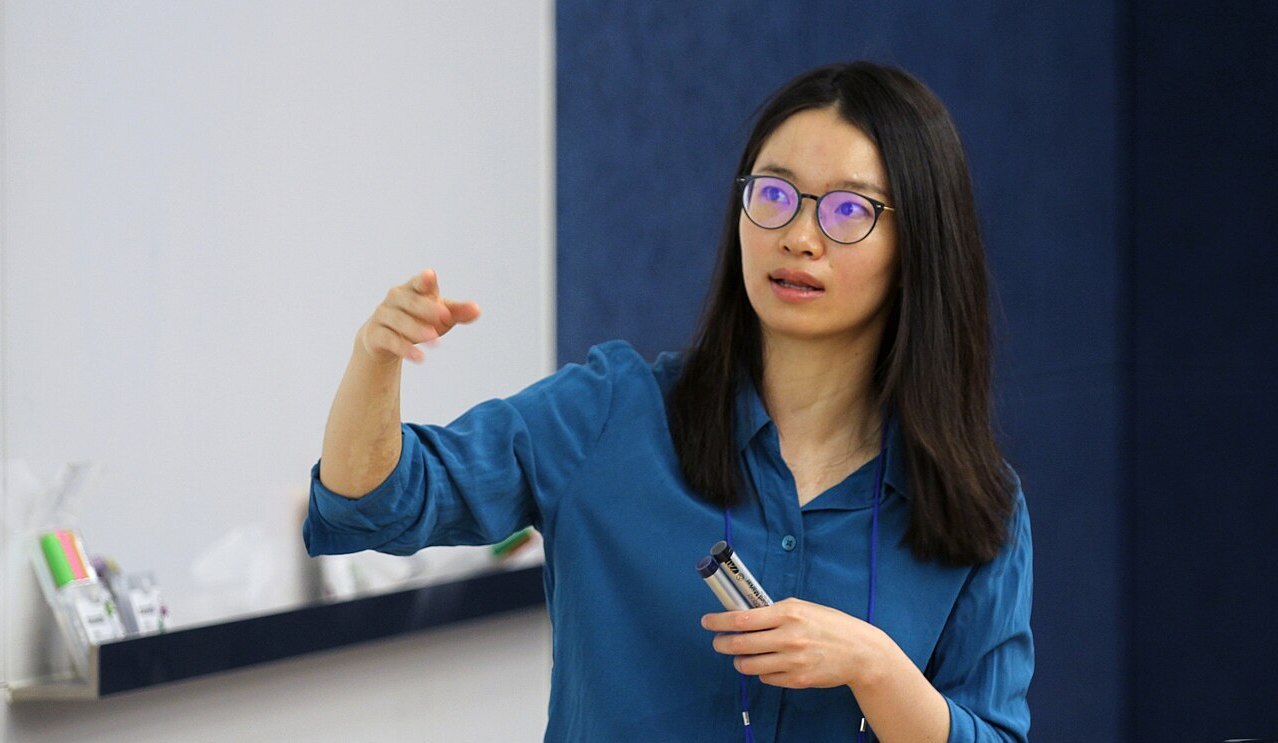
Hong Wang: The Elegance on the Other Side of Hard
Last week we published our 2025/2026 Annual Review, celebrating a year in which our network grew to twenty-two partner universities, MIT among the newest to join. It is achievements like those of Hong Wang, who earned her PhD at MIT and is now a professor at NYU, that show what these universities make possible. This summer she was awarded the Fields Medal, the highest honour in mathematics, given only once every four years to researchers under 40, for solving the Kakeya conjecture in three dimensions, a problem that had resisted the field for roughly half a century.
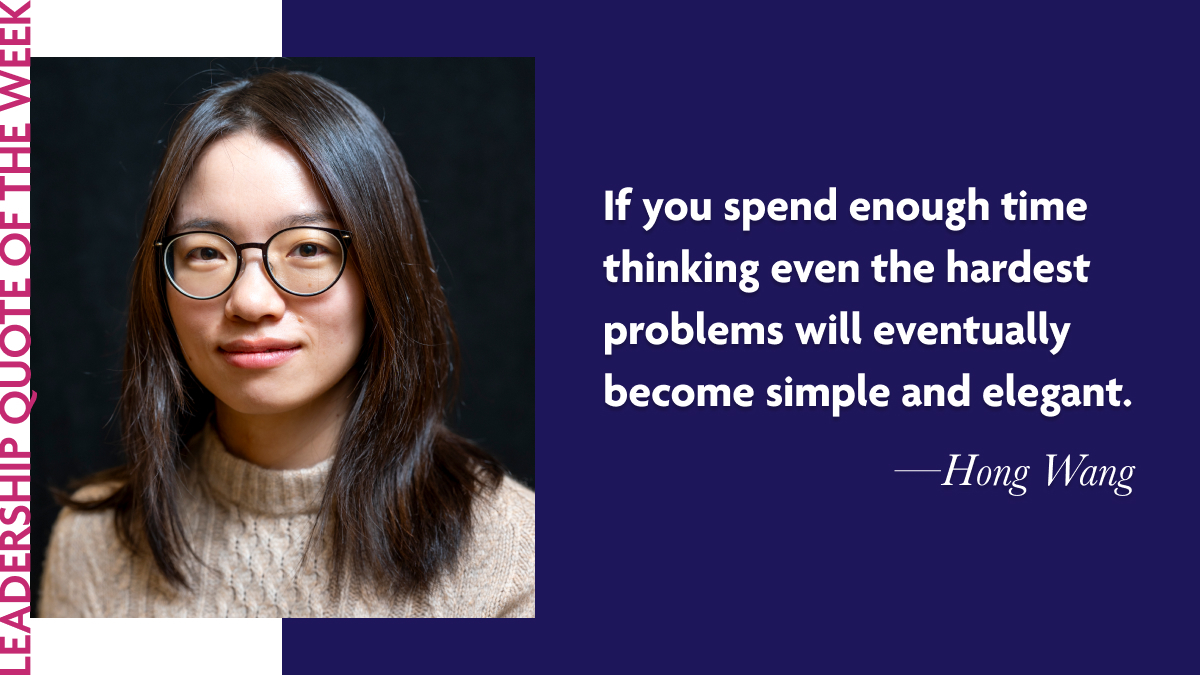
Hong Wang: "If you spend enough time thinking even the hardest problems will eventually become simple and elegant." | Photo credit: Simons Foundation, CC BY 4.0, via Wikimedia Commons
A Problem Held for Years
Wang first encountered the Kakeya conjecture as a doctoral student at MIT, working under her supervisor Larry Guth, and it stayed with her long after her PhD was finished. She carried it for the better part of a decade, through her postdoctoral years and into her professorship, before she and her collaborator Joshua Zahl produced a proof running to 127 pages. The Kakeya conjecture asks how small a region can be while still allowing a line to point in every possible direction within it, a question that had defeated mathematicians for around fifty years. Solving it in three dimensions is the achievement the Fields Medal recognises, and it placed Wang among a very small group, only the third woman to win the medal in its ninety-year history.
What Depth Asks of You
There is something in Wang's words worth holding onto when a problem refuses to give way. The hardest problems become simple, in her telling, only for those willing to stay with them long after most people would have moved on. Her own decade with the Kakeya conjecture shows what that persistence can produce. What she offers, in the end, is a kinder way to read difficulty, where a tangled question rarely reflects the limits of ability. More often it is a sign that the problem is still revealing itself, and that the understanding it holds sits further in.
Values in Focus
Wang's message speaks to the Laidlaw value of being #Curious and the Oxford Character Project virtue of #Judgment. Curiosity is what keeps you returning to a hard problem, asking why and what if long after others have set it aside. Judgment is what that sustained attention slowly builds, the deepening insight that lets you see the structure underneath a problem clearly enough to make it simple.
A Call to Reflect
As you consider Hong Wang's words, we invite you to reflect and share in the comments: what is a problem you once found impossibly hard that became clear only after you had spent real time with it?
🌟 There is much more to celebrate from a remarkable year across our programmes. Read our 2025/2026 Annual Review here

Hi! I'm Amanda, a third year Neuroscience student and Laidlaw alum from UCL. I'm Swedish-Persian and grew up in Sweden before moving to London for uni. These days, alongside my studies, I work for the Foundation as a Marketing Assistant.
For my first year research project, I worked on optimising alginate hydrogels for 3D astrocyte culture systems. In simpler terms, I was figuring out the best way to prepare a jelly-like scaffolds so that star-shaped brain cells called astrocytes could grow in three dimensions rather than flat on a dish. This matters because 3D environments mimic the brain more realistically, which could help researchers develop better treatments for neurological disorders!
For my Leadership-in-Action project, I co-created Beyond the Books, a resource designed to help students from underrepresented backgrounds navigate the unwritten rules of university life, from internships and networking to professional opportunities that aren't always obvious if you're the first in your family to go to uni.
Always happy to connect, whether you want to chat about neuroscience, widening access, the Laidlaw experience, or just say hello! One of my favourite things about this community is getting to meet people from different universities and backgrounds, so please do reach out! 🌟