From Scotland to the United States: Research, Caregiving Innovation, and Sustainable Leadership
I remember being a sophomore, feeling somewhat out of place, sitting on a couch at the front of an interest meeting mostly attended by freshmen. When applying to Laidlaw, I wrote that I hoped to develop “resilience, adaptability, and collaboration.” Writing this now as a senior at Duke University after completing a summer full of research and a Leadership-in-Practice summer, I have tangible examples of when I embodied resilience, adaptability, and collaboration.
Before getting to know the Laidlaw Scholars Program, some of my strongest examples of leadership were through creation. Being able to recognize the issue at hand. Developing an ambitious and thoughtful idea. Making that into reality. Now, my understanding has become much more delicate than that. Laidlaw has complicated this understanding because I know now that there’s this space between recognizing the problem and creating meaningful change; this path is not always linear and straightforward, and sometimes this means knowing when to act, to listen, to change courses, and to build relationships and infrastructures that allow promising work to persist.
Researching abroad in St. Andrews, Scotland just last year, my former ways of thinking were already being tested beyond the research challenges themselves. While letting the waves at St Andrews wash away older doubts about my independence, I was learning best practices for working with principal investigators and on large co-authored projects. Because much of the research I was used to had been done behind a screen, I was connecting an author list to the welcoming faces of medical students at the University of St Andrews.
I considered how the way of life in Scotland, where things seemed to move at a slower, more relaxed pace, tied into how I now navigate research. Research and healthcare interventions cannot always be transferred from one region to another without reevaluating the people, systems, and circumstances that receive them. Initially, I saw this learning moment as a lesson tied to research, but I now find it even more closely connected to leadership principles.
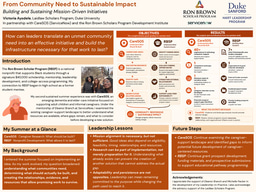
A year later, I entered one of my first conversations with my new mentor, Eleanor Branch, expecting us to discuss timelines for developing a dementia and eldercare prototype of CareSOS, a platform intended to support adult children and informal caregivers of people living with dementia. Yet one of Eleanor's first assignments to me had little to do with the prototype. She asked me to write ten things I wanted from my life. My list included ambition, independence, freedom, companionship, creativity, structure, and mission-driven work. Some of these seemed almost contradictory. I wanted independence and companionship, freedom and structure, ambition and purpose. Becoming the leader I wanted to be would also require learning how to hold competing values in tension rather than pretending they did not exist.
As we worked on the project, relying on what I learned in Scotland, my first question became, “What actually needs to be built in order to move the needle in eldercare?” Across the summer, I investigated over forty caregiving organizations and technology companies and helped develop a caregiver interview survey for outreach to caregivers. I thought we needed to understand what caregivers already have access to, where existing approaches were successful, and then define the remaining gaps. At the same time, my nonprofit development work with the Ron Brown Scholar Program showed me another side of sustainability. Supporting grant research and external funding efforts taught me that a meaningful mission is only one part of sustaining an initiative; eligibility, scale, timing, relationships, and feasibility matter too.
While these two experiences appear vastly different, my concept of leadership across the Laidlaw Scholars Program has steadily changed in parallel. I now clearly see the invisible work behind the screen: developing relationships, securing resources, and sometimes deciding when not to build yet.
Competence is not simply being capable of carrying out an idea or plan. Collaboration can mean allowing external feedback to change your approach, rather than simply inviting them to an already-designed plan. And character increasingly means staying true to your values, even when upholding them requires delays or changes to your plans.
Perhaps the most challenging pill to swallow is that adaptability does not always contradict persistence. If an obstacle appears as I attempt to accomplish a task, my natural inclination is to work harder toward the original goal and make up lost ground. While this can be true in leadership, the nuance is that ethical leadership sometimes requires me to look beyond the original goal. It requires enough persistence to remain committed to the purpose, but enough humility to let go of the trajectory I imagined for achieving it.
When I applied to Laidlaw, I wrote that leadership could be “quiet and humble” and that it meant consistently showing up for people who depend on you. I still believe this. What has transformed is my understanding of what showing up sometimes demands. It may mean creating something new. It may mean doubting an idea you love, reversing a plan you worked hard to make, doing hidden work that receives little recognition, or listening long enough to uncover that the contribution you imagined is not the contribution that is needed.
I do not want to leave Laidlaw less ambitious. If anything, these two years in this program have made me more convinced that enterprising ideas are worth seeking. But I want my ambition to become more disciplined: to ask better questions before settling on answers, to distinguish persistence from attachment, to build relationships alongside programs, and to think about sustainability at conception rather than at completion.
I entered Laidlaw knowing I wanted to be someone capable of creating meaningful change. Looking back at the sophomore sitting on that couch, feeling a little out of place, I leave Laidlaw more comfortable entering spaces where I do not yet know exactly where I fit. I leave with a difficult and, I suppose, more useful aspiration: to become someone capable of identifying what meaningful change actually requires -- and willing to adapt accordingly.
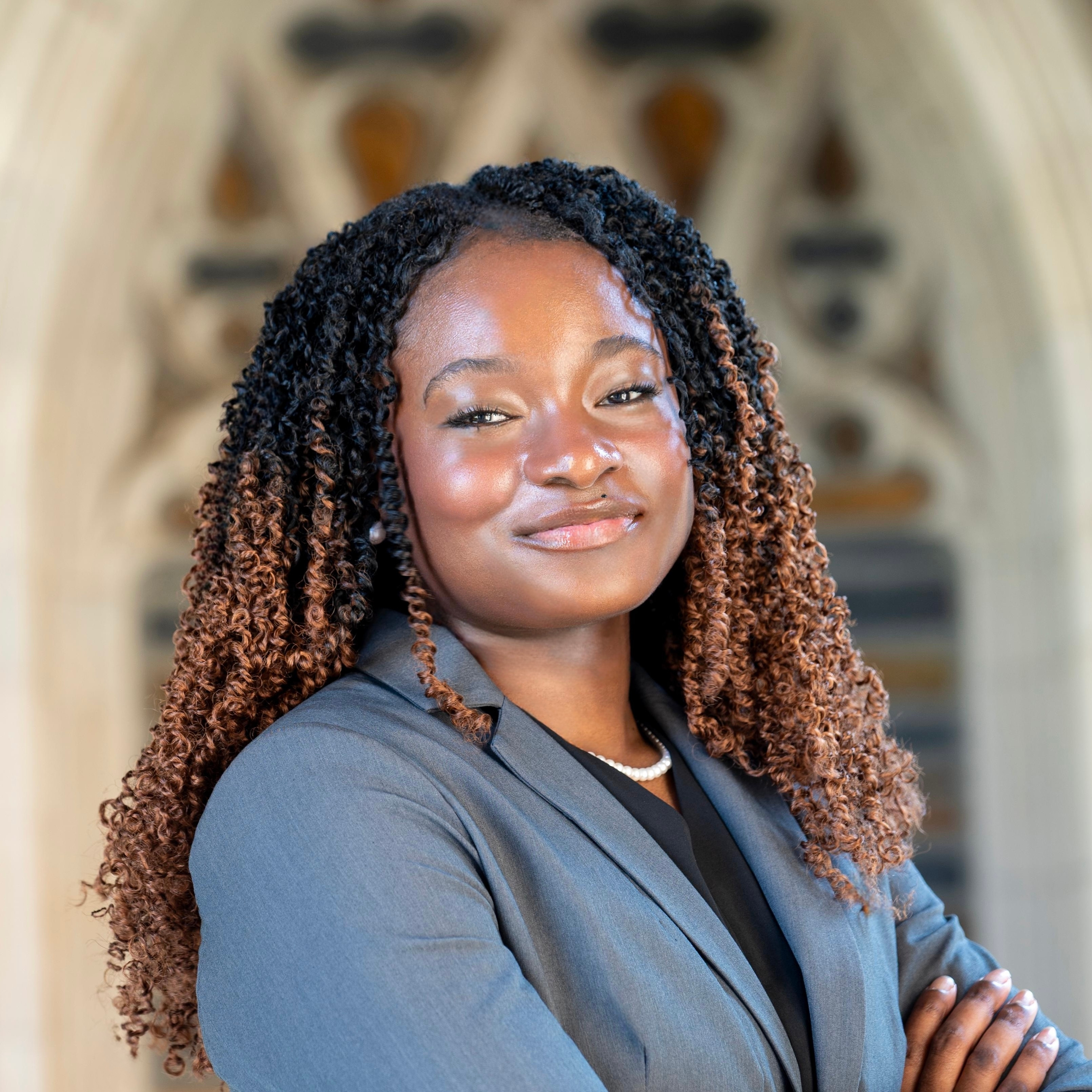
Victoria Ayodele is a Duke University undergraduate pursuing a self-designed “Neurological Development and Nutrition” curriculum, integrating neuroscience, biochemistry, pharmacology, and global health from Atlanta, Georgia. Her interdisciplinary work investigates how societal nutrition consumption and health disparities contribute to neurological impairment and influence the future of healthcare systems. As a Laidlaw Scholar and aspiring physician-leader, she is dedicated to advancing neurological health equity in international communities. A passionate advocate for community-based health solutions, Victoria led public health initiatives in sub-Saharan Africa through Leadership Initiatives in partnership with the Center of Disease Control and Prevention (CDC), the World Health Organization (WHO), and Georgetown University, collaborating with health professionals and Bauchi State officials to directly combat nutritional anemia and marasmus internationally. Her efforts include developing culturally sensitive workshops and clinical diagnostic kits for first-time mothers over two years. Victoria collaborates with community leaders in Nigeria, Ghana, Tanzania, Uganda, the UK, and Germany.
As Executive Director of the Duke Research Scholars Program, she researches how nutritional access and pharmacokinetics affect fetal development, cognitive growth, and immune health. Her work includes conference presentations at Brown University, the Association for Diagnostics & Laboratory Medicine, and the Annual Biomedical Research Conference for Minority Students. In her local communities, she assists North Carolina and Georgia patients as a medical and dietary assistant, addressing conditions such as Type II diabetes, obesity, and preeclampsia.
In her free time, Victoria enjoys playing sports, reading novels, and meeting new people. She is excited to participate more in the Laidlaw Scholars Program and meet students from around the world. If anyone would like to strike up a conversation with Victoria, her email is vta2@duke.edu.