What new ideas, challenges, or other issues have you encountered with regard to your project (this might include data collection, information that contradicts your assumptions or the assertions of others, materials that have enriched your understanding of the topic or led you to change your project, etc.)?
How have these ideas or challenges shaped the bigger picture of your research? Has the scope or focus of your topic changed since you began this project? If so, how?
(I'm combing the two questions)
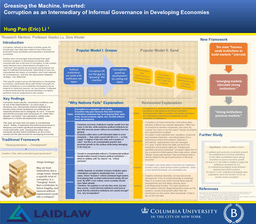
I think the biggest disappointment, but also the most rewarding experience, was that every result that came from the research turned out to be moot because there were assumptions that did not hold, like how a Jenga tower (I keep returning to this metaphor) collapses because of a fragile foundation. It was rather interesting to see how immediately this lesson from research applies to real life.
One of those problems was understanding that you cannot use logic to prove logic; i.e., it is insufficient to prove that X cannot function as Z without Y simply by stating that X ceased to function as Z without Y. Rather, one would need an example of X that is independent of Y and then see whether it still functions as Z. In clearer terms, I can only prove that there exists a causal pathway P to growth of which corruption is one component, but I cannot prove that every causal pathway leading to growth necessarily contains corruption. It is a very classical necessary-but-insufficient situation, which should have been obvious in hindsight. My premises only establish that corruption is one condition contributing to the functioning of the dual-track system, not that it is the unique causal mechanism—the latter being what I attempted to prove but failed to do, even though I still think it is true by its nature. However, establishing that claim would require much more evidence than I could provide at this stage.
In any case, I have learned, briefly speaking, to know one's limits and to re-scope a project, even at the last moment. In my case, adjusting the thesis from "Reducing A causes reduced B" into "A causes B" for the relationship between certain corruption and certain economic development. Not all of the work goes to waste; I just have to narrow the claim so that it is more defensible, even if it also becomes less satisfying and immediately useful—which I think is a lesson that every scholar eventually has to learn.
Now that you’ve engaged in Part II of the Leadership Retreat, reflect on a learning point that remains with you as a new way to understand leadership, and to incorporate into your own engagement, in the future.
Throughout the leadership retreat, we were introduced to different kinds of "leadership"—for example, leadership from the front versus leadership from behind. We also learned about different models of leadership, such as the classical hierarchical model and the multimodal one. Obviously, there is no a priori "better" leadership style or model; everything has to be contextualized.
But this begs the question: should I change myself after becoming aware of these differences? What does "contextualized" mean? Should I accommodate or should I insist? Should I try to become more amicable, knowing that I am a hardcore "analytics" person? Should I really care that I prioritize "Status" over "High Pay"? Awareness itself is obviously useful, but what to do with that awareness is another way of understanding leadership that I still have to learn.
For me, that remains with me as a new way to understand leadership, perhaps something to be learned, in the future.

Hello there!
I'm a history major at Columbia University. I spent 14 years as a border-crossing student, living in mainland China and commuting to Hong Kong every day. I spent my high school years in Houston, Texas. My primary focus is transnational Asian history, though I am also broadly interested in philosophy, IR, and political theory.
I spent my freshman year at Rice and transferred to Columbia as a sophomore. I'm currently a rising junior.
I speak English, Mandarin, and Cantonese. I am currently unsuccessfully acquiring Japanese and French.