What does it mean to practice ethical leadership and embrace global citizenship?
This question has stayed with me throughout my Laidlaw scholarship journey. I have come to realise that neither of them is a formal title or an abstract concept. Instead, both are living choices we make in small, everyday moments.
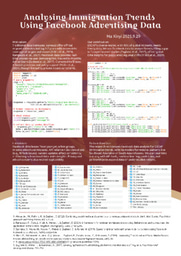
My demographic research on cross‑border migration has brought these ideas into focus. Working with advertising data to analyse immigration trends, I constantly confronted ethical dilemmas behind numbers. Datasets can quantify migrant flows, but they can also overlook vulnerable groups: people excluded by low digital penetration, short‑term migrants whose stories remain invisible. Ethical leadership, for me, starts with intellectual honesty in research. It means acknowledging data limitations, recognising who may be uncounted, and resisting the urge to over‑interpret results. Good intentions are not enough; we must hold ourselves accountable for the gaps embedded in our work.
The Oxford Character Training deepened my accountability, which is a cornerstone of ethical leadership. During trainings, I repeatedly absent sessions. While those external burdens were genuine, the bahaviour is selfish and may hurt the bigger group. Accountability means owning commitments and understanding how one’s actions ripple outwards to shape a community. I had treated programme participation as flexible, prioritising personal staff over my obligations to peers, mentors and the wider Laidlaw collective. My absences risked slowing group dialogue, draining collective energy and signalling unreliability to others.
This mindset also informs how I think about my future Leadership‑in‑Action project. Global citizenship is not only about learning global problems from textbooks or datasets. It calls for humble engagement: listening first, understanding local realities, and showing up without assuming I hold all the solutions.
Ethical leadership and global citizenship are inseparable. To lead ethically is to see beyond our own interests; to be a global citizen is to recognise our shared humanity across borders. These are lifelong practices that I will continue to carry forward in my future.
I’m Maggie from HKU. In high school, I won 1st prize in mathematical paper writing and ability tests. I chose statistics as my first major in college and learned probability theory. I also master linear algebra, multivariable calculus, and Python. I’m pretty interested in supply chains and optimization strategies. I wish to pursue a doctoral degree and make a difference in the world by estimating and optimizing strategies in life. Undergraduate research is an important chance to explore my interests and learn more about this field.