End of Program Reflection
When I began the Laidlaw Scholars Programme, I understood research primarily as an individual process: identifying a gap in existing scholarship, developing a methodology, collecting data, and producing an argument that could contribute to a larger academic conversation. Over the course of the programme, however, I came to understand that research cannot be separated from the communities in which it is conducted, the people who make it possible, or the responsibilities that accompany the production of knowledge. My experiences across the summer research project, leadership development sessions, Oxford Character Project, annual conference, global cohort, Leadership-in-Action placement, and international experience gradually reshaped my understanding of research, leadership, and global citizenship as interconnected practices.
My research project on Chinese slash fiction and digital feminism was the central component through which I developed this understanding. I initially approached the project through a relatively straightforward question: whether the feminist potential of Chinese slash fiction emerges primarily through its form or its content. Through thematic narrative analysis and semi-structured interviews with five Chinese slash fiction authors, I found that the distinction was considerably less stable than I had initially anticipated. Three of the five participants were more form-oriented in their understanding of slash fiction, emphasizing its ability to create a space for female expression and to explore gendered social dynamics from a degree of emotional distance. The research therefore became less about determining whether slash fiction was inherently feminist and more about understanding how feminist expression operates within a particular cultural and digital context.
This shift in my research question was also a shift in my understanding of leadership. The research process required me to make decisions independently, but it also required me to recognize the limitations of my own perspective. My participants did not simply provide evidence for an argument I had already constructed. Their responses complicated my assumptions and required me to reconsider the categories through which I was interpreting their experiences. This became particularly important when examining Chinese digital feminism, where censorship, backlash, and internal community policing create a context that differs significantly from many Western understandings of feminist digital activism. I therefore came to understand intellectual leadership not as the ability to produce a definitive interpretation, but as the ability to remain responsive when evidence challenges one's initial assumptions.
The 2025 Laidlaw Annual Conference at Brown University provided a different context in which to develop this form of confidence. Presenting my research to an international cohort of scholars was an opportunity to articulate the significance of a project that occupies a relatively unconventional position within academic research. My project was subsequently shortlisted by Taylor & Francis for potential publication, which was a meaningful recognition of the work I had undertaken. At the same time, the conference made me more conscious of how disciplinary hierarchies can shape perceptions of research. I was surrounded by projects in fields where the outcomes and applications of research could often be presented more immediately than those of humanities research. Rather than interpreting this difference as a limitation of my own project, I became more confident in articulating why questions concerning literature, gender, digital culture, and representation are themselves significant forms of knowledge production.
The leadership development sessions and Oxford Character Project further complicated my understanding of what leadership entails. Before Laidlaw, I largely associated leadership with visible forms of responsibility: organizing projects, communicating effectively, and taking initiative. The character-focused components of the programme encouraged me to consider the less visible dimensions of leadership, particularly the relationship between competence and responsibility. A leader is not simply someone who can make decisions, but someone who must consider how those decisions affect others and remain accountable for the consequences. This distinction became increasingly relevant during my Leadership-in-Action experience.
My LiA placement with FEW Japan did not follow the project outline I had originally developed. Instead, my responsibilities shifted according to the organization's changing needs. I spent the first half of my placement working on social media content, promotional materials, and event communications before transitioning into legal research concerning Japanese privacy regulations and FEW's privacy policy. The transition was unexpected, but it required me to work independently while remaining responsive to the needs of a volunteer-run organization. The experience demonstrated that leadership within a community does not necessarily involve directing others. In some contexts, it is instead expressed through adaptability, careful listening, and a willingness to contribute where one's skills are most useful.
My international experience in Japan also challenged my understanding of global citizenship. Although I approached the experience with an existing academic interest in East Asia, I quickly became aware of the distinction between cultural familiarity and cultural competence. Working with Japanese legislation presented linguistic difficulties that could not always be resolved through direct translation, while FEW's organizational structure required me to adjust to professional expectations that differed from those I had anticipated. These experiences made me more conscious of the limitations of approaching another cultural context through assumptions formed elsewhere.
This awareness was reinforced through my interactions with the global Laidlaw cohort. Speaking with scholars from different countries, disciplines, and personal backgrounds exposed me to perspectives that could not be reduced to a single understanding of what constitutes academic or professional success. I became increasingly aware that my own experiences represent only one position from which to interpret the world. In this sense, global citizenship came to mean more than international mobility. It became a practice of recognizing the partiality of one's own perspective and remaining willing to revise it through sustained engagement with others.
Across the programme, these experiences have also shaped how I understand ethical leadership. My research required me to consider participant confidentiality and representation; my LiA experience required me to consider how my contributions could serve an organization beyond my own six-week placement; and my international experience required me to recognize the limitations of my cultural and linguistic perspective. These were different contexts, but each required a similar form of responsibility: understanding that my actions exist within systems and communities larger than myself.
As I continue beyond the Laidlaw programme, I hope to carry this approach into both my academic and professional work. As a researcher, I want to remain attentive to the communities represented in my work and resist the temptation to impose conclusions upon experiences that I do not share. As a leader, I want to prioritize listening and accountability alongside initiative and competence. As a global citizen, I want to continue engaging with communities and perspectives outside of my immediate environment while remaining conscious of the assumptions I bring into those interactions.
Ultimately, Laidlaw has not provided me with a single definition of leadership or global citizenship. Instead, it has demonstrated that both are ongoing processes shaped by context, relationships, and reflection. The programme began with a research question about how feminist expression operates within Chinese digital culture. It ends with a much broader understanding of how knowledge, responsibility, and community intersect. I will treasure the experiences that this programme has gifted to me, and the relationships it has fostered. I leave Laidlaw not with a fixed idea of the person I intend to become, but with a clearer framework for how I want to approach that process: with curiosity, accountability, and a willingness to reconsider what I think I already know.
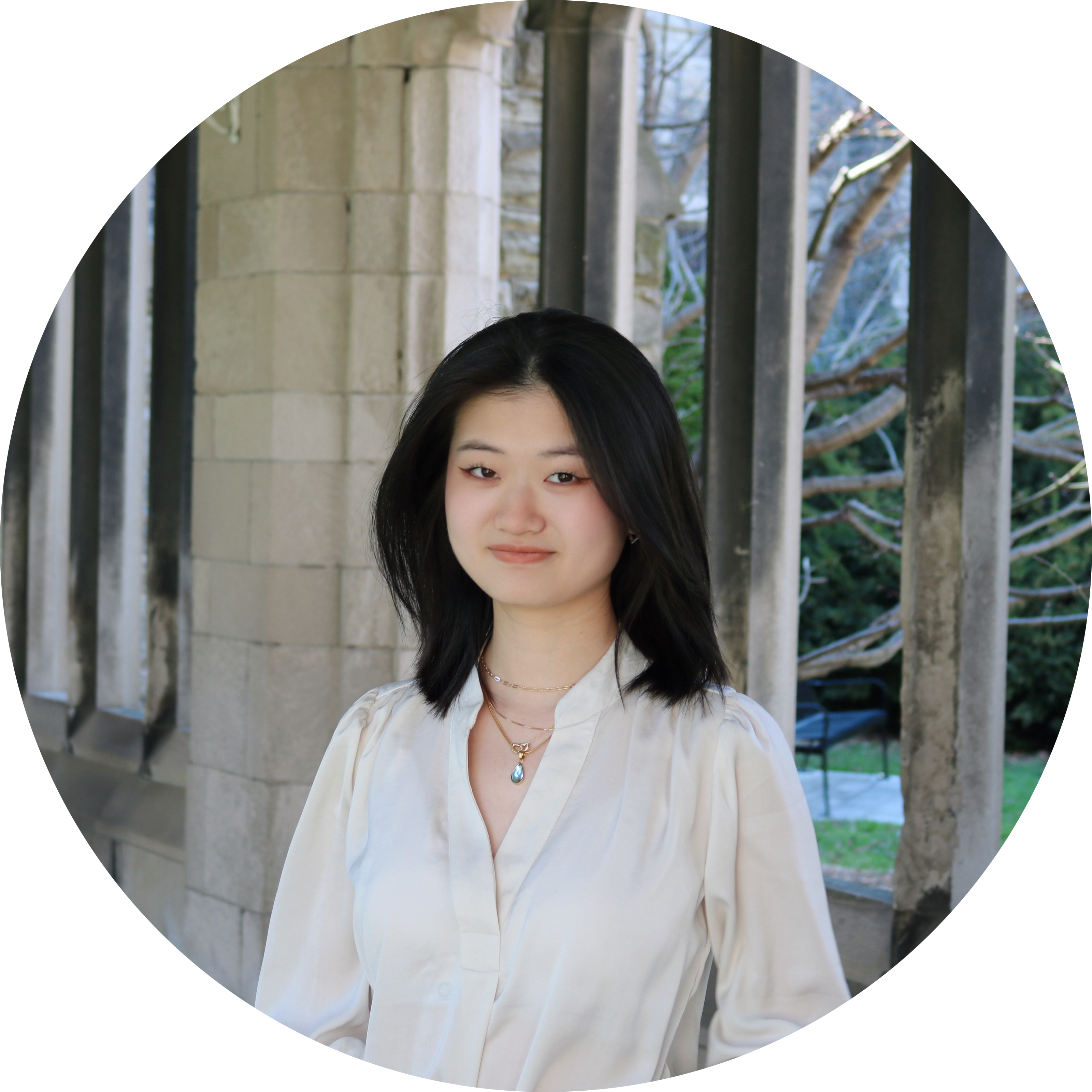
Hello :) My name is Ella, a second-year student at the University of Toronto!
My research looks at how Chinese slash fiction is used by women to reflect real-life struggles and promote feminist awareness. I focus on why this genre—centered on queer male relationships—is chosen to express female experiences, and how censorship and cultural factors in China influence that decision. In the past, I have researched how coming-of-age narratives are portrayed in Western slash fiction.
Outside of academia, I love to snowboard (in the winter) and ride my electric unicycle (in the summer). My favourite pastime is trying new foods and drinks while (sometimes) discussing how certain aspects of fanfiction reflect social justice issues.
My (more normal) hobbies include reading—anything except mysteries—with a focus on Asian North American stories, listening to pop and classical music, and playing badminton. I will be studying English and East Asian Studies over the next three years!