Where it started
When I applied for Laidlaw, I was only thinking about the research project. It looked like a great internship for a first year student. Two years later, it's the best decision I've made at UCL.
Laidlaw gave me so much more than an internship. I learnt more about myself, found new friends and discovered opportunities I didn't know existed.
I realised this at the Laidlaw Global Annual Conference in Durham. I was surrounded by hundreds of scholars from all over the world. Everyone was unique, talented and driven. Sitting in that room, I felt a strong sense that I was capable of great things too, because every single person there was special in their own way.
Character through adaptability
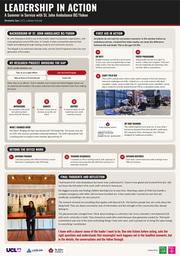
My two summers could not have looked more different. The first was in a pharmacy lab at UCL, working on electrospun orodispersible films for paediatric drug delivery. The second was a Leadership in Action placement with St. John Ambulance BC/Yukon in Vancouver. Yet both were about the same thing: making care work better for young people.
In the lab, almost every skill was new to me. I had never used techniques like TGA, DSC, PXRD or SEM before. In Vancouver, I had to adjust to a new city, a new culture and a workplace I didn't yet understand.
What carried me through both was the same. I focused on the people around me and what the work meant to them. I found real passion in it, which made the unfamiliar parts worth learning. I also learnt not to be afraid to ask for help and, slowly, to trust myself. I didn't need to know everything on day one to do good work.
What I learnt about leading
Before Laidlaw, I thought leaders were the people with all the answers. The Scholarship taught me the opposite.
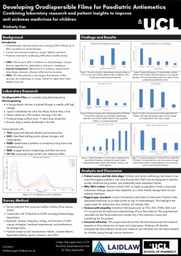
What stayed with me most from my research summer actually happened outside the lab. As part of my project, I interviewed patients at Great Ormond Street Hospital. It was hard speaking to them, knowing what they were going through. But it reminded me who the work was really for. My role was small, yet what we were building could one day change their lives, or the lives of patients after them. I was determined to give it my very best.
I carried that same sense of purpose to Vancouver. As someone new to SJA, I learnt to ask a question and then wait. The most honest answers came after the pause. Watching cadets, most no older than 15, take charge at Cadet Field Day pushed me to earn my own first aid certificate. Before I left, I handed over the survey and a draft transition manual so the work could carry on without me.
Both summers changed how I see leadership. It isn't about knowing everything. It's about being willing to be vulnerable with others, so they feel safe being vulnerable with you. That's how you grow together.
Laidlaw describes leadership through the 3Cs: Change Maker Values, Character and Capacities. Looking back, I can see all three. Curiosity pushed me to dig deeper, character meant honouring the trust people gave me and my capacities grew every time I listened, adapted and followed through.
The people I met along the way
Honestly, the best part of Laidlaw has been the people. Even just the 30 UCL scholars in my cohort were a gift. Beyond them, I met scholars from around the world working across completely different fields. Hearing their passions and goals shifted something inside me.
It's easy to get enclosed in our own world. At university, I'm mostly surrounded by UCL people. Laidlaw opened my eyes to how many paths are out there for me.
Every person comes with a story. Listening to them and understanding them has taught me more than any lecture ever could. To me, that's what a global mindset really is. It isn't about how many places you've been. It's about how willing you are to learn from the people you meet.
Looking back
I came to Laidlaw for a research project. I'm leaving with friendships, a wider view of the world and a clearer sense of the leader I want to be. One who listens before acting, asks the right questions and understands that meaningful work happens not in the headline moments, but in the details, the conversations and the follow through.
Every volunteer I met in Vancouver balanced SJA with work, university or both. They showed up week after week because they genuinely wanted to. That quiet commitment is the kind of leadership I want to carry forward.
From here, I want to work where healthcare, science and business meet. Leading ethically there means never losing sight of the patient, especially children and communities who are easy to overlook. Wherever I end up, I'll keep my first aid up to date and keep volunteering.
Laidlaw didn't just give me an internship. It gave me the belief that I'm capable of great things, and a community of people who remind me of that. I can't wait to see where it takes me next.
Thank you to the Laidlaw Foundation and UCL for making this journey possible.

My name is Kimberly Gan, and I study Medical Innovation and Enterprise at UCL.
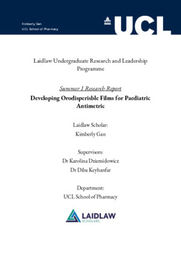
For my summer Laidlaw Scholarship research project, I explored the development of orodispersible films designed to improve the treatment of chemotherapy induced nausea and vomiting in children. Based at the UCL School of Pharmacy and in collaboration with Great Ormond Street Hospital (GOSH) in London, my project combined hands on laboratory work with direct patient engagement.