Tracing the Cosmic Web. A dual study (Research Report)
Preview

Modern observational cosmology relies heavily on automated pipelines to process massive spectroscopic surveys, making data validation and analysis crucial for further research. This study first evaluates the performance of the 4MOST automated pipeline through the Visual Inspection (VI) of 1,015 spectra, assessing classification and redshift accuracy across galaxies, stars, quasars and unknown objects. The pipeline achieved an overall accuracy of 86.70% for redshift estimation and 83.45% for object classification. While stars showed 100% agreement and high-confidence quality flags reliably implied accurate redshifts, the pipeline exhibited a systematic bias by over-classifying low-quality galaxy spectra as quasars and assigning low-confidence flags rather than marking objects as unknown. These results will be later on exploited by the Laboratory of Astrophysics of EPFL for further research in observational cosmology.
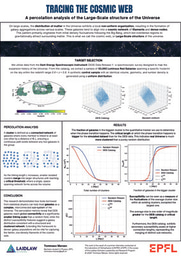
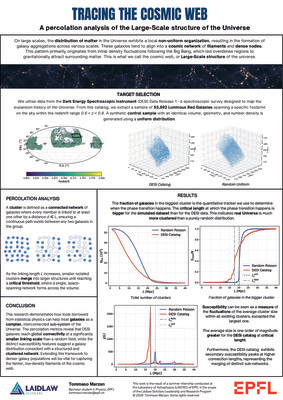
We then analyse the statistical properties of Large-Scale galaxy clustering using 53,592 Luminous Red Galaxies (LRGs) from the Dark Energy Spectroscopic Instrument (DESI) Data Release 1. Their 3D spatial distribution was reconstructed under the standard Planck 2018 model and compared against a reference catalog with a perfectly uniform spatial distribution over the same volume. By applying 3D site percolation theory, we evaluated how galaxies link together as the connection distance increases. The analysis reveals clear phase transitions, marked by the sudden emergence of a single "super-cluster" spanning the entire sample. Crucially, this percolation phase transition occurs at a smaller distance threshold in the real DESI data than in the control sample. This earlier transition is directly consistent with theoretical expectations, as gravitational attraction pulls galaxies into dense structures, making it significantly easier for large-scale connected networks to form compared to a uniform distribution. This interdisciplinary approach demonstrates how applying statistical physics to the study of galaxies provides a comprehensive framework to map the cosmic web and quantify galaxy clustering across current and upcoming spectroscopic observations.
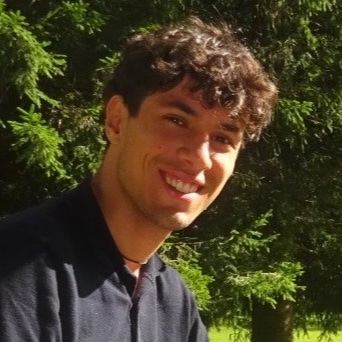
Hi there! I’m Tommaso (with two Ms!) and I’m a 3rd year bachelor student in Physics at EPFL.
Beyond Physics, I have a deep passion about journalism and current events, along with history of arts and its way of crafting societies. I enjoy spending time in nature, especially when it comes to mountain sports like rock climbing or skiing. I've also practiced track and field for many years, and I currently enjoy going for a run along the lake!
Happy to chat anytime about any topic!