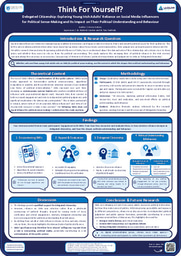
My research explores whether, why and how young Irish adults may come to rely on social media influencers and online commentators for aspects of political sense-making. Drawing on 15 semi-structured interviews, it moves beyond simply asking whether SMIs influence citizens to examine the demand side of this relationship: how and why young people may “outsource” elements of political interpretation and judgement to these emerging digital actors. I introduce the concept of “delegated citizenship” to capture this conscious or unconscious reliance, and consider what it might mean for the public sphere and democracy more broadly.
This summer has been such an adventure and I feel incredibly fortunate to have had the opportunity to take this project from an initial question through interviews, analysis and, finally, this paper. Speaking directly with young people across Ireland and hearing their experiences and perspectives has been one of the most rewarding parts of the process, and I’ve learned an enormous amount along the way.
A huge thank you to the Laidlaw Foundation, and particularly to Kate, Darren and Orla from the Laidlaw team at Trinity College Dublin, for making this research possible and for all their support and encouragement throughout Summer 1.
I’m also especially grateful to my supervisors, Dr. Roderick Condon and Dr. Tom Paskhalis, for their guidance, feedback and encouragement throughout the research process, and, of course, to everyone who generously gave their time to participate in the study and share their perspectives. This research would not have been possible without them.
I’m very excited to continue developing these ideas as I move into the next stage of my Laidlaw journey, and to begin turning my learning into action.