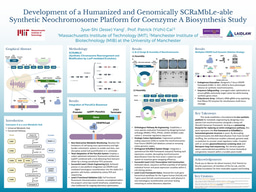
Research Paper - Development of a Humanized and Genomically Scramblable Synthetic Neochromosome Platform for Coenzyme A Biosynthesis Study

Preview
This project built a custom synthetic chromosome in yeast to study how human and yeast genes can work together and change. To safely study these gene changes without damaging the main yeast genome, the project used a separate, standalone chromosome design. The work successfully combined gene building in bacteria with natural combination steps inside yeast to create the first- and second-level constructs. The design also included special triggers for future gene-shuffling, a gene-editing tool to remove the yeast's original genes, and a specialized sensor called PancACe to track chemical levels inside the cell in real time. The results showed that these new synthetic chromosome parts were successfully built and verified with accurate sequences. Future uses of this platform include screening engineered strains for better industrial production and serving as a flexible template for studying other complex human pathways. The next steps for this project are to complete tests to prove the synthetic chromosome can keep cells alive when original genes are removed, finish validating the real-time sensor, and run gene-shuffling screens to find the best-performing cell strains.