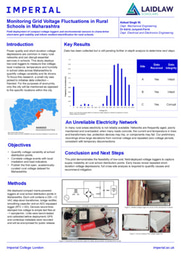
Laidlaw LiA 2026 Poster Anhad Singh
Preview
From research to real-world impact
My Laidlaw research focused on repurposing second-life solar technology for rural electrification. It taught me a great deal about the engineering behind sustainable energy systems, but it also left me thinking about a different problem: how do promising technical solutions actually reach the people who need them?
For my Leadership in Action, I wanted to explore that question from an entrepreneurship perspective.
I delivered a series of university lectures across Punjab, including sessions at Punjab Engineering College (PEC) Chandigarh, Guru Nanak Dev Engineering College (GNDEC) Ludhiana and the Central University of Punjab, Bathinda.
The aim was simple. Help engineering students recognise problems around them, understand how their technical skills could become commercially viable solutions, and feel confident taking the first step.
What I delivered
My lectures combined practical entrepreneurship with engineering and sustainability.
I used my previous research into second-life solar panels and mini-grids, alongside examples from my academic supervisor's work, to explore how sustainable hardware technologies could move beyond research and towards deployment.
We then examined locally relevant business opportunities. One case study involved developing software for wedding planners, taking students through customer discovery, identifying recurring problems, testing a minimum viable product and considering a paid pilot.
The underlying lesson was that students did not need significant funding or a finished product to start. They needed a genuine problem, someone experiencing it, and a way to test whether solving it would create value.
Measuring the impact
I used Mentimeter surveys before and after the lectures to assess how students perceived their entrepreneurial abilities.
Across the PEC Chandigarh and GNDEC Ludhiana survey responses, the combined average score across three statements increased from 5.42/10 before the lectures to 6.24/10 afterwards.
The individual results were:
-
Ability to test an idea before building: 6.12 to 6.76
-
Knowing how to find potential customers: 4.72 to 5.56
-
Readiness to take the first step: 5.42 to 6.41
These were response-weighted group averages from 106 initial responses and 65 follow-up responses. They reflect immediate changes in self-reported confidence rather than evidence of businesses being established, and the respondent groups were not individually matched.
Students also submitted actions they wanted to pursue, including contacting local businesses, visiting manufacturers to understand their problems and exploring opportunities for sustainable packaging.
SMART goals and leadership development
My project centred on delivering practical entrepreneurship education to engineering students within the LiA period. I measured immediate learning outcomes through pre- and post-session polling, used existing university connections to make delivery achievable, and tailored the lectures to local industries and sustainable development challenges.
The experience also developed the Laidlaw 3Cs:
Character: Speaking to unfamiliar audiences and taking responsibility for delivering useful, engaging sessions.
Curiosity: Learning about the industries, opportunities and challenges facing students in different parts of Punjab.
Commitment: Preparing locally relevant material, delivering the lectures and evaluating the results rather than simply presenting and leaving.
Working across universities also strengthened my global perspective. Approaches to entrepreneurship that seem straightforward in the UK cannot automatically be transferred elsewhere without understanding local markets, resources and opportunities.
Final reflections
Perhaps my biggest takeaway was that engineering students often have more potential to become entrepreneurs than they initially recognise. What they may lack is exposure to the process of starting.
I wanted students to leave knowing that their first step could be as simple as speaking to a local business owner about a problem.
An engineering solution does not scale itself. Helping people understand how to take an idea beyond the classroom is where I hope this project has made a contribution.
I'm grateful to the institutions, organisers and students who made these sessions possible, alongside the Laidlaw Foundation and Imperial College London for supporting the experience.