Why Good Ideas in Maternal Health Care Struggle to Become Routine Practice
Research Overview
Field: Public Health
Project Title: Case Studies of Continuity-of-Care Initiatives for Women Across the Reproductive Life Course
Name: Karen Yoda
Program: Laidlaw Scholars Leadership & Research Programme
Faculty Advisor/PI: Ishani Ganguli
Supervisor/Mentor: Margaret McConnell
Host Institution/Department: Harvard Medical School; Harvard T.H. Chan School of Public Health
Concentration/Major: Human Developmental and Regenerative Biology
College: Harvard College
House: Leverett House
Graduation Year: 2029
Maternal health outcomes in the United States remain poorer than those of other high-income countries despite advances in obstetric care. Increasingly, maternal health research has emphasized the importance of continuity of care across the reproductive life course, or the degree to which healthcare across multiple encounters is experienced as coherent, connected, and consistent with a patient’s medical needs and personal context. Continuity of care has been associated with improved maternal outcomes and patient experience, yet relatively few initiatives designed to strengthen continuity across the reproductive life course become routine practice. This study examines why promising continuity-of-care initiatives, including government policies, insurance programs, digital health technologies, and healthcare delivery models, struggle to move beyond the pilot stage into sustained implementation. Eight comparative case studies were selected across government, insurance, healthcare delivery, and technology sectors. Publicly available documents were analyzed using qualitative content analysis to identify recurring implementation barriers, supplemented by interviews with individuals involved in these initiatives. Findings suggested that implementation barriers often lie outside the implementing organization while cross-sector coordination emerged as a possible facilitator of implementation. In other words, continuity-of-care interventions are often initiated by organizations that do not control the conditions necessary for the intervention’s success. By comparing implementation efforts across multiple sectors, this study shifts attention from intervention design to the organizational and system-level conditions necessary for long-term integration into routine care. These findings may help inform policymakers, healthcare organizations, and other stakeholders seeking to strengthen continuity of care and integrate maternal health innovations into routine practice.
Introduction
Why is pregnancy still dangerous for too many women in the US and around the world?
My initial “answer” to that question was simple: a lack of preconception care.
This made sense in my head. The literature suggests that preconception care—health optimization prior to conception combined with appropriate contraceptive use—can improve maternal outcomes. Research has also suggested that simply increasing access to prenatal care may be insufficient to substantially improve outcomes. Naturally, my conclusion was: if prenatal care is too late, then we should intervene before conception.
One week of research showed me that reality is not that simple.
In trying to understand the barriers to nationwide adoption of preconception care, I realized that some of those barriers may be extraordinarily difficult to overcome. Many women, particularly those from socioeconomically disadvantaged backgrounds, lack consistent access to primary care. Meanwhile, many mothers covered by Medicaid qualify only because they are currently pregnant or recently gave birth. Ensuring every person has an established relationship with a primary care provider is a very high bar. As important as that goal may be, policymakers and health systems have increasingly turned toward alternative solutions.
Refining My Research Question
I realized preconception care is one piece of a larger puzzle of a mother’s health. As a result, I found myself shifting away from preconception care and toward a broader focus on continuity-of-care and the creative solutions being developed to address maternal health challenges.
Continuity of care has been defined by Haggerty and colleagues as “the degree to which a series of discrete healthcare events is experienced as coherent and connected and consistent with the patient’s medical needs and personal context.” This can mean that a new physician has access to a patient’s history, that care is coordinated across obstetric and primary-care settings, or that a patient develops an ongoing relationship with the same clinician.
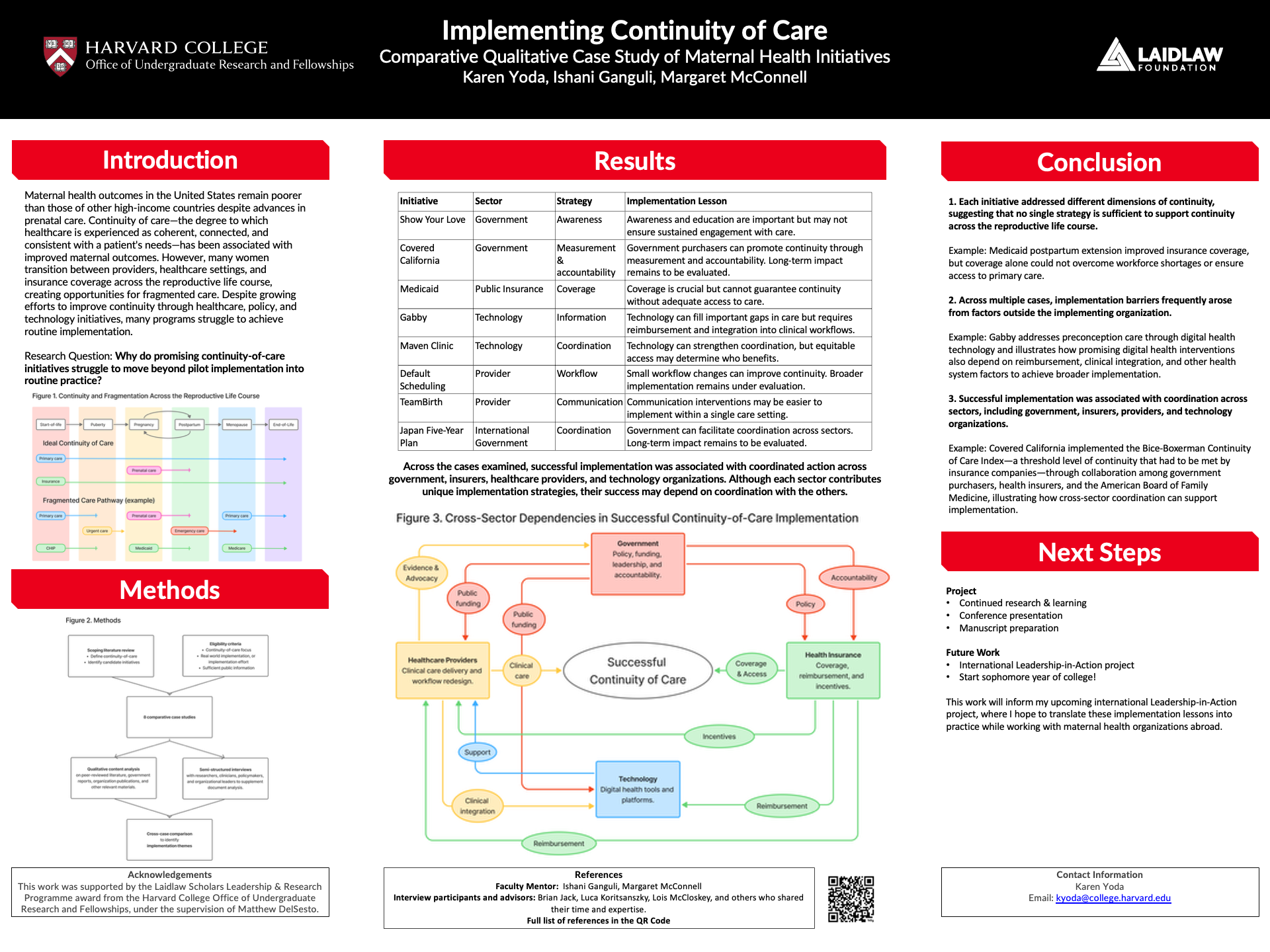
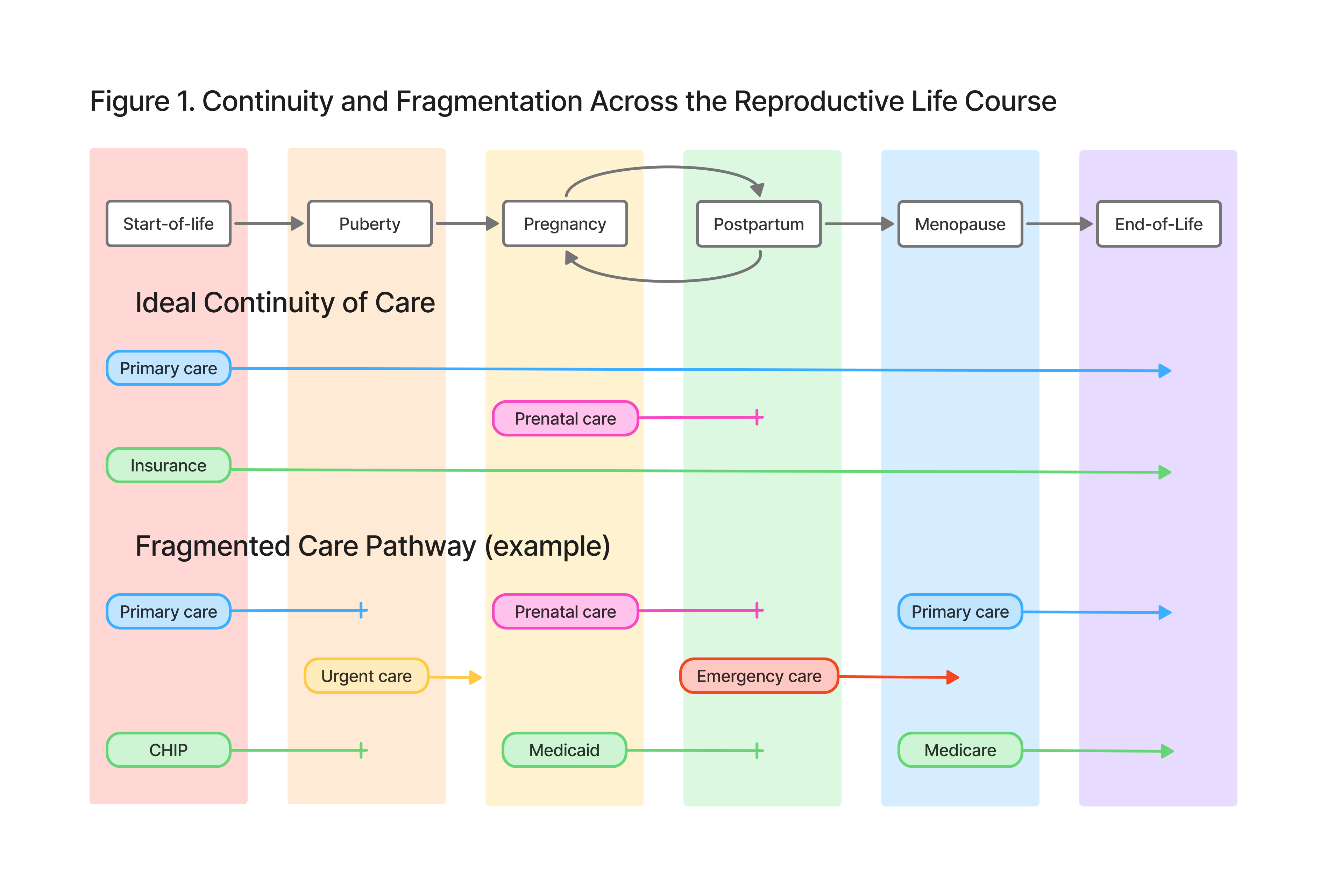
Increased continuity of care has been associated with improved maternal outcomes and patient experience. In practice, however, women often move between insurance programs and care settings across the reproductive life course, producing gaps in both coverage and clinical relationships (Figure 1).
I learned that developing an effective intervention is not the same as making it part of routine healthcare. An initiative can succeed in a trial but have little population-level impact if health systems cannot sustainably finance, integrate, or deliver it.
So I asked a new question: why do promising continuity-of-care initiatives in maternal health struggle to move beyond the pilot stage into routine practice?
Gathering Evidence
To answer this question, I used a comparative case-study approach.
My research began with a conversation with Lois McCloskey, who helped lead the 2019 conference Bridging the Chasm Between Pregnancy and Health Over the Life Course: A National Agenda for Research and Action. The conference brought together more than 70 stakeholders to discuss continuity of care in maternal health and produced a national agenda of potential interventions. With guidance from my mentors, I used this agenda as a starting point for identifying initiatives to study. I then developed selection criteria and ultimately chose eight initiatives spanning government, insurance, healthcare delivery, and technology. These included Medicaid postpartum coverage expansion, TeamBirth, the Gabby preconception-care system, Maven Clinic, and government initiatives in the United States and Japan.
I analyzed publicly available materials—including peer-reviewed literature, government reports, organizational publications, and implementation evaluations—using qualitative content analysis. To supplement this document analysis, I conducted semi-structured interviews with leaders involved in continuity-of-care initiatives. I organized recurring observations using a coding framework focused on implementation barriers, allowing each initiative to be coded across multiple categories when appropriate.
When I began, I had limited experience with research and literature reviews and struggled to find a systematic way to gather and interpret evidence. Although I tried to limit my biases when summarizing the materials, I recognized that deciding which information to emphasize inevitably involved my own judgment. Matthew DelSesto, a sociologist and Laidlaw program leader, introduced me to qualitative content analysis and taught me how to use NVivo to code and systematically organize my data. Neither coding nor software can eliminate researcher bias, but these tools helped me analyze hundreds of pages of research articles, organizational documents, and interview notes more consistently.
The interviews provided some of my most valuable insights. Publicly available records often documented an initiative’s launch and early results but offered less information when implementation stalled or an organization changed direction. By speaking with experts directly, I gained a better understanding of the reasoning behind these decisions and the challenges that published materials did not always capture. I was inspired by their commitment to changing the healthcare system and their excitement when describing their projects, while also hearing their frustration with how difficult changing that system could be.
My Findings
Finding 1. Continuity is multidimensional.
While analyzing the interventions in my case studies, I noticed that each intervention tackled a specific aspect of continuity.
For example, the Show Your Love Campaign, run in coordination with the CDC, aimed to increase awareness of preconception care through educational materials, webinars, and public awareness campaigns. Although the campaign created a substantial collection of evidence-based resources, its public visibility appears to have declined over time. This campaign focused on awareness and education about preconception care. Although a crucial initial step to making preconception care routine practice, education alone does not address structural barriers such as limited access to care.
Medicaid postpartum expansion also illustrates that insurance coverage does not automatically ensure access to care. States continue to face structural challenges, including workforce shortages and limited awareness of the policy among patients and clinicians. In response, some have developed programs intended to strengthen the workforce and increase awareness of the expanded coverage.
Although each initiative sought to strengthen continuity of care, they did so through different implementation strategies targeting distinct dimensions of the problem. Collectively, these findings suggest that continuity of care cannot be achieved through any single intervention. Rather, continuity across the reproductive life course appears to depend on multiple complementary implementation strategies operating simultaneously.
Finding 2. Implementation barriers often lie outside the implementing organization.
Gabby is a computer-based preconception care platform designed to provide personalized health education and counseling before pregnancy, and was shown to be effective in efficacy trials. Rather than the technology itself, its greatest barriers were difficulty integrating into an already overworked healthcare system and the lack of a sustainable reimbursement mechanism for preconception care.
Medicaid postpartum expansion encountered a similar problem. Extending coverage was within the government’s control, but ensuring that patients could use that coverage depended on other conditions, including primary care provider visit capacity and awareness of the policy among patients and providers.
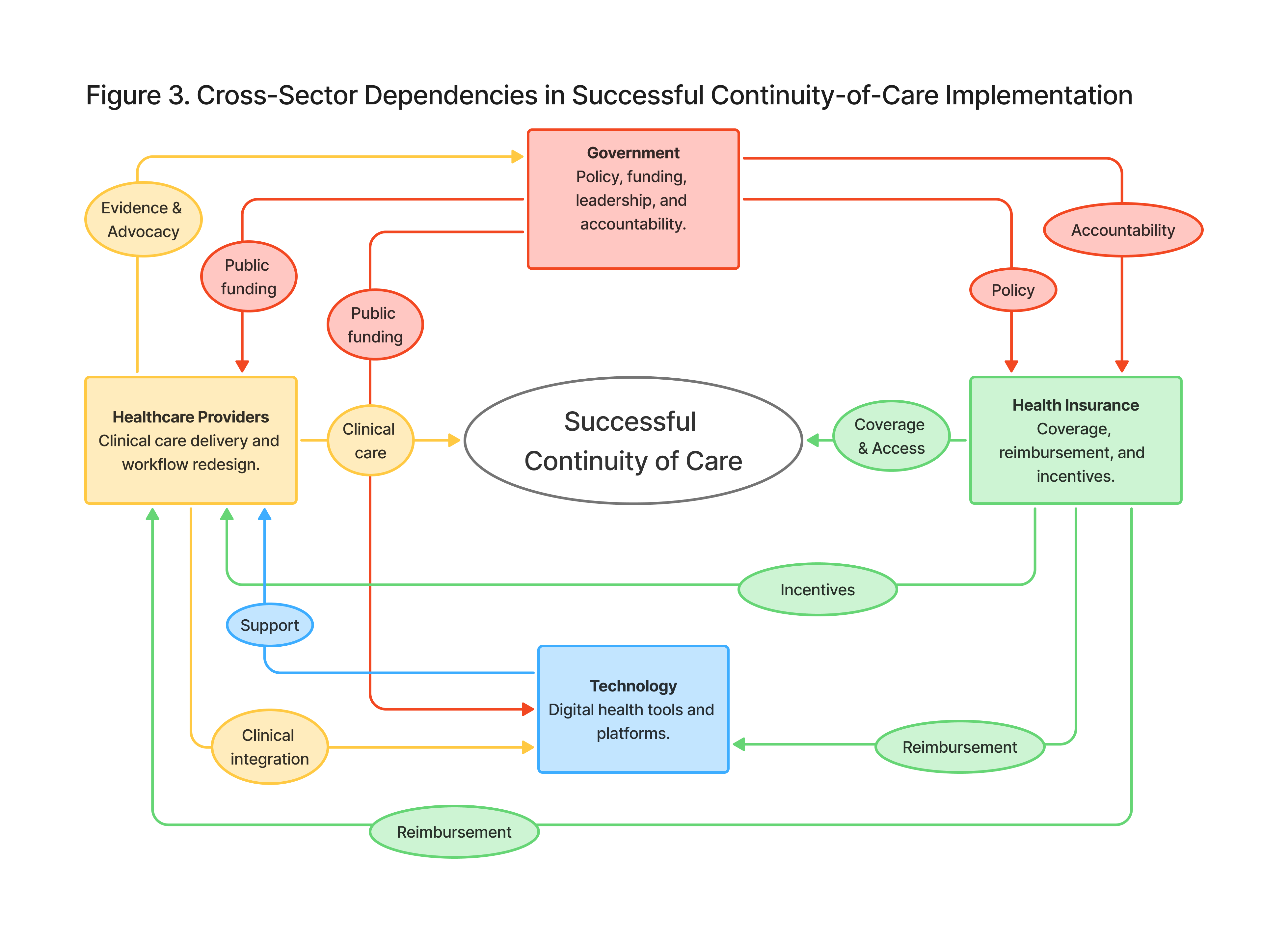
These barriers extended beyond a single organizational boundary. A technology company could design an effective tool but could not create a sustainable reimbursement mechanism. A government could extend insurance eligibility but could not by that action alone create clinicians or coordinate care. The intervention and the conditions required to sustain it often belonged to different actors (Figure 3).
Finding 3. Cross-sector coordination emerged as a possible facilitator of implementation.
One promising example of cross-sector coordination is a continuity-of-care performance standard instituted by Covered California. The Bice-Boxerman Continuity of Care Index, developed by Thomas Bice and Stuart Boxerman in 1977, measures how concentrated a patient’s visits are among providers: scores range from 0, where every visit is with a different provider, to 1, where every visit is with the same provider. Covered California adopted reporting specifications developed by the American Board of Family Medicine, requiring participating insurers to report the share of enrollees with an index score of at least 0.7. In the stakeholder comment process, issuers noted that PPO members often select those plans in order to see any network provider without a referral, and that plans cannot require members to use an assigned provider. Covered California responded that its own analysis found only small differences in continuity between HMO and PPO plans. The adopted requirement applies to all plan types: where fewer than 60 percent of enrollees meet the standard, plans must submit planned improvement activities. This approach could encourage continuity by producing plan-level data on a common measure and requiring underperforming insurers to identify how they will improve. The initiative illustrates how a purchaser can use standardized measurement and contracting requirements to encourage coordination among insurers and provider organizations. Because the requirement took effect only in 2026 and Covered California has identified measurement year 2028 as the first year it would consider improvement targets, its effect on continuity cannot yet be evaluated.
Another example is Japan’s Five-Year Plan for Promoting Preconception Care, which the Children and Families Agency describes as promoting “the dissemination of accurate knowledge on sexuality and health and the enhancement of consultation support.” The initiative focuses on public education, employer engagement, and professional training to strengthen population health across the reproductive life course, emphasizing coordination among government agencies, employers, healthcare organizations, and local communities. Because the program has only been running for a year, its impacts cannot yet be evaluated.
These cases illustrate cross-sector coordination operating at two different levels: as a route to adoption, in Covered California, and as a design principle, in Japan’s plan. The long-term outcomes of both remain to be evaluated.
Study Limitations
This exploratory study has several limitations. Its eight cases are not representative of all maternal continuity-of-care initiatives, and the analysis drew on a limited number of stakeholder interviews alongside publicly available materials. These sources may emphasize accomplishments while revealing less about internal challenges or unsuccessful implementation efforts. Because the analysis was conducted by a single researcher and did not use a structured comparison framework, the findings identify recurring perceived barriers and plausible explanations rather than causal determinants of implementation outcomes.
Drawing Conclusions: Clean Stories and Evidence-Backed Sentences
My conclusions began with a pattern: barriers often appeared outside the organization implementing the intervention. If the intervention was a new technology, for example, its greatest barriers might involve reimbursement and integration into clinical workflows—conditions largely outside the technology developer’s control.
That observation was exciting because it seemed to explain many of the cases I had studied, but that was when I took my observation a bit too far.
My first poster draft was met with constructive but stern criticism because I blurred the lines between what I had evidence for, and what would fit my narrative cleanly. After a round of slightly panicked emails asking my mentors—who thankfully had not yet read the poster—to ignore that draft, I started the painstaking process of ensuring that every sentence could be defended by the evidence I had collected.
Here is an example of the process.
The original sentence summarizing Covered California was that “measurement alone cannot overcome fragmented insurance coverage.”
I believed that the sentence was true. Individuals frequently transition between insurance plans. Pregnancy and the first postpartum year alone span approximately 21 months, longer than the average 14-month enrollment in Covered California; even if continuity were achieved within a single insurance plan, it would not fully address disruptions in continuity of care for maternal health. As a result, I concluded that measuring continuity alone cannot overcome disruptions created by fragmented insurance coverage.
It felt clean, and it fit very nicely with my initial observation about cross-sector dependencies, and how barriers arise in other sectors.
But my sentence was not supported by the data I had available.
Here’s what I actually knew about the Covered California Bice-Boxerman Index:
- the reporting requirement was implemented;
- stakeholders were engaged through a public process; and
- accountability was introduced.
I didn’t know:
- whether the reporting requirement would improve continuity;
- whether insurance fragmentation meaningfully affected this initiative; or
- whether the two were connected.
So my conclusion was neat but unsupported.
In the final version of the poster, I concluded that “Government purchasers can promote continuity through measurement and accountability. Long-term impact remains to be evaluated.”
The Easiest Person to Fool
I began this research angry at the gap between maternal-health evidence and practice. I believed that pursuing evidence carefully could protect me from reaching unsupported conclusions.
Yet good intentions are not enough. In trying to construct a coherent story, I had pushed my conclusions beyond what the evidence actually supported.
In a 1974 commencement address, physicist Richard Feynman warned, “The first principle is that you must not fool yourself—and you are the easiest person to fool.”
I know I will make more mistakes. But I hope I will learn to recognize them: the sentence that fits too neatly, the one I want to be true. And I hope I keep the humility to have my work checked, and checked again, by peers and mentors—because the story I want to tell might not be the one the evidence supports.