Week 6 LiA Reflection
What went well?
Right at the start of my six weeks, the other scholars and I had a meeting with Mercy and Isaac, in which we learnt about the history of the school, the endless challenges they have faced and persevered through, but most importantly, the difficulties facing them now. In short, the school cannot raise enough money through fees (nor get any money through government funding) to support the salaries for its staff and the resources the children need. We (the four scholars) decided to start a fundraiser for the school on GoFundMe, and worked on pieces of a fundraising video throughout the project. In this last week, we started to put those pieces together and set up the fundraiser.
We also set the ball in motion for the installation of a borehole and water pump on the school grounds – a vital infrastructural development. During Zambia’s dry season, the school receives water as rarely as once a month, leaving them no option but to drive to someone else’s borehole, pay to fill up a few drums of water, and take these back to the school. This has to be done every day. Ensuring that the pupils have access to plenty of clean drinking water during the dry season is key, and we hope that a borehole on the school grounds will deliver that.
Looking back on the project as a whole, I’m proud of how I adapted over the six weeks. Never having left Europe, I arrived in Ng’ombe not really knowing what to expect. I was nervous, not only about the prospect of going halfway across the world, but about the work too – I had a serious responsibility for and duty to the children I was going to teach. I’d like to thank Mercy and Isaac for making it feel like home, for welcoming me and the other scholars into their family with open arms, and for the incredible support and guidance they gave us all throughout the project.
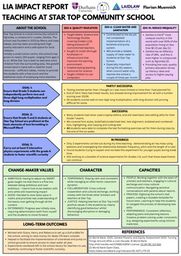
My first SMART goal, ‘Ensure that Grade 5 students can independently perform two and three-digit long multiplication and long division’ was partly successful. The progress was measured in the end-of-term tests (marked out of 26) in which three out of the ten students scored over 20. Almost all students succeeded on the two-digit long multiplication, with the majority still struggling with some of the harder long division questions. While I can’t say that this goal was completely achieved, all of the students made significant progress during the six weeks. A number of them had never even seen long division before, and many initially struggled to tackle even the simplest of problems. This individual progress is something I’m really proud of them for.
My second SMART goal was ‘Ensure that Grade 5 and 6 students at Star Top School are proficient at the basic elements of text formatting in Microsoft Word’, and this I can say was successful. In our technology lessons, we covered font styles, bold/italic/underlined text, text alignment, bulleted and numbered lists, highlighting, and copying and cutting text. Their proficiency was easily measured, as the lessons were all hands-on. I gave them tasks in which they had to apply these skills, and they took it in turns to work on the two laptops. Many had never used a laptop before, and by the end of the project, they could all (if not confidently) carry out the tasks I set them. Most importantly, they all really enjoyed these sessions!
My final SMART goal was ‘Carry out at least 5 interactive physics experiments with the grade 6 students to foster scientific curiosity’, and this was not completely successful. Due to absences in my Grade 6 class, as well as the need to prioritise covering and revising content before the tests, we only managed to carry out two experiments. We demonstrated that air has mass, using two balloons and a stick, and investigated the relationship between pitch, frequency and the length of a ruler. While this fell short of the intended 5 experiments, I think I was successful in fostering their scientific curiosity – I found them trying to recreate the balloon experiment and explain it to the younger children during their break later that same day. I spent week 6 also working on a booklet of science experiments suitable for Grades 1-6, which I hope will help the teachers to get the children involved in more hands-on science activities.
Watching the Grade 5s go from struggling with basic multiplication to tackling long division with confidence, or seeing the Grade 6s try to recreate a science experiment at lunchtime purely out of curiosity, are the moments I'll remember forever. If this project has taught me anything, it's that meaningful impact is not about trying to change everything overnight, or even within six weeks. It’s about planting a seed which will only flower long after you have gone.
What could have been done differently?
This was a learning experience for me as much as it was for the students. However, there are a few things that I think I could have done better. While I think I was right not to plan too much in advance (as you really can’t have a good idea of how to pace the content until you start teaching) I do think it would have been useful to sit down with Mercy and draw up my timetable beforehand, as well as look through the exact material that I’d be covering. The lack of access to digital resources means this would have been difficult, but I could have made the first few days easier by making more of an effort in advance.
One thing I regret is not getting started with the borehole/pump project earlier. Due to some unforeseeable issues with bank transfers, the borehole cannot be installed until after next term (it has to be done during the holidays). Had I started this earlier, it would have definitely been put into place before next term and I may have even got to see it being put in during my last week. Keeping an eye on the bigger picture whilst in the weeds of teaching and planning lessons day-to-day was tricky, but I should have had better awareness of it.
Leadership reflection
A standout Laidlaw value in this project was ambitious. Aiming to have a lasting impact on students within 6 weeks is inherently ambitious, but this is also a value I had to think about a lot. My SMART goals coming into the project were clearly over-ambitious, and I quickly realized that some of what I had aimed to get done was simply unrealistic. Re-calibrating and shifting these goals required intentional temperance and judgment; I had to find the right balance between ambitious and realistic. Another value present throughout the six weeks was curiosity. The student’s eagerness to learn, ability to ask deep questions and the fun they found in experimentation also brought out my curiosity. I believe that being interested in your students, demonstrating a willingness to understand their struggles and thought process, is essential to teaching effectively.
Temperance, judgment and justice were key character dimensions in the classroom. One thing that stood out to me was just how many split-second decisions you have to make when teaching a room full of children. One child says something in Cinyanja to the other, who gets upset – but as you were writing on the board, you missed the rest of the interaction. A coin is lost, and everyone blames one student; one accuses the other of copying. Often all of these are happening at the same time. Initially, I will admit I found this overwhelming, especially the pressure I felt to get every decision 100% right. Exercising effective judgment in these scenarios became easier over time, as I made conscious efforts to improve and got to know all the students better. It is that situational awareness and ability to do the right thing under pressure that has been the most noticeable change in myself over the course of this project.