Week 4 Reflective Journal
My Core Values
This week I spent time sitting with a question I thought I already had an answer to. When I first started this programme, I would have said my leadership values were fairly generic — things like "hard work" or "vision." But the more I've reflected, the more I've realised my values are much more specific to why I want to lead at all. They are:
- Respect — treating people as the authority on their own experience
- Making a difference — measuring leadership not by title but by whether anything has actually changed for the people it was meant to serve.
- Service — leading from underneath rather than above; a bottom up approach rather than a top down approach .
Representation vs. Inclusion
A room can look diverse and still not be inclusive. This is the distinction I want to hold onto going forward. You can have people of different ethnicities, religions, and class backgrounds sitting around the same table — and still have a space where only some of them feel safe enough to speak, where only some voices are treated as credible, and where difference is tolerated rather than valued.
Representation is seen. Inclusion is a felt experience — whether someone believes their contribution will be heard, taken seriously, and acted on. My value of respect only really means something if it shows up here: in whether I am creating conditions where people feel able to disagree with me, correct me, or bring something new to the table without fear of being dismissed.
Refining Our Research Question
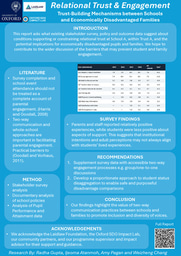
We started with a broader question about disadvantage and educational outcomes. This week we sharpened it considerably: how can schools better establish trust between themselves and disadvantaged students and families — where we are specifically defining "disadvantaged" as working class.
This shift matters because trust is where representation and inclusion actually diverge in practice. A school can have working-class students on its roll (representation) while those same families feel unseen, unheard, or actively misunderstood by the institution (a failure of inclusion). Trust is the mechanism through which inclusion either happens or doesn't.
This connects directly to a report I've been reading this week: the Independent Inquiry into White Working Class Educational Outcomes, commissioned by Star Academies and supported by the Department for Education, published in June 2026. The Inquiry is one of the most extensive pieces of research into this issue in recent years, combining large-scale polling, focus groups, school visits, and evidence sessions, and it draws on data covering roughly 1.25 million white British pupils eligible for free school meals.
A few points from the report stood out to me:
- The Inquiry is explicit that underachievement is not the result of low aspiration or individual failure among young people. Instead, it points to a wider set of systemic issues: early developmental gaps, weaker relationships between families and schools, lower sense of belonging, higher absence, and unclear routes into further study or work.
- One of its headline findings is that the education system and white working-class communities are often misaligned in how they define success and the purpose of education itself — which is essentially a trust and inclusion problem, not simply an attainment problem.
- The report also found that white working-class families report a poorer overall experience of the school system than their peers, and that key transition points (such as moving from primary to secondary school) are where trust and engagement tend to break down further.
- Crucially, the Inquiry found that outcomes are not fixed — schools that build highly relational, ambitious relationships with these families, rather than deficit-framed ones, are already achieving markedly better results.
What struck me most is that the existing literature on educational disadvantage overwhelmingly frames the issue through a socioeconomic lens — free school meal eligibility, income, geography — and rightly so. But this report is a reminder that even within that socioeconomic framing, white working-class pupils and families are consistently among the worst served by the system, and that this has been comparatively under-examined against other axes of disadvantage. That gap in attention is itself an inclusion failure at a policy level, and it's part of why we felt it was important to name "working class" specifically in our research question rather than leaving disadvantage undefined or assumed.
Source referenced: Independent Inquiry into White Working Class Educational Outcomes (Star Academies, in partnership with the Department for Education), published June 2026 — educationaloutcomes.org.uk