The Sounds of Aging : How Voice Disorders Shape Listener Perceptions of Older Adults in Hong Kong
Voice disorders are relatively common among older adults. A systematic review and meta-analysis done by Wang et al. found that 15.2% of older adults who live independently are affected by voice disorders, as well as 33.03% of older adults who are institutionalized (2023). These voice disorders and changes can be caused by multiple factors, such as the aging process, also known as presbyphonia. As someone ages, their laryngeal structures can change, leading to the atrophy of vocal folds (resulting in a thinner sounding voice), vocal fold stiffness, and more, leading to presbyphonia (Wong & Ma, 2019). However, the effects of a voice disorder may extend beyond the physical barriers of producing speech. Due to voice being an integral part of communication and therefore daily life, characteristics like loudness, pitch, and stability of one’s voice may influence how listeners perceive a speaker with a voice disorder.
Voice disorders are sometimes associated with aging, something that is especially important in Hong Kong, China where a large population of older adults speak primarily Cantonese. According to Hong Kong’s Population Census and Statistics Department (2023), 91.1% of adults who are ages 65 and older listed Cantonese as their spoken language while at home. Additionally, voice problems seem to be relatively common among this population. In 2019, it was found that 27.7% of participants reported having voice issues and this placed significant impacts on their quality of life (Wong & Ma). These findings highlight how voice disorders are a relevant concern among the older adult population in Hong Kong, and examining voice disorders in a Cantonese speaking context may help others understand the experiences of older adults.
This is an important topic to research because listeners form judgements about speakers based on certain aspects of their voices. When someone speaks, their voice can provide listeners with certain information that influences how they view that person and aspects of their identity, such as age, health, and even credibility. In a study consisting of two experiments with 36 listeners each listening to trivia statements produced in “typical and atypical voices”, researchers found that there is a social consequence of having a voice disorder. Listeners were more likely to think statements said in an atypical voice were less credible than statements produced in a typical voice, which could mean that having a voice disorder may make some listeners think of you as less credible (Schroeder et al., 2020).
For older adults, the way they are perceived is especially important to understand because age alone can influence a listeners’ perception of the speaker. Lortie et al. (2018) found that the age of the speaker influences how their voice is perceived, and how willing the listener is to interact with the speaker. This means that the way an older adult sounds does not just affect how their voice is judged, but also how they are treated as a person.
Together, these results suggest that voice quality and age can influence how a listener perceives the speaker and thinks of them as an individual. However, there is still limited research that explores how older adults who speak Cantonese may be perceived with varying levels of voice severity. Therefore, the purpose of this pilot study was to examine how listeners in Hong Kong, who also spoke Cantonese, perceived older adults with normal voice, mild voice, and moderate voice disorders. This study used mixed methods to gain a better understanding of listeners’ perceptions of these voice conditions and of the speakers that have them.
This study hypothesized that the listeners would have more negative perceptions of older adults with mild and moderate voice conditions than those with normal voice conditions. As a pilot study, this research provides introductory findings that may help guide future research conducted on listener perceptions of older Cantonese speaking adults with voice disorders. The rest of this paper will describe the methods used to collect the data, present the results of the study, and use them to discuss the findings in relation to other research previously done on aging and voice disorders. Additionally, the limitations and future steps for research will also be discussed.
Methods
Participants
Participants were recruited through flyer distribution at The University of Hong Kong (HKU) in the Meng Wah Complex building and the RunMe Shaw building, along with handing out flyers to individuals at HKU. To participate in this study, individuals had to be between the ages of 18 and 40 and be able to speak and understand both English and Cantonese. People were excluded from this study if they were not within the age range or if they could not understand Cantonese because the voice samples used in the listening and rating task were in Cantonese. A total of 10 adults participated in this pilot study.
Procedures
Study One: Interview
Participants engaged in a two part study. At first, they took part in an interview that was created to understand and record their attitudes toward voice disorders, aging, and the role of one’s voice in social interactions. The interview was placed before the listening and rating task so that participants could discuss their general beliefs without being exposed to the voice samples, influencing their implicit beliefs. Participants were then asked the following questions:
- How would you define a voice disorder in your own words?
- What changes, if any, do you think occur in a person’s voice as they get older?
- What impact do you think a voice disorder might have on a person’s daily life?
- What assumptions do people make about someone based on their voice?
- Do you think changes in someone’s voice could affect an older adult’s relationships and confidence? Why or why not?
- How much do you think a person’s voice influences your first impression of them?
- Do you think voice quality affects how people are perceived in social situations? Can you explain?
- Follow-up questions and/or any additional comments/sharing.
With their permission, the interviews were also audio recorded so I could return to them and analyze them at a later date.
Study 2: Listening and Rating Task
After the interview, participants completed the listening and rating task, where they listened to voice samples of older adults reading a portion of the story The North Wind and the Sun in Cantonese. The samples for this study were given to me from data previously collected by Dr. Estella Ma, the supervising professor over this study. Eight voice samples were then selected to be used, and they varied in terms of severity. Three samples were normal voices, three samples were from people with mild voice disorders, and two samples were from people with moderate voice disorders.
The eight voice samples were presented twice, therefore a total of 16 trials were presented to each participant. They were not informed that the samples would be repeated, however. The first presentation included the eight samples in a specific order, while samples 9-16 were listed in a random order. Randomizing the second set of samples was intended to decrease the chances that participants would recognize the repeated samples and alter their responses based on their previous ratings.
After listening to one sample, they’d then rate their impressions of the speaker using a Visual Analog Scale (VAS) and repeat the process for all 16 samples. The VAS had 13 bipolar adjective pairs that represented different attitudes toward the speaker. Participants then used the VAS to indicate their response along a 10 cm line between the two opposing adjectives. The descriptors on each end of the VAS were listed in both English and Cantonese to ensure that each participant could understand the meaning. I also varied the positioning of each negative and positive descriptor to prevent the participants from becoming used to a consistent response pattern. The scales included:
- friendly 友善的 - unfriendly 不友善的
- intelligent 聰明的 - unintelligent 不聰明的
- unhealthy 唔健康的 - healthy 健康的
- incompetent 冇能力的 - competent 有能力的
- energetic 有活力的 - tired 疲倦的
- gloomy 沉悶的 - cheerful 開朗的
- kind 友善的 - unkind 不友善的
- pleasant 討人歡喜的 - unpleasant 討厭的
- strong 強壯的 - weak軟弱的
- unreliable 不可靠的 - reliable 可靠的
- approachable 易親近的 - unapproachable 難接近的
- unconfident 冇自信的 - confident 有自信的
- negative 負面的 - positive 正面的
Study one, the qualitative interview, provided me with information about the participants’ broader perceptions of voice disorders, aging, and the potential effects of voice disorders on the social interactions of older adults. Study two, the quantitative listening and rating task, measured participants’ impressions of each speaker across the different voice conditions.
Data Analysis
Study One : Qualitative Interview Results
After the interviews were conducted, the data was analyzed using a qualitative thematic analysis approach. Each interview was audio recorded with the participants’ permission and was transcribed verbatim by me. Then, I reviewed each transcript and identified initial codes for each response. After creating codes for all of the individual responses, the codes were then compared across each response to identify patterns. I then grouped the codes that frequently appeared or were related to each other into broader themes.
Study Two : Quantitative Listening and Rating Task
The quantitative data was collected from the participants’ ratings of the voice sample trials using a Visual Analog Scale (VAS). Participants rated each of the 16 samples on the 13 bipolar adjective scales. The location of each mark on the 10 cm VAS was then measured and recorded for each participant and each sample. Due to the adjective pairs being presented sometimes with the negative descriptor being first, the scores were revered coded by subtracting the measurement from 10 so that ratings were consistent across scales. The measurements were then entered into Excel and organized according to voice severity (normal, mild, and moderate), with the three normal, three mild, and two moderate samples grouped together in columns. The 13 positive adjectives were organized by row, with one cell being a participants’ rating for that level of severity and adjective. The means and standard deviations were calculated by Jamvoi for each adjective and level of severity for both the original and duplicate samples. The averages for each participant were then placed into another excel sheet together and averaged to examine the patterns in the ratings across the three levels of severity.
Results
Study One : Qualitative Interview
Four major themes were identified after I analyzed the initial codes and grouped them together: 1) voice as a social cue 2) voice as a barrier to communication 3) perceived characteristics of voice disorders and aging voice and 4) the psychological impact of voice changes. These themes describe the participants’ perceptions of the role that voice plays in communication and how voice changes may impact how older adults are perceived.
Theme One: Voice as a social cue
This theme represents the belief that someone’s voice gives the listener information about the speaker beyond what is actually being said. During the interview, participants described someone’s voice as something that can influence social perceptions and judgements. Some codes within this theme were voice influencing social perceptions, voice influencing listener attention, voice conveying power, and voice being used to judge characteristics like age and gender.
I also found subthemes within this theme, such as voice informing first impressions. Participants talked about how voice is an important part of how they initially perceive another person. For example, one participant estimated that when they make first impressions, someone’s voice accounts for around 30% of that, stating “For me, I think it's about 30%, I reckon.” This same participant emphasized that the way someone sounds was especially important when they interacted with people over zoom and in other remote formats, explaining that “how they introduce themselves and their voice, that’s really important, not just their looks, especially when we’re in quite a digital world and you hear someone’s voice over the phone or whatever.” Participants also associated specific vocal qualities with particular personality traits. One person said that a deeper voice could make a listener assume that the speaker is older and “less enthusiastic and do[esn’t] really want to communicate with you or something.”
Another subtheme is voice conveying identity and personality. Using someone’s voice to make assumptions about a speaker’s identity and personality came up in interviews. One participant mentioned “I can judge their age, their gender, even their character, based on their voice.” Similarly, another participant explained that when someone sounds aggressive, they are more likely to associate the voice with that person’s personality, “[...] if someone comes to me and he or she is quite aggressive, you might link them to that personality”.
Through this theme and two subthemes, participants described voice as an important social cue in which listeners can form quick judgements about a speaker’s identity and personality.
Theme Two: Voice as a Facilitator or Barrier to Communication
This second theme conveys how participants’ believed voice quality was something vital for successful communication and how the effects of voice disorders can pose issues in communicating. Codes within this theme were difficulty being understood, difficulty expressing thoughts, reduced intelligibility and articulation, and miscommunication.
Participants consistently described aspects of voice disorders as potential barriers to communications, such as reduced vocal clarity or volume. One participant stated that an aging voice could result in reduced volume, and that “others cannot uh, listen clearly to what they say.” Another participant described the effects of voice disorders more broadly, saying “I think a lot of impact [voice disorders have on daily life] because I feel like, first of all, you cannot communicate as effectively as you wish.”
They were also mentioning listener challenges that can come with communicating with someone when they have a voice disorder, like the listener’s ability or willingness to engage in the conversation. Specifically, one participant stated how listeners may lose attention and patience when talking to someone with a voice disorder and how it might be more difficult for them to communicate with family and friends “people always lose attention [...] lose their patience to communicate with them.” These responses show that the participants viewed voice as an important part of maintaining communication, and also saw how one’s voice can be an inhibitor of communication.
Theme Three : Perceived Characteristics of Voice Disorders and Aging Voices
The third theme, perceived characteristics of voice disorders and aging voices, is about participants’ perceptions about what people with voice disorders sound like. Throughout the interview, participants identified qualities of voice disorders that I coded individually, such as reduced volume and vocal strength, lower pitch, slower speech, and changes in vocal quality.
One of the participants described a voice disorder as having a voice that is “very horse” and “breathy”. They also mentioned that speaking may “take much effort” and those with voice disorders may have a “weak voice”. Additionally, they thought that sometimes people with voice disorders sound “cracky” and “raspy”. Participants in this pilot study had specific ideas and beliefs about what a voice disorder sounds like and the characteristics associated with them.
A subtheme within this theme is characteristics of aging voices. Participants frequently associated aging with changes in one’s voice quality. When asked about older voices, someone described them as having “lower voice ranges”. Someone even provided a possible physical explanation for the changes that happen to older adults’ voices as they age, stating that their vocal structures may become “worn out over time”, resulting in voices that “tend to get a bit raspy”. Voices may also become softer, they said, because “they’re [the speaker] struggling to use a lot of energy to produce sounds”.
Theme Four : Psychological Impact of Voice Changes
Lastly, theme four, the psychological impact of voice changes, is the participants’ belief that changes in someone’s voice quality can affect their confidence, social interaction, relationships, and more. Codes within this theme are reduced confidence, reduced listener attention, impact on daily life, and social interaction.
In this theme, participants were asked if voice disorders could affect how confident an individual feels when they are communicating. One participant stated that people with more serious voice disorders “may be, um, less confident in expressing themselves because, like, the voice is what you show to other people”. This same participant explained that as an older adult’s voice changes, they may experience reduced confidence because they “feel different” and would “have less confidence when they’re talking to other people”.
In the subtheme of impact on relationships, participants also described how voice disorders can affect the speaker’s social relationships. A participant mentioned communication between older adults and their family, particularly their grandchildren, and explained that children might “lose their patience and get distracted with something” when trying to communicate with their grandparent(s). This is because their voice disorder might impact the speed or volume in which they communicate, resulting in “difficulties to chat with their grandkids or with their children”.
Communication difficulties can accumulate over time and affect relationships, participants noticed, with one mentioning how older adults may have to spend “have to spend a lot of time trying to explain to the other person what you're trying to say”. This then results in others being confused and “it affects the quality of their relationships in a bad direction”.
Study Two : Quantitative Listening and Rating Task
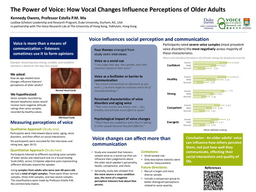
The listening and rating task examined participants’ perceptions of older adult speakers across three voice severity conditions, which were normal, mild, and moderate. Participants rated each voice sample using 13 bipolar adjective scales on a 10 cm VAS and the scores were coded so that the higher scores represented ratings closer to the negative adjective, while lower scores represented ratings closer to the positive descriptor. The means and standard deviations for each adjective for all three levels of severity are located in Table 1.
Overall, the results showed a general pattern of increasingly negative ratings as voice severity increased. For 10 out the 13 adjective pairs, the normal condition received the lowest mean rating, followed by the mild condition, with the moderate condition having the highest mean rating. This pattern was especially evident in characteristics related to health, energy, strength, competence, confidence, and cheerfulness.
The largest differences across voice severity were for healthy, energetic, and strong. When asked how healthy the speaker on the voice sample sounded, the normal condition was rated M=2.46, while the mild condition increased to M=5.53, and the moderate condition increased to M=8.22. Ratings for energetic followed a similar pattern, where ratings in the normal condition were at M=2.93 and increased to M=5.67 for mild voices and M=8.43 for moderate voices. Strong ratings increased from M=3.16 to M=5.05 to M=7.73 for the normal, mild, and moderate voice samples, respectively.
Some of the smaller differences between the mild and moderate severity levels were observed in intelligence, pleasant, and positive. For intelligent, mean ratings increased from M=3.20 for normal voices to M=4.62 to M=5.85 for moderate voices, a difference of 1.23 from mild to moderate. Pleasant ratings increased at M=3.35 to M=4.46 and M=5.13, while positive ratings increased from M=2.85 to M=4.22 to M=5.45, from normal to moderate.
Three of the adjective scales, friendly, kind, and approachable, showed a different pattern. For each of these, the mild severity level received a higher mean rating than the moderate condition. Friendly ratings increased from M=3.19 for normal voices to M=4.14 for mild voices before it decreased slightly to M=4.03 for moderate voices. Kind ratings were measured at M=2.86 to M=4.31 and then decreased to M=4.19. Similarly, approachable followed the same pattern with patterns increasing from M=3.49 for normal voices to M=4.61 for mild voices, before decreasing to M=4.05 for moderate voices.
Overall, these results show a general increase in negative ratings from the normal to mild and moderate voice conditions. This pattern was most obvious in the health, energy, strength, cheerfulness, competence, and reliability category, while friendly, kind, and approachable were less consistent between the mild and moderate conditions.
Table 1. Mean Ratings and Standard Deviations by Voice Severity.
|
|
Normal M (SD) |
Mild M (SD) |
Moderate M (SD) |
|
Friendly |
3.19 (1.33) |
4.07 (1.49) |
4.01 (1.63) |
|
Intelligent |
3.04 (1.04) |
4.65 (1.19) |
5.72 (1.61) |
|
Healthy |
2.33 (1.08) |
5.40 (1.57) |
8.27 (0.739) |
|
Competent |
2.82 (1.18) |
4.46 (1.65) |
6.52 (1.90) |
|
Energetic |
2.94 (0.890) |
5.59 (1.35) |
8.39 (0.610) |
|
Cheerful |
3.59 (0.813) |
6.16 (1.62) |
7.46 (1.14) |
|
Kind |
2.73 (1.08) |
4.23 (1.59) |
4.25 (1.76) |
|
Pleasant |
3.26 (1.37) |
4.61 (1.59) |
5.20 (2.03) |
|
Strong |
3.12 (1.15) |
4.86 (0.939) |
7.66 (0.942) |
|
Reliable |
3.10 (1.37) |
4.12 (1.21) |
5.49 (1.83) |
|
Approachable |
3.46 (1.31) |
4.54 (1.72) |
4.01 (2.28) |
|
Confident |
3.00 (1.17) |
4.31 (1.32) |
6.11 (1.93) |
|
Positive |
2.82 (1.30) |
4.12 (1.67) |
5.53 (2.06) |
Discussion
This pilot study’s goal was to examine listeners’ perceptions of older adults with differing levels of voice disorder severity. Using a mixed methods two part study design, study one focused on participants’ beliefs about voice and the role of voice in social interactions, while study two measured how participants rated older adult speakers with normal, mild, and moderate voice conditions. Overall, the findings from both studies convey that participants viewed voice as important to one’s social life and relationships, and that changes in voice quality may influence how speakers are perceived. In study two, ratings generally became more negative as voice severity increased, with normal voices receiving the worst ratings and moderate voices receiving the highest rating on the VAS. The findings in this study were consistent with the hypothesis that older adults with mild and moderate voice conditions would be perceived more negatively than those with normal voices.
Study One : Qualitative Interview
The findings from study one are that participants viewed voice as an important source of social information rather than just as a means of communication. They described how they personally used vocal characteristics to form judgements about a speaker’s personality, age, confidence, and social status. At the same time, participants also recognized that changes in vocal quality and intelligibility could inhibit successful communication and influence how the speaker is understood. Both of these results show that the participants believed voice has a social and functional role in communication, which is also supported by other research. McAleer et al. (2014) found that listeners formed impressions on people’s personality even from brief voice samples, demonstrating that someone’s vocal characteristics can influence judgements even when the listener knows little about the speaker.
Participants also had specific expectations regarding an aging voice and voice disorder. Hoarseness, breathiness, lower pitch, and slower speech were commonly brought up in the interviews across participants. This finding supports the idea that participants have pre-determined beliefs in some capacity for what an aging or disordered voice should like and this is important because they would use these expectations to make broader judgments about the speaker.
Most importantly, participants thought of voice changes and disorders as having other consequences for speakers other than communication barriers. They discussed a reduction of one’s confidence, difficulties interacting socially, relationship challenges, and changes in everyday activities. Participants realized that voice changes can potentially affect both how people are perceived by others, and also by themselves as their social life could potentially change majorly as a result of their voice challenges. This is supported by Etter et al. (2013), whose study found that older adults with voice disorders withdrew from some social activities because their voices did not allow them to communicate the most effectively, despite them having the desire to do so.
The findings of these four themes suggest that the participants in this pilot study viewed voice as multidimensional in the context of communication. Voice was seen as something that provided social information to other members of society, facilitated or interfered with communication, having characteristics associated with aging, and potentially affecting the psychological and social well-being of those with voice disorders. These beliefs were discussed before their exposure to the samples in study two, meaning these results are representative of their general beliefs, not perceptions informed by the samples.
Study Two : Listening and Rating Task
Study two’s findings provide support for the hypothesis that increasing voice severity would result in more negative listener perceptions. Across the majority of the VAS adjective pairs, mean ratings increased from the normal voice condition to the mild and moderate conditions. Higher scores represented ratings closer to the negative descriptor, so this means that participants perceived mild and moderate voices generally more negatively than the normal voices. This pattern was particularly observable for the characteristics related to health, energy, and strength.
However, not all characteristics demonstrated this same pattern. Friendly, kind, and approachable showed smaller differences between the mild and moderate conditions, with the moderate condition not always receiving the most negative rating. This could be due to some characteristics being less strongly associated with voice severity, unlike health, energy, and strength. These judgements could also depend on other aspects of communication, such as speech content or facial expressions.
When considered with the findings from study one, the results of study two further support the idea that voice is multidimensional for communication. During the interviews, participants described voice as influencing many different aspects of one’s life, through measures of health, confidence, and more. In study two, the participants gave increasingly negative ratings for several of these same characteristics as voice severity increased. Although this study cannot establish a direct relationship between participants’ qualitative perceptions and their quantitative ratings, the consistency between both studies suggest that the pre-existing beliefs someone has about voice may be relevant to how listeners perceive speakers with different levels of voice severity. These results highlight how voice changes could influence perceptions of older adults in ways that go beyond communication difficulties alone.
Limitations and Future Research Directions
Some limitations should be considered when interpreting the findings of this pilot study. First, this study had a small sample of participants. As a pilot study, the purpose of this was to explore the participants’ perceptions and identify patterns but the small sample size limits the generalizability of these findings. The results found in study one and two may not represent a broader population.
A second limitation to this study is that only descriptive statistics were used in study two. Means and standard deviations were used to describe participants’ VAS ratings; therefore, the observed differences between the three levels of severity cannot be interpreted as statistically significant. Although the pattern of higher scores for the mild and moderate conditions was consistent with the hypothesis, statistical tests and analyses would be necessary to determine if these differences are reliable. The current findings should be considered as preliminary.
Another limitation is that study one has no control group or comparison. There was no comparison group in which the participants’ beliefs could be evaluated against. Therefore, it is unclear whether the themes identified are unique to the study sample or if they reflect broader beliefs about this topic.
Future research should build on these findings by using a larger and more diverse sample of listeners and speakers. Increasing the number of participants would improve the generalizability of the findings and allow for statistical tests to be performed to determine if the findings are statistically significant. There should also be the implementation of a comparison group in future studies done on this topic to determine how common the themes are and what similarities emerge across different populations of participants.
Conclusions
The findings of this study showed that participants viewed voice as more than a means of communication and recognized that changes in voice may influence how individuals are perceived, how effectively they communicate, and their confidence and social interactions. When study one and two’s findings are taken together, it ultimately suggests that changes in one’s voice may have consequences outside of the physical characteristics of the voice itself. Voice may influence listeners’ perceptions of an older adult and contribute to more negative social and psychological experiences. Although the small sample size and descriptive statistics of the quantitative findings limit the conclusions that can be drawn, this pilot study provides introductory evidence that calls for further investigation into how voice severity influences the perceptions of older adults and their quality of life.
References
Census and Statistics Department. (2023). Hong Kong 2021 population census: Thematic report: Older persons. DATA.GOV.HK. https://data.gov.hk/en-data/dataset/hk-censtatd-census21c-b1120118
Etter, N. M., Stemple, J. C., & Howell, D. M. (2013). Defining the lived experience of older adults with voice disorders. Journal of Voice, 27(1), 61–67. https://doi.org/10.1016/j.jvoice.2012.07.002
Lortie, C. L., Deschamps, I., Guitton, M. J., & Tremblay, P. (2018). Age differences in voice evaluation: From auditory-perceptual evaluation to social interactions. Journal of Speech, Language, and Hearing Research, 61(2), 227–245. https://doi.org/10.1044/2017_jslhr-s-16-0202
McAleer, P., Todorov, A., & Belin, P. (2014). How do you say ‘hello’? personality impressions from brief novel voices. PLoS ONE, 9(3). https://doi.org/10.1371/journal.pone.0090779
Schroeder, S. R., Rembrandt, H. N., May, S., & Freeman, M. R. (2020). Does having a voice disorder hurt credibility? Journal of Communication Disorders, 87, 106035. https://doi.org/10.1016/j.jcomdis.2020.106035
The jamovi project (2025). jamovi. (Version 2.7) [Computer Software]. Retrieved from https://www.jamovi.org.
Wang, L.-H., Doan, T.-N., Chang, F.-C., To, T.-L., Ho, W.-C., & Chou, L.-W. (2023). Prevalence of Voice Disorders in Older Adults:A Systematic Review and Meta-Analysis. American Journal of Speech-Language Pathology, 32(4), 1758–1769. https://doi.org/https://doi.org/10.1044/2023_AJSLP-22-00393
Wong, H. Y.-K., & Ma, E. P.-M. (2021). Self-perceived voice problems in a nontreatment seeking older population in Hong Kong. Journal of Voice, 35(4), 597–603. https://doi.org/10.1016/j.jvoice.2019.12.012

Hello, my name is Kennedy Owens, and I am a junior at Duke University currently majoring in Psychology with a minor in Education and a certificate in Child Policy. I am interested in juvenile justice and want to advocate against the injustices faced by vulnerable populations. I am also passionate about inequities in education and how it intersects with systems of punishment, particularly for marginalized youth. Through my academic work and leadership experiences, I hope to contribute to more equitable systems that support young people and their communities.