My work day at the Escritório Modelo is pretty standard, but also varies along with the activities that the office is up to that specific week. During my third week, I spent all of Tuesday accompanying a group to a neighborhood on the outskirts of São Paulo, Perus. There, we got involved in the intersection between law and medicine, and gave a community education session to a group of local medical professionals and women on personal rights surrounding pregnancy and the medical system in Brazil. There, I learned some surprising facts about medicine and pregnancy in Brazil. Brazil has one of the highest rates of birth by C-section in the world, and this is because the incentive structure that exists in the country's medical system encourages doctors to perform them. In Brazil's public health system, (SUS, or Sistema Unica de Saude) doctors facilitating births are paid by the birth, not by the hour, and so they often opt to provide C-section births to women instead of natural births because the C-section is four times quicker. However, the C-section is an invasive procedure, and when not medically necessary, is unnecessarily invasive. Accordingly, in Brazil women giving birth have a right to be informed on what procedure their doctor intends to perform, and also have the right to refuse a C-section if they would prefer to give birth naturally. However, between a lack of general education on these rights, and the high level of social prestige given to the medial profession, many women don't question doctors' decisions even when it would be advantageous to do so. In this sense, although my project has narrowed in scope, the fields and topics with which I've been engaging day to day have widened from my original expectations.
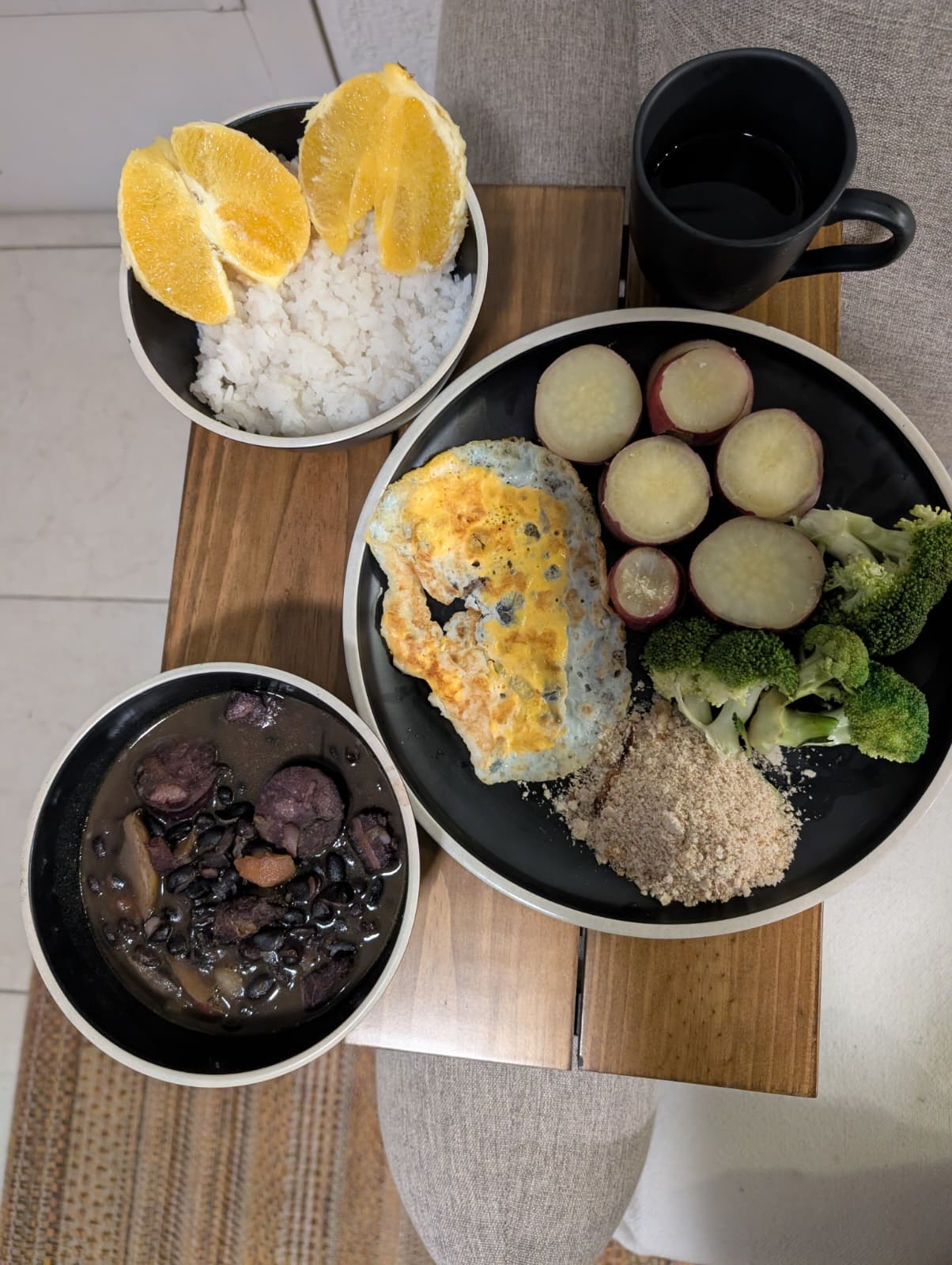
Here's a dinner I cooked myself -- ive been experimenting a lot with the Brazilian food palette, which I love! It was Saturday, the traditional day for the consumption of Feijoada, Brazil's national dih, and so i tried to make some myself! Feijoada is primarily a stew, with a base of beans and filled with pork sausage, pork ear, and bone-on pork ribs. I also added carrot and potato, which appear here and there in the culinary landscape here. Traditionally, it's served along with rice, farofa (savory cassava flour), and orange slices. I also added an egg, which commonly comes along with many Brazilian dishes. Foi muito gostoso, aproveitei, comeria de novo :)