Research Proposal
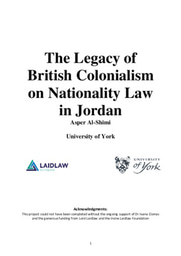
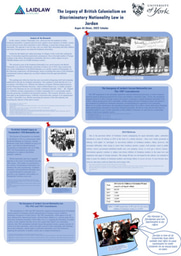
The colonial ambition of civilising the ‘barbaric’ native man underlay the many legal reforms that mirrored that of English Law. Colonial rule thus codified a more male-dominated law in regard to social order compared to the indigenous one that pre-existed colonial presence. Colonial powers, though, often ignored the unique experiences of the native people, and instead, enforced an English law that fails to consider their culture and history. I argue that the lack of historic context-sensitivity of colonial law survives today, thereby continuing to promote British interest all while frustrating that of native women. My research aims to specifically elucidates the experiences of women under a nationality law that continues to implement the gendered legacy of British Imperialism with a case study specific to Jordan. I will employ methods and theoretical perspectives developed by intersectional feminists and Third World Approaches in International Law Scholars in specific to examine the following research question; How has the legacy of British imperialism infused nationality laws in Jordan with colonial and patriarchal values?
My research, at its core, closely links to Justice and Equality: one of the seven University of York research themes. It calls for the disposal of the patriarchal values pervaded in the laws of post-colonial territories that allow for the legal and social exclusion of native women all while glorifying and promoting the interests of their western counterparts. This is so as to implement a system that pertains its cultural traditions while simultaneously acknowledging the need for democratization and furthering the development of human rights. My research will draw on the work of renowned human rights defenders and organisations, specifically The Global South Academic Network and its scholars, to emphasise the need for the extension of the feminist movement to include native women without the western rejection of their racial, cultural, and social specificities. Because in doing so, they enforce the principle that the western woman is the only woman deserving of tolerance and act as potential oppressors in effect. I seek to positively enforce a feminist approach that acknowledges the diversity of women worldwide explicating that they are heterogeneous entities who do not share the same characteristics, beliefs, values and practices, but are all deserving of inclusivity, equality, and tolerance, nonetheless.
During the first week, I aim to conduct a thematic literature review, engaging in particular with intersectional feminist critique and TWAIL scholarship of the gendered legacy of British imperialism. This will produce an abstract and introduction in effect. The following three weeks would include more in-depth, desk-based research into the specific British-imported national law in Jordan to examine it from an intersectional feminist perspective so as to unearth its gendered colonial roots and effects. The following week, I will employ a qualitative research method, such as semi-structured interviews conducted online with key informants to include women activists working on my topic of project in Jordan, to accurately reflect the understandings of those on the ground fighting for their rights. In the final week, I will utilise the views from the on-ground activists to arrive to a conclusion that explores, in practice, methods of reforming patriarchal laws grounded in indigenous culture and the already-existing activism that deserves to not be ignored.

Hi!