Research Poster: Where There's Fire, There's Smoke: Correlating Wildfire Activity with PM2.5 In Los Angeles, California and Jakarta, Indonesia
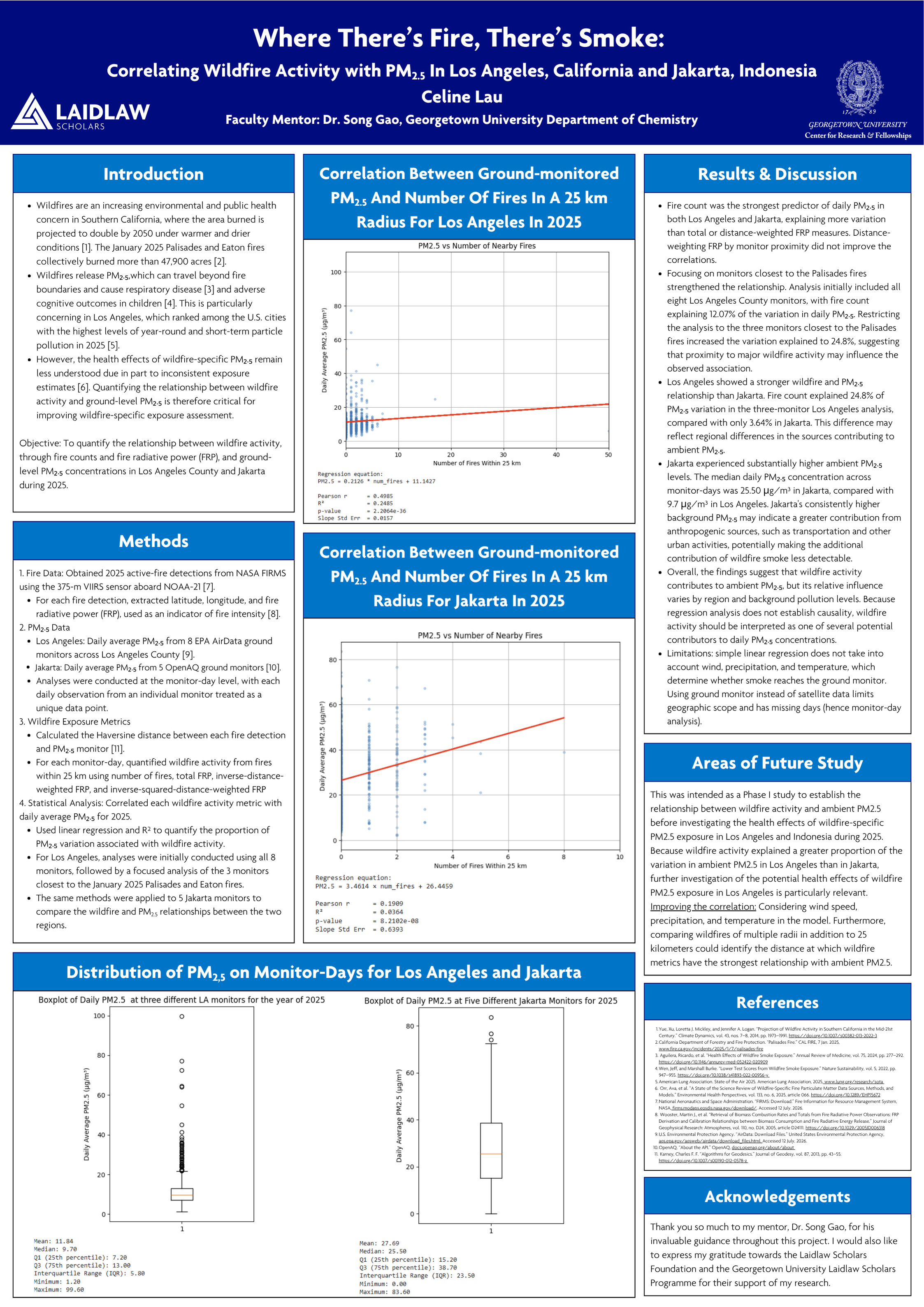
 Wildfire activity is an increasing environmental and public health concern, as wildfire smoke
releases fine particulate matter (PM₂.₅) that can adversely affect respiratory and other health
outcomes. This study investigates the relationship between wildfire activity and ambient PM₂.₅
concentrations in Los Angeles County and Jakarta, Indonesia. Fire activity was measured using
fire radiative power from NASA’s NOAA-21 satellite and correlated with daily average PM2.5
measurements from EPA and OpenAQ ground monitors. For each monitor-day, wildfire activity
was calculated using fire detections within a 25-km radius of the PM₂.₅ monitor, including total
number of fires, total FRP, and distance-weighted FRP. In Los Angeles, the strongest relationship
between wildfire activity and ambient PM₂.₅ was observed for the total number of fire detections
within 25 km of the three monitors closest to the Palisades Fire, with a statistically significant
positive correlation (Pearson’s r = 0.4985, R² = 0.2485, p = 2.21 × 10⁻³⁶). In comparison,
correlations between wildfire activity metrics and ambient PM₂.₅ were substantially weaker in
Jakarta, suggesting that wildfire activity accounted for less of the observed variation in ambient
PM₂.₅ in Jakarta than in Los Angeles. These findings demonstrate that regional differences lead
to different sources of ambient PM2.5 and further research is needed to determine the health
effects of wildfire-specific PM2.5.

Celine Lau is a rising sophomore at Georgetown University studying Neurobiology with a minor in Statistics on the pre-medical track. She is passionate about understanding how environmental and biological factors influence human health, particularly in the context of neurodegenerative diseases.
As a Laidlaw Scholar, Celine is investigating the relationship between environmental exposures, such as fine particulate matter (PM2.5), and student health outcomes. Her research explores how differences in air quality across regions may contribute to disparities in educational and cognitive outcomes, with a focus on developing a deeper understanding of environmental determinants of health.
Celine also conducts research in the laboratory of Dr. Priyanka Joshi at Georgetown University, where she studies metabolic pathways involved in neurodegenerative diseases, including Alzheimer’s, Parkinson’s, and ALS. Her broader interests lie at the intersection of neuroscience, environmental health, and translational medicine, with the goal of contributing to research that improves prevention, diagnosis, and treatment of complex diseases.
Beyond research, Celine is involved in healthcare and community service initiatives, including EMT work, free clinic volunteering, and student organizations focused on music, bioethics, and Alzheimer’s awareness. She hopes to pursue a career as a physician-scientist, combining clinical care with research to address pressing challenges in human health.