Reflective Report: Creative Approaches to the Historical Collections of the Royal Armouries Museum, Leeds
Research Overview
The project centers on bringing a medieval collection of arms and armour at the Royal Armouries Museum to life by presenting it to public audiences in more imaginative ways. The museum holds one of the world’s finest archive of such material, spanning war and tournament contexts across continents and centuries.
I narrowed my focus on medieval gauntlets, its surrounding phrases and rituals for my research after being fascinated by them on my initial visit to the museum at Leeds. The seemingly modest pieces of hand armour protected a knight’s most essential tools: the hands that gripped the sword, lance, or reins. Gauntlets are small objects, yet they encapsulate larger stories about technology, status, honour, and cultural memory. They appear in physical form in museum cases, in manuscript illuminations and effigies, in legal and ceremonial records, and even in everyday language long after their life on the battlefield ended.
My central aim is to make less well-known objects much more accessible to non-academic audiences, especially young people, while maintaining historical interest and relevance. Instead of traditional text‑heavy academic formats, the project attempts to make use of artistic reconstruction as legitimate modes of historical scholarship. It moves graphics beyond mere decoration on the object labels, rather explaining the bigger picture alongside the text.
Two primary research questions thus guided this investigation: how did gauntlet styles evolve across the thirteenth to sixteenth centuries and what technical, tactical, and social factors drove those changes? How could the symbolic meanings of the gauntlet, particularly its role in formal ritual challenges, be portrayed effectively through visual art so that contemporary viewers grasp its lingering cultural resonance?
Research Process
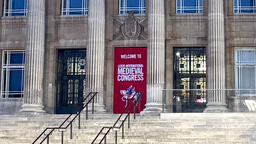
After settling on gauntlets as the focal point, I worked closely with both primary and secondary sources to have a more comprehensive understanding of medieval arms and the role of a gauntlet. Through extensive reading in both the Leeds University library and the museum’s collections, I realised that gauntlets were not just armour for the hands. They showed real technical skill, shifted in style over time, and carried meanings that stayed powerful long after knights stopped wearing them. I examined the objects themselves in the War and Tournament galleries at Leeds, visited the collected at the Tower of London, consulted specialist publications, and followed discussions at the International Medieval Congress (IMC). The research is divided into two strands: the physical object itself and the broader language and rituals that grew around it.
1. The object
I decided on mapping the change in styles and materials of the object through a structural timeline.
The museum’s collection is carefully divided into war and tournament equipment. In evaluating the physical artifacts, gauntlets made for the battlefield and those engineered for competitions differ noticeably in weight and thickness. Field gauntlets required a lightweight, non‑restrictive design so a knight could fight, ride, and remain agile over prolonged engagements without exhausting the hands and arms. Tournament pieces could afford greater robustness and more specialized features. An example would be locking gauntlets, which feature extra-long finger lames or internal springs that mechanically fixed the hand around a weapon. They were unique to games and prevented weapons from being knocked away, but were still strictly regulated or banned at some events because they altered the fundamental nature of the contest.
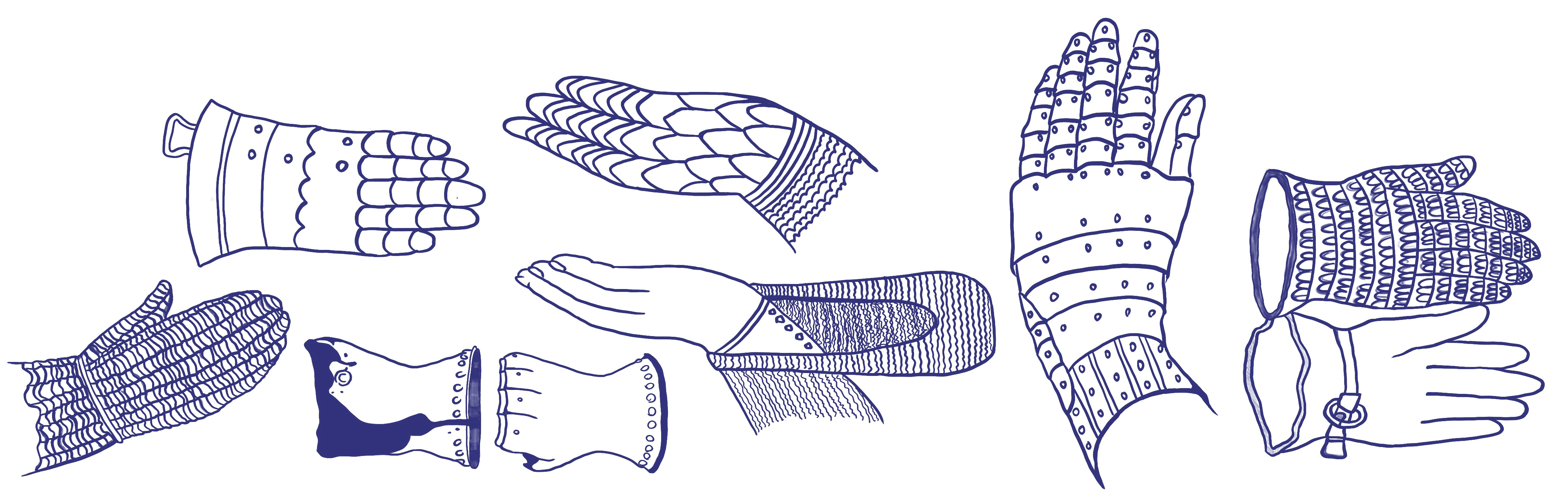
The mechanical sophistication of plate gauntlets is striking. What appears rigid at first glance is actually intricately articulated. Multiple overlapping plates joined by rivets permit the hand and wrist a surprising range of motion, even greater than an unarmoured wrist in certain directions. On one hand, fingered gauntlets, as the name suggest, wrap each finger individually, allowing a flexible and secure grip on a sword hilt. On the other hand, mitten styles have a larger surface to dissipate the impact, prioritising robust protection over fine dexterity. Later Gothic and Maximilian‑style armour introduced delicate fluting and raised ridges on the finger plates to ensure design consistency with the larger parts of the armour. These decorative elements were not purely ornamental, they also stiffened the metal and directed blows.
On material, at the IMC I encountered a discussion on a pair of whalebone gauntlets and the use of baleen in medieval British armour. Work by Ralph Moffat, Curator of European Arms and Armour at Glasgow Museums, and related studies highlight how armourers utilized available materials effectively at times of war. Steel outer plates combined with leather linings and, in some cases, baleen components offered a balance of protection, flexibility, and resource efficiency. This mixed‑media approach reveals pragmatic craftsmanship that can accommodate a range of substances.
Production of luxury gauntlets often bear detailed engraving or marks distinctive to its owner. They require a high level of customization, meaning not everyone could afford them. In wartime, records suggest that during military musters soldiers borrowed gauntlets to ensure every man presented a complete harness. This implies that the same pair might be catalogued more than once. This operational detail reminds us that armour was once functional, lived‑in equipment before becoming static museum display.
A key secondary source for establishing this chronological progression was Baron de Cosson’s 1884 paper “On Gauntlets,” extracted from the Archaeological Journal. It surveys forms from early mail mittens to hourglass profiles to fully fingered late‑plate gauntlets, recording them with sketches and photographs.
Learning to draw these objects presented its own challenges. Representing articulated plates that follow the natural flexion of the hand requires careful observation of both the armour and the underlying anatomy. The later‑period fluting and cusped edges demand even more precision to capture the details of the gothic influences. It is a constant battle for my drawings to convey both historical accuracy and the elegance of the original design.
2. The phrase and ritual
Parallel to this physical analysis ran an investigation into how the gauntlet embedded itself in language and courtly ceremony. Nowadays, the idiom “throwing down the gauntlet” means to issue a challenge; “picking up the gauntlet” means to accept it. It preserves a literal medieval practice in which a knight cast his armoured glove to the ground as a formal invitation to combat. The practice survived into the early nineteenth century, transforming into a ritual as part of the King’s coronation banquet.
I was particularly inspired by a paper titled “The Armour of the Champion of George IV” at the IMC, delivered by Henry Yallop, a curator at the Royal Armouries. In 1821, twenty‑year‑old Henry Dymoke performed the role of King’s Champion at the coronation banquet of King George IV. The tradition of throwing down the gauntlet was actually performed following the coronation ceremony at the lavish banquet. Fully armoured and mounted, Dymoke rode into Westminster Hall accompanied by squires and heralds. The herald read out the challenge three times as the party processed the length of the hall, with each challenge, the champion cast down his gauntlet. None of the challenges were ever accepted. This marked the final historical instance in which the full ritual of the mounted, armoured Champion throwing down the gauntlet was executed at a British coronation.
The armour worn at the coronation has recently been acquired by the Royal Armouries and is displayed at the Tower of London. Visiting the Tower allowed me to closely examine the Maximilian‑style suit. With the help of the rather detailed object label next to the suit, I thought of what the day could have looked like. Imagining that scene led me to present my findings through animation.
Conducting a comparative research between the current physical objects, past drawings, and secondary accounts revealed intriguing discrepancies. While the gauntlets displayed alongside the suit are in mitten‑form, a portrait painted just days after the coronation clearly depicted Dymoke wearing finger gauntlets. Some suspect that Dymoke himself might have changed out the style at the coronation for a better visual effect. It is also known that Henry was acting in place of his father, the hereditary Champion, who was a clergyman and thus barred from taking up arms. Hence, the change in personal preference and comfort is a reasonable explanation. Yet it may simply have been the artist’s choice to depict a different style from the one actually used. It remains unclear how far the artist’s own preferences influenced the accuracy of the print.
Archival records also show that his mount was a trained horse borrowed from Astley’s Circus, chosen because it was accustomed to loud crowds and unlikely to panic within the confined and packed space of Westminster Hall. Rather than wearing armour, the horse had festive decorations to match the joyous occasion. Other things I had to figure out include how the hall was dressed, the color of the carpet, and the composition of the audience. These were small historical points I would never have considered if I had not been attempting to create a colored drawing. Records of itemized lists and paintings by other artists all fed into the visual reconstruction.
All of the above findings shaped the narrative and visual decisions for the animation I planned. The sequence begins with the Champion riding into the hall and issuing the challenge. A subtle supernatural touch is added, with the crown flying onto George’s head. It simplifies the complex liturgical and procedural elements of the actual coronation, keeping the viewer’s attention focused on the gauntlet and the challenge. A quiet closing scene shows Dymoke retrieving the gauntlet after the ceremony, answering a question that someone raised at the IMC: who picked it up from the floor when no challenger appeared? The detail adds a humourous note and gives the animation a slightly silly ending.
Disseminating Research
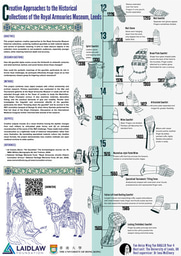
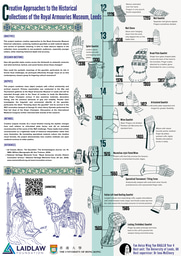
To bridge academic research and public engagement, the project yields two visual outputs designed for museum integration. The first is a visual timeline of gauntlet styles from the thirteenth to the sixteenth centuries, showing the transition from mail mittens to hourglass forms to articulated mitten and fingered gauntlets. The later highly decorated Gothic and Maximilian examples are also included.
The second output is an animated reconstruction of the 1821 Champion’s challenge. It is a simplified depiction of the ritual but captures the important aspects.
Both graphics will be included in my Laidlaw research poster as well. Together, these visual media translate vague historical ideas into intuitive formats.
Research Impact
Infographics can help viewers grasp the evolution that may feel abstract with text alone. The progressive articulation of plates, the narrowing of cuffs, or the introduction of fluting does not only show design changes. It also explains the development in combat technique, the relationship between gauntlets and other armour components, and the eventual decline of plate hand defences on the battlefield. Contributing factors such as the cost of steel, the rise of hand protection integrated into sword hilts, and the emergence of new fabric materials. Eventually, gauntlets were removed from everyday military use and only carried symbolic power.
The animation, meanwhile, re‑enacts a ceremony that most people know only as an idiom. Existing static drawings of the coronation banquet only capture single moments. An animation conveys progression. Seeing how each step was performed helps contemporary audiences visualize the moment.
After the stages of finding and creating, the project left me to do much thinking. Perhaps much of what initially drawn me to gauntlets is the lack of metal gauntlets in Chinese combat in the middle ages. Chinese warfare placed greater emphasis on archery and different close‑combat traditions, producing completely different armour systems. It reminded me that objects often reflect broader strategic and cultural choices, also evident in the loss of the ritual. Cost‑cutting under King William IV’s coronation a decade later was likely the reason they no longer had a champion throwing down the gauntlet. At Queen Victoria’s ceremony, there was a focus to present the event to the wider public instead of confining the occasion to a banquet, ending the already dying tradition. Yet elements of armour and hand symbolism persisted. Other pieces of armour were still featured on Victoria such as the sword of state and her gold gauntlet cuff. In 2023, King Charles III wore the Coronation Gauntlet, a leather glove rather than a steel one, on his right hand while holding the Sovereign’s Sceptre with Cross. Traditions are rarely extinguished; they adapt. The steel gauntlet of the battlefield became the ceremonial glove of constitutional monarchy.
Further, creative choices inevitably convey perspective. Selecting which scenes to animate, which details to emphasise, and which style to adopt involves judgement. A creative‑critical approach allows deliberate decisions that prioritise clarity and engagement for a young audience while staying accountable to the evidence. The goal is to make the existing past more legible and memorable but not reinvent it.
Future Plans
Six weeks is a short time to complete both deep research and creative work. Much of the preliminary investigation is done, yet the drawings and animation require continued refinement. I am still trying to strike a balance between historical accuracy and personal artistic voice to create a piece that holds attention. I intend to keep working on the timeline and animation with a view to eventually them display alongside related objects in the museum. I also hope to return to the IMC next year to present the process itself, showing how creative methods can open medieval collections to new audiences.
Leadership Development
On leadership, the project strengthened my skills in cross-cultural communication and collaborative problem-solving. Attending the IMC alone meant communicating with numerous historians and creative individuals. Their diverse perspectives and backgrounds guided and enriched my findings. My conversations with other Laidlaw scholars further expanded these exchanges, introducing me to a range of approaches in other fields that could be applied to my own research. The regular meetings with my advisor Dr Iona McCleery let me practice consolidating my findings every week and presenting them in a logical manner. Such interactions required me to listen carefully, adapt my communication style when needed, and integrate differing viewpoints into a coherent project. Much of the research itself required critical thinking and imaginative problem‑solving, since turning historical evidence into accessible visual and narrative forms involve constant experimentation and reflection. Through these experiences I strengthened my attempts in leading inclusive and creative inquiry while staying grounded in scholarship.
Personal Notes
For the first time I was not just a regular visitor at a museum. Having access to the museum stores and conversations with curatorial staff gave me a concrete sense of the day‑to‑day work of caring for and interpreting a national collection. Attending a major academic conference as an undergraduate was both daunting and rewarding. Diving into such an extensive range of topics and papers has shown me that medieval studies is deeply interdisciplinary. Other than armour, I joined sessions on canon law in medieval literature that align well with my current studies. Another presentation was on integrating digital tools in visualising court rolls, highlighting exciting new methodologies for research. Tools for presenting ideas, visual as well as verbal, became as interesting as the content itself.
This was also my first extended period living and backpacking independently in England. Journeys to London, around Yorkshire, and to cities such as Birmingham and Manchester broadened the experience. In addition to visiting major tourist landmarks and notable museums, I attended local festivals, making the trip incredibly rewarding. These travels added a great deal of enjoyment to my time and built practical skills in navigation, budgeting, and adaptability. Though not directly related to my research, they completed my deeply rewarding time abroad.
Creative history, afterall, is one of many ways to make an archive coherent. To study armour is to study the people, the place and its impact: remembering who made and wore it, where it was used or displayed, and the lasting meaning. The gauntlet, small enough to hold in the hand yet bearing centuries of practical and symbolic significance, proved an ideal vehicle for that exploration.