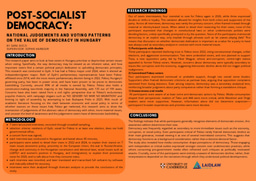
I applied to the Laidlaw Programme for two main reasons. Firstly, I was excited by the prospect of gaining work experience and genuinely contributing something to the world, somewhere new and exciting. Secondly, I was unsure whether research was for me and wanted to test myself in that area. I end the programme having achieved both of the things I set out to do, along with numerous other valuable experiences.
My first summer research project, and the interviews in particular, was eye-opening. It made me realise that I am probably not suited to a research career, especially one centred on primary research. It is somewhat unfortunate that I did not enjoy that summer, but all experience is valuable. Now, as I write my dissertation, I can draw on everything I learnt from the research process two years ago and avoid repeating the same mistakes.
One thing I did enjoy about Summer One was the leadership training. The workshops had a fairly limited scope, but I still found the introduction to corporate-style leadership and group training valuable, especially learning about the different models and frameworks used. I found the Oxford Character Project training less valuable in my second year. Being online was already a limiting factor, and the experience of working alone rather than in a group was made worse by a very individualistic perspective on leadership.
An unexpected highlight of the programme was the Laidlaw Conference in Durham, which was valuable both professionally and personally. I particularly enjoyed listening to other scholars present their research and was impressed by many of the projects. Meeting fellow scholars from across the world was also wonderful. Everyone was open and friendly, and we spent time together outside the conference itself. Simply visiting Durham counts as a highlight too. As an international student, I have limited time in the UK, and I probably would not have discovered the city if not for the conference.
My Leadership in Action project, however, got off to a rocky start. Although I began searching for placements relatively early, I struggled to get organisations to respond. I initially set my sights on Melbourne, Australia, but after a few months pivoted to options in Europe. In the end, the organisation that agreed to host me was based in Melbourne after all, and I was thrilled at the chance to visit Australia.
There, I spent my time with Electronic Frontiers Australia (EFA), a digital rights organisation, writing op-eds for its website and helping to compile a policy reference document on its positions across a range of digital rights issues. The work pushed me into areas such as law, AI development, and the mechanics of policymaking that I had never engaged with before, and it showed me how advocacy organisations turn principles into concrete policy. While Summer One taught me that research was probably not the path for me, Summer Two solidified my interest in working in Public Policy.
What I will remember just as much is the experience of being there. Living on the other side of the world taught me to be independent, and it came with its share of surprises, including having to complete the Australian census. Melbourne was also much colder than I had expected, but that did not stop it from being a wonderful place to explore. I knew little about Australia beforehand, and visiting its museums, national parks, and landmarks taught me a great deal about nature conservation, colonial history, and Aboriginal and Torres Strait Islander peoples.
Looking back, the Laidlaw Programme gave me what I hoped for, though not always in the way I expected. My first summer showed me that primary research is not where my strengths lie, and that was just as valuable as discovering something I loved. The conference in Durham and my placement in Melbourne gave me the chance to contribute meaningfully to something beyond my own studies while meeting people and visiting places I would otherwise never have encountered. I leave the programme with sharper research skills, a clearer sense of my interests in digital policy, and the confidence to work independently in unfamiliar settings. Most importantly, I leave with a stronger commitment to making sure that technology and innovation serve people, not the other way around.