Coming to the end of the 18th-month Laidlaw programme, I can’t believe how much has happened since it began. I wrote my application in February 2025 with a lot of enthusiasm but very little idea of what exactly was required to implement a 6-week research project and a further leadership placement. Since then, I have moved countries twice, conducted qualitative research, learned to use power tools and met so many wonderful and inspiring people. The Laidlaw programme has been defining to my college experience and has completely reshaped my understanding of my own capabilities, my understanding of leadership and my ambitions for the future.
When I started this programme, my image of leadership was one of stress. A leader had to have all the answers, be constantly motivated, never let the bad days show. My idea of a leader was the Energiser bunny. As a chronic perfectionist, a crash and burnout seemed inevitable.
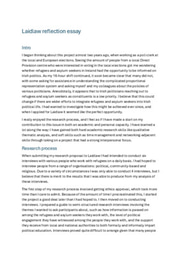
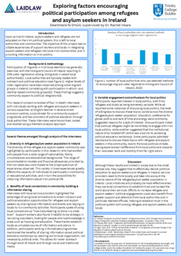
In my first summer of the Laidlaw programme, I conducted a qualitative study of the barriers to political participation for asylum seekers and refugees in Ireland. This was my first experience of qualitative research as an undergraduate and it proved to be a remarkable and invaluable learning experience. I had my first taste of the challenges and rewards of interview-based research. From the academic side of synthesising and coding interview transcripts and analysing the results to the mundane administrative issue of finding and scheduling participant interviews, the process was challenging and thrilling in equal measure. I learned a lot not only about the research process itself but also about the power of curiosity and ambition within academia to enact real-world change. I was assisted in the research process by my supervisor, Dr. Rachel Hoare, who I cannot thank enough for her guidance and encouragement. I continue to be inspired by her example: spearheading research and community initiatives side by side in her work in Trinity College Dublin and the University of Sanctuary programme.
In addition to the research work in Summer One, I participated in five Lead Days, two of which took place on an overnight trip to Carlingford Adventure Centre, as well as the Oxford Character Project. The Lead Days included modules on project management, public speaking and personal character development and understanding. They were an invaluable part of my Laidlaw experience. The project management workshop stood out to me in particular as an incredible skills-building workshop. I have always been someone who rushes out with a million ideas, while following through is not my strongest suit. Learning the skills necessary to break down a project into manageable chunks with deadlines and spreadsheets was game-changing not only for my Laidlaw research project and LiA, but also several personal projects.
What stuck with me the most from the Lead Days and workshops, however, was the people I got to do those with: my cohort of fellow Laidlaw scholars. My peers have been my biggest inspiration throughout the programme. Whether it was through hearing of the exciting things they did on their summer projects, getting guidance from my peer-mentoring groups, or simply getting to talk with each other and hear each others’ perspectives on life, I always find myself excited and inspired by fellow scholars. Getting to do the programme with this wonderful group of people has shaped my understanding of leadership more than anything else; working with and becoming friends with people with very different styles of leadership has made me reflect on my own understanding of leadership and try out and adopt different styles.
My experiences on the Laidlaw programme have taught me the importance of being flexible in the projects I undertake. Both in my Summer 1 project and in my LiA I experienced changes of plans and setbacks, but often the results I was proudest of came from unexpected places. I started to allow myself to adapt and pivot as needed, to get frustrated by challenges but to take breaks and then come back to attack the problem again. I found the line before burnout and learned when to take a step back. I also started to understand that I don’t always have to be the expert, and I don’t need to do everything: it’s both more effective and more personally fulfilling if I give 100% to the things I am passionate about and qualified for than to spread myself thin on a project I don’t even feel is important.
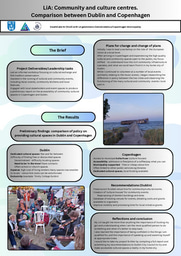
This brings me to my LiA, the culmination of my time in the Laidlaw programme. When I wrote my application, I thought that I would be some kind of bossy project manager by the end: the person who can do everything and has all the answers. That couldn’t be further from the truth. When I arrived in Copenhagen to begin planning and running a workshop on the EU with Ungdommens Demokratiehus, I quickly realised the limits of my capacity. Not only was I not the person qualified to run such a workshop, I also found that I didn’t particularly believe in this idea anymore and didn’t feel interested or inspired by it. Thankfully the team in Ungdommens Demokratiehus were more than happy with me to be flexible and adapt my project to what seemed like a more genuine community need. It was the work of the organisation itself, a ‘culture house’ within the Copenhagen City Municipality, that filled me with excitement to explore what could be done to improve the cultural infrastructure back home in Dublin. Thus my new LiA was born: a comparison of the availability of cultural spaces in both cities.
Taking part in the leadership programme has given me greater ambition and vision in the change I want to enact in the world. The practical experience of the research project and LiA has given me a greater understanding of the stakeholders in the issues I care about, and of the smaller steps involved in any large push for change. Seeing how people and organisations are able to work towards change over long periods has strengthened my determination and ability to stay motivated long-term and follow through on projects and given me a better understanding of what I can achieve as an individual by connecting with others and working strategically. I am going into my final year of college with the goal of turning both my LiA and research project findings into research reports that can be used to influence policy at a local level.
More than anything, being around changemakers during my time on the Laidlaw programme has inspired me. Between interviewees on my first project and the event and festival organisers I met on my LiA, the speakers at Lead Days and the others scholars in my cohort, seeing how people’s small actions and consistent work add up has given me a lot of hope that I might see things take a turn for the better, and has inspired me to be one part of that change.
To sum up my learnings during my Laidlaw experience, I would no longer say that leadership is about being everywhere at once or having all the answers. It’s not having ten grand ideas before breakfast or constantly running around. Often, leadership is simply about showing up and pitching in with others - listening to what is needed rather than being in charge all the time, and working at seemingly small things that will one day add up to big changes.

I am a third year European Studies student at Trinity College Dublin, currently completing an exchange year in Germany. My Summer 1 research project investigated factors that encouraged political participation among refugees and asylum seekers in Ireland.