Reflecting on My Laidlaw Journey: Science, Community, and Ethical Leadership
The last two years have reshaped my understanding of science, leadership, and my responsibilities as a future healthcare professional. My curiosity for cutting-edge medical research evolved into a sustained process of learning, failing, listening, and co-creating with communities.
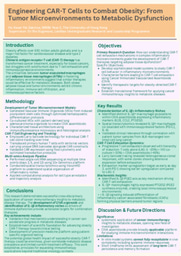
My Lailaw journey began started in the lab, exploring metabolic immunotherapy and CAR-macrophages designed to target obesity-associated adipose tissue. Coming into the project with no prior research experience, I quickly realized how much I had underestimated the complexity of scientific inquiry. What seemed straightforward in literature transformed into an intricate process of CITE-seq data analysis, CAR construct design, and unexpected setbacks. There were moments of frustration when experiments failed, but those moments taught me humility and resilience. I realized that scientific progress isn’t about immediate perfection; it is built on patience, careful observation, and the courage to adapt when results challenge your assumptions. Translating complex molecular biology into a meaningful strategy for a global health crisis became, for me, an act of ethical responsibility.
Through the Oxford Character Project, I gained the vocabulary to make sense of these lab experiences. I learned that courage in research and healthcare is not about reckless certainty, but about discernment, and to know when to push forward through uncertainty and when to pause, reassess, and listen.
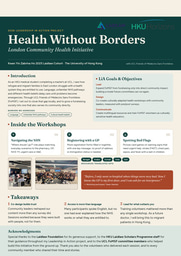
I transitioned from the laboratory to my Leadership in Action project, Health Without Borders in East London. Working alongside refugee and migrant support organizations to design culturally sensitive health education forced me to move beyond theoretical science into the lived realities of health inequality. Leading the strategic expansion of UCL Friends of Médecins Sans Frontières meant navigating complex logistics, developing multilingual resources in Arabic, Bengali, and Somali, and training student volunteers as empathetic health educators. The exhaustion of coordinating multi-session workshops was replaced by quiet pride when community leaders told us our resources helped bridge critical gaps in NHS access and health literacy. That hands-on work taught me practical, inclusive leadership, including how to build sustainable partnerships, protect volunteer well-being, and center community voices rather than imposing top-down solutions.
Reflecting through the Laidlaw 3C’s Framework helped me articulate this growth:
-
Curiosity & Capacity: My technical capacities expanded from molecular biology techniques to cross-cultural communication, workshop design, and impact evaluation using community feedback.
-
Character & Connections: My character was tested and grounded in intellectual humility, patience, and ethical accountability. Building bridges between student volunteers, local charities, and international health missions showed me the power of shared purpose.
Through this dual experience, global citizenship stopped being an abstract ideal and became a daily commitment. Whether analyzing single-cell sequencing data or adapting health resources for non-English speakers, both experiences demand that evidence and action be rooted in deep respect for people’s dignity and lived experiences.
The Lailaw Scholarship has provided me a clearer map for leading ethically in healthcare. I leave the programme more technically capable, more ethically attuned, and deeply committed to health equity. I carry forward the memory of data that demanded humility, community sessions that demanded empathy, and partners who proved that leadership is most powerful when it is shared.
Student, University of Hong Kong