Reflecting on the past two years I’ve spent taking part in the Laidlaw Leadership and Research Scholarship, it is truly amazing to see how many opportunities and skills I have had the privilege to gain. On hearing I had been accepted onto the programme, I was most excited to get started on my research project, this being what had initially drawn me to apply, whilst the leadership aspects were something I was much more unsure about. Having started university as a naturally more introverted and reserved person, I didn’t see leadership as something that was accessible or possible to me, but this scholarship really has changed how I view leadership, and I am so grateful for it. Since embarking on this journey, I have become so much more confident in how I navigate the world, and have taken on countless new leadership opportunities at Durham, such as being Welfare Officer for my college and President of our Pride Society, neither of which I would have felt prepared to do without taking part in the Laidlaw Scholarship!
Similarly, whilst I was aware of both ethical leadership and global citizenship as concepts, I feel that they did not gain true personal meanings for me until taking part in my Leadership in Action projects in Mexico City. I now understand just how important it is to approach leadership with humility and integrity, and that the most effective forms of leadership involve knowing when to step back and let others lead the way, as well as recognising that promoting wellbeing and inclusion are vital responsibilities of today’s leaders. Similarly, I have developed a real commitment to global citizenship, using my strengths of empathy and cultural awareness to develop sustainable solutions to the issues facing the world, valuing the perspectives of those most affected by them.
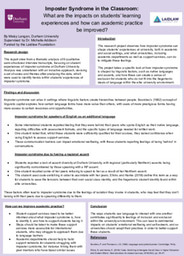
Looking back to the summer of 2024 and my research project, titled ‘Imposter Syndrome in the Classroom’, I am still proud of the research conducted by me and my teammates, and the impact our findings have had on the first-generation student community at Durham University. Through completing this project, I actually confronted a lot of my own imposter syndrome as a student at Durham, also being a first-generation and neurodivergent student. I originally wondered how someone like me would manage to ‘fit in’ on such a prestigious scheme as the Laidlaw Scholarship, but I have honestly truly felt such a sense of belonging in this inspiring and lovely community.
As I mentioned in my previous post, taking part in my Leadership in Action trip to Mexico City, I learned one very important lesson - I am capable of so much more than I think! There were several times throughout those six weeks when I felt completely overwhelmed with the completely new environment and unfamiliar tasks, but I really do believe that I flourished as a result of this challenge.
Delving deeper into the significance of ethical leadership to my Laidlaw experience, I really began to understand this properly on my Leadership in Action trip. Working with Las Sabinas, my team and I realised just how important it is to not speak for survivors of gender-based violence, even if this is done with good intentions, but instead to work with and platform their own narratives. Similarly, in our work with local activists and volunteers, I thoroughly enjoyed getting to collaborate with these people and mobilise community action, but the real joy I found in this was using the leadership skills I have learned throughout the scholarship to help them to lead their own projects themselves. Ethical leadership is often about knowing our own strengths as leaders, whilst realising that we do not know everything, and that often we need to step back and listen to other perspectives.
Building on this, global citizenship was a priority that really resonated with me in Mexico City. My team and I were careful to understand the cultural differences between our home countries and the culture in Mexico City, and how this influenced experiences and perceptions of gender-based violence. These discussions shaped the content we created for Las Sabinas, as we were keen to ensure we were being mindful of the local community and their viewpoints. I feel that this experience really helped me to further strengthen my humility. To summarise the relevance of global citizenship to this project, gender-based violence is a major global issue, and we wanted to raise awareness of this, with an emphasis on how it is simultaneously a local issue.
As a result of these experiences, I feel that the principles of ethical leadership and global citizenship are even more important to me, and I try to include them in everything I do! I feel that I have become a much more confident and successful team player, and now feel able to bring my passion for inclusion and making people feel like they belong into my work, as well as truly nurturing diverse perspectives. In my academic work, I feel that I now fully understand the importance of working and leading ethically too. Looking forward to my career as I leave university later this year, I am excited to use the skills I have learned to work with a range of communities in a responsible and ethical way!

Hi there! I’m Maisy and I’m a second year Sociology student at Durham University. I’m passionate about working to make the education system a more accessible and equal environment.