Rare, Brief & Non-Recurring: My LiA at It Takes a City


 My project has been both fulfilling and stimulating, and I’m especially glad to have had the chance to work alongside another Laidlaw scholar who was working on a complementary project. Sitting within the wider Cambridge Homelessness Charter, my LiA was part of a bigger city-wide collaborative effort to make homelessness rare, brief, and non-recurring. I’m grateful to have had the chance to work on a project which connects to my existing interests in women’s empowerment and policy whilst teaching me new skills!
Initially, there were many things which surprised me. These included the scale of the Charter, its existing impact on Cambridge, and the complexity of homelessness as a system rather than one singular problem. This links back to my work in the IB Diploma looking at Systems approaches in the Environmental Systems & Societies course. This was where I first learnt to think about a single issue as the product of many interacting parts. Such logic also applies to homelessness in Cambridge, where housing, health, employment and support all feed into and from each other, which makes the Charter’s six-pillar structure make sense to me.
My LiA: What I did & What I enjoyed
My LiA had multiple strands encompassing my various interests. These included:
- Support Pillar: Working with the Support Pillar to produce a Tenancy Sustainment Report
- Women’s Daytime Activity Programme: Establishing partnerships for the Women’s Service’s daytime activities
- Women’s Rough Sleeping Census: Supporting the delivery of the Women’s Rough Sleeping Census + Women’s Services Directory
I also had the opportunity to collate lived-experience and staff rankings across seven themes (telling your story once, partnership working, clear communication, choice of activities / support, community, support to avoid homelessness, trusted person / place), which was drawn from a wide base of Cambridge homelessness services. Here, it was interesting to see where the two groups’ priorities diverged. Staff considered the importance of structural themes, whilst people with lived experience emphasised choice of activities. This is one of the clearest pieces of evidence I saw for why co-production, not just consultation, is essential for the design of services.
One of my favourite things which I worked on over my project was the creation of a podcasting guide and multi-episode outline. I had the chance to connect with an external podcasting team and learnt from them. Through this opportunity, I made the decision to apply to be a Researcher for the Feminist Files, a University podcast which is focused on feminist issues across Cambridge.
I also learnt data management skills, for example using Excel spreadsheets to analyse data and extract the most valuable findings.
- Excel: Borda count, weighted scoring, per-capita normalisation, auto-updating charts, data analysis
- Report writing: For a practitioner audience
- Event/volunteer logistics
I did survey work, which meant I had a quantitative base built from responses across multiple organisations.
Initial Reflections

What surprised me about the Women’s Rough Sleeping Census is the use of terminology. ‘Rough Sleeping’ does not always have to mean sleeping outside; the Census is intended to capture all women who are experiencing homelessness, including women experiencing “hidden homelessness”. One of the challenges this aspect of my project included was working to ensure that this cohort of women was going to be included in the count. This meant coming up with creating solutions for capturing the data, such as structuring outreach around the places and times women in hidden homelessness are likely to be encountered, rather than relying solely on traditional street counts.
Another example of the use of terminology is the lexis “homelessness” in itself. Online, there is significant discourse around the use of the word “homeless” as an adjective, and whether it is appropriate or offensive. Typically “unhoused” is used in some context, especially in the United States. However, in the UK, “homeless” seems more appropriate - yet, using it as an adjective turns it into a defining feature of someone’s identity. This can be dehumanising. Therefore, using the phrase “experiencing homelessness” becomes more appropriate.
This links to my language studies at University, where I hope to have the opportunity to continue learning about the power of language through entering into 2nd year of the History & French course. I can’t wait to find out more about the intersections between language, history and culture.
I also managed to have conversations with practitioners across various backgrounds, such as legal and criminology professionals. This connected to my own interests and future career aspirations. Hearing how someone with a legal background thinks about the structural and rights-based side of homelessness gave me a clearer sense about what that kind of career could actually involve.
What I produced…
Throughout my LiA project, I produced:
- 2 Slide Decks:
- Tenancy Sustainment
- Priorities for the Cambridge Homelessness Charter’s Support Pillar
- 1 Report:
- Tenancy Sustainment Support, which combined survey data and rigorous analysis
- 3 Excel Spreadsheets:
- Priority Tables Data
- Tenancy Sustainment Support Data
- WRSC Volunteer outreach schedule and tracking spreadsheet
- Visuals:
- Canva graphics on the journey out of homelessness
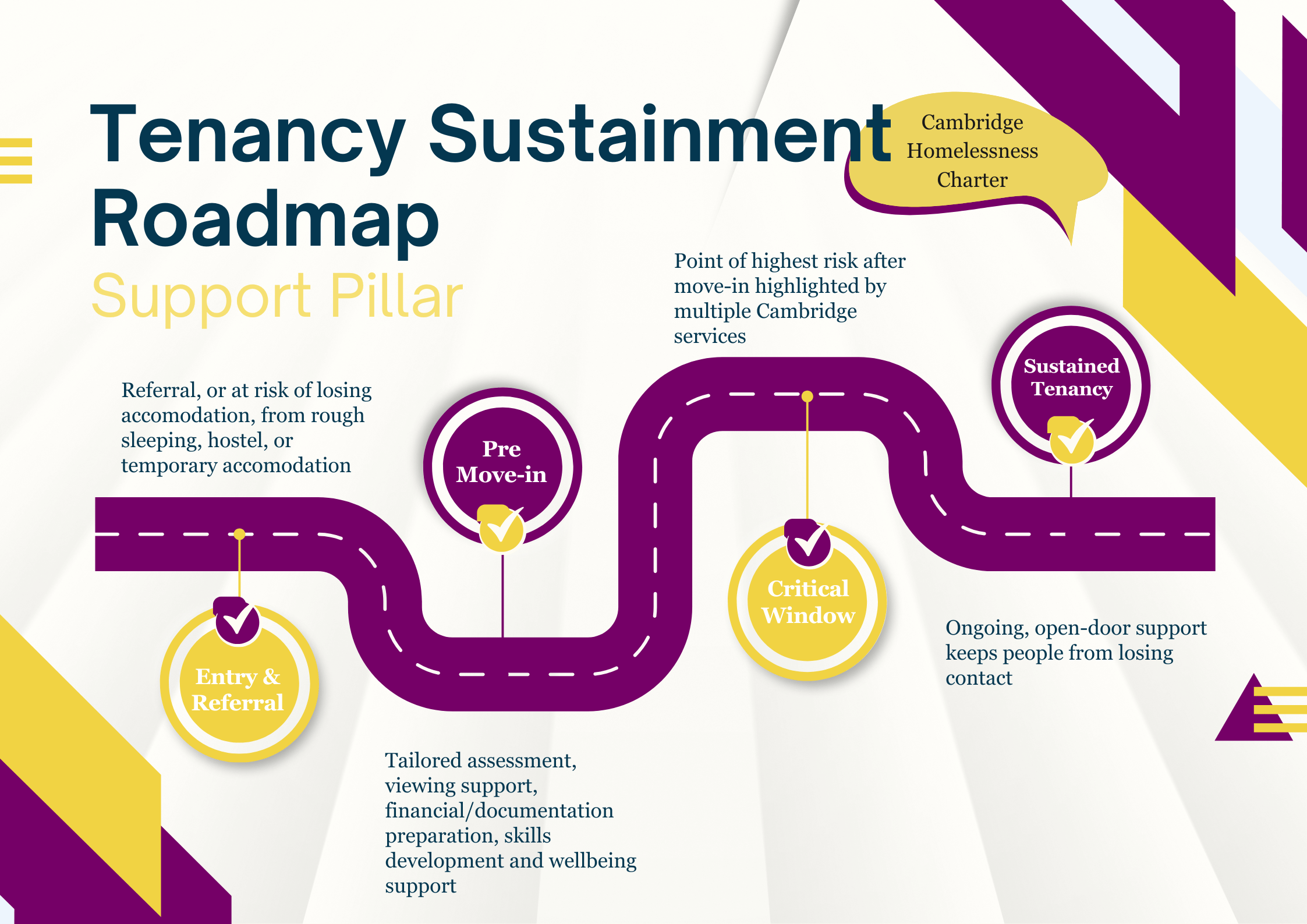
- Tenancy sustainment infographic
Additionally, I created some handover materials, including:
- Pack for the activity programme (with a suggested schedule, contact information and a graphics style guide)
- Pack for the Census (including cleaned up meeting notes, sign-up forms and trackers, and an outreach schedule)
The evolution of my project…
Across the six weeks, one factor which impacted my work was shifts in staff availability. This meant that some strands of my project were co-designed less than planned, and others had to be carried more independently.
My role on the Census clarified over time towards being a supporting role. This was an adjustment since I’d gone in expecting to help shape more of the Census’s direction myself before learning that it follows the national framework, with ITAC facilitating it locally. I instead learnt what it means to add value to something without needing to be the one driving it. Yet, there are local aspects to the Census, including having additional local questions at the end to inform practice.
This meant that I shifted how I thought about finishing my work, and decided to prioritise legible handovers which someone else could pick up, which is just as essential as work I personally closed.
Through this, I learnt that flexibility is not just things going wrong but an active leadership skill. It’s about deciding what to prioritise when I have six weeks, three strands and an organisation with its own demands.
The importance of spaces
I learnt about the importance of having a women’s-specific wellbeing space to support women in their journey out of homelessness. Seeing the impact of that space in practice shaped my understanding of homelessness as a spectrum, instead of it being a single fixed state. For example, women are significantly more likely to experience “hidden homelessness” than men – this means that they are more likely to sofa surf and exhaust all informal opportunities for support before approaching services. Having an informal, drop-in space to act as an initial bridge matters since it allows women to approach the services on their own terms before reaching the point of crisis formal referrals usually require. In a trauma-conscious context specifically, a space without a fixed entry criteria and without a requirement to explain yourself first removes a barrier for someone who might have had to justify their experiences to multiple services already.

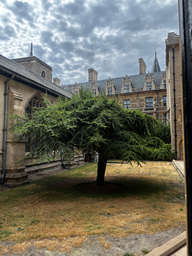
Not having a single fixed workspace turned out to be its own kind of learning. The value of not having one set office space all of the time meant that I could work from cafes across Cambridge and visit various services. A highlight for me was the chance to make the most of my College’s beautiful gardens and work outside to take advantage of the beautiful (albeit extremely warm) weather. This reminded me of the importance of green spaces – working in Cambridge over Summer, where it has been much quieter, has been great and peaceful and reminded me of why I love this city so much.

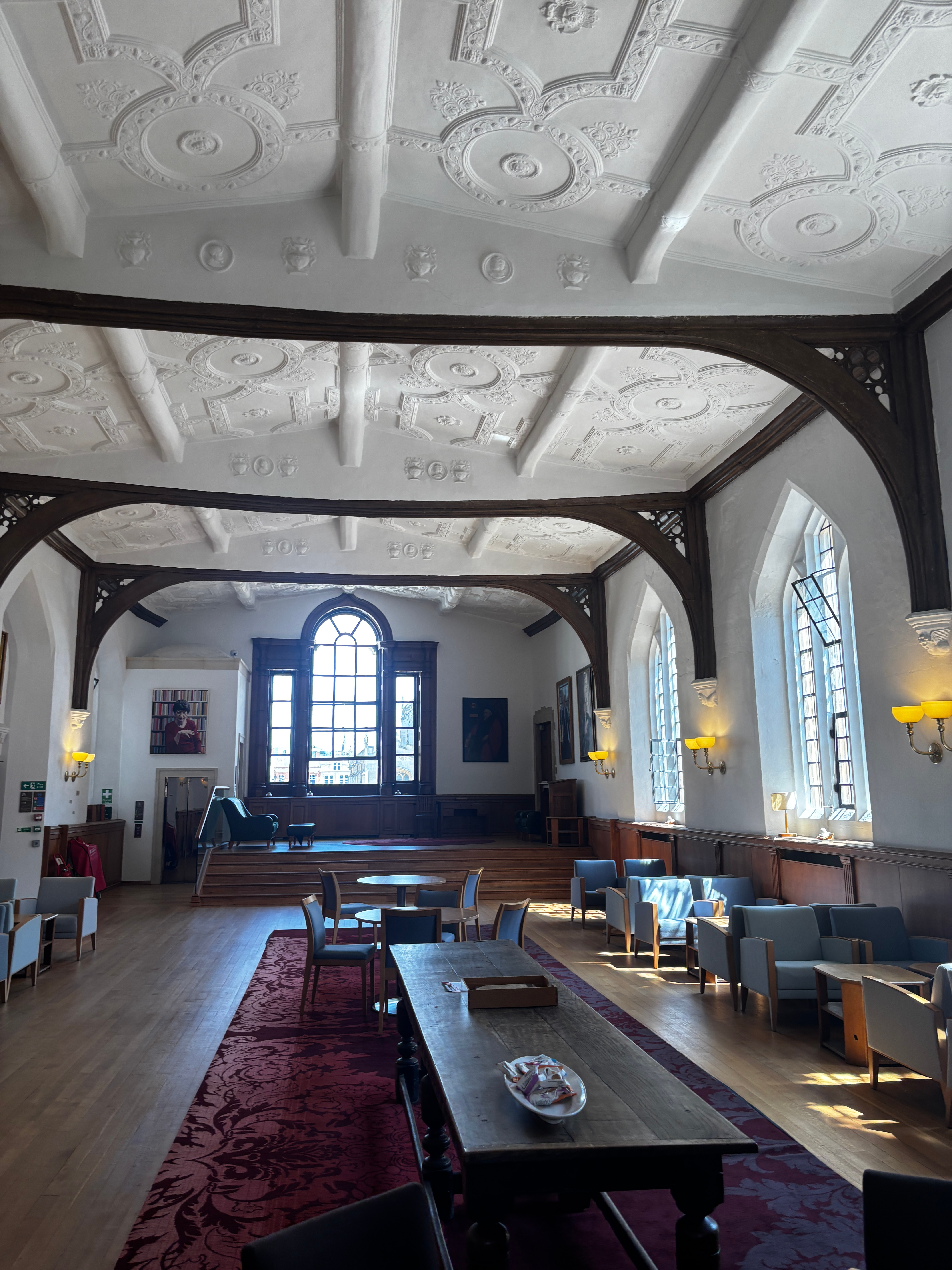
Visiting other organisations’ spaces across Cambridge taught me as much as working within my own. My recent reflection mentioned how I had the opportunity to visit the Fitzwilliam Museum. I also toured WinterComfort, visited the Cambridge Access Surgery and Change Grow Live. Of course, I visited ITAC’s Summer service 176 as well as the Haven on numerous occasions as well. Seeing how each organisation shaped its physical space around the people it served gave me a clearer sense of the impact of a building’s layout and how it mirrors the organisational values. Working from St Andrew’s Baptist Church provided a stable place for me to co-work with people from the organisation and fellow Laidlaw Scholars as well. Overall, the welcome I had from all of the Cambridge-based organisations as well as some in the wider area was warm and incredibly memorable, so I am grateful for this chance.
How I brought this into the recent Laidlaw Leadership Day
I was able to bring some of the things I learnt to the recent Laidlaw leadership day, where I delivered a short micro-teach to some fellow Laidlaw scholars on trauma-conscious care. I learnt from ITAC that being trauma-conscious (instead of trauma-informed) is an ongoing, active awareness. In practice, this looks like a staff member checking in on how someone wants to be approached today, and recognising someone’s needs and capacity can shift session to session, not just at intake. Teaching it to peers was in itself a challenge, because I had to make it clear and memorable - this taught me synthesis and presentation skills.
The Laidlaw Values
It was really valuable to understand relational leadership and the opportunities available to build trust across power differentials within organisations. The Team Around the Person (TAP) approach in combination with having a Trusted Person demonstrated to me the extraordinary passion which service workers have for their jobs and the motivation which they have for staying with someone through a non-linear process, when progress isn’t visible week-by-week. I could especially see this from working with the Women’s Service Coordinator at ITAC, learning how trust shifts and how pivotal having that trusted person can be in people’s journeys.
Entering the project as a learner, it was incredible to have the chance to follow the lead of ITAC staff and service users. I found that having my assumptions challenged altered my perspective on homelessness and what effective care looks like in practice. This, in my opinion, is what makes a good leader. Remaining responsible even when the project changes rather than pushing to keep it rigidly as planned.
Being ambitious in my project was also worthwhile. I went in fully open to what the organisation wanted and needed, and then was able to get a project tailored to their needs as opposed to proposing something which was entirely my own. Holding multiple strands to a project whilst meaningfully advancing each kept me stretched across various kinds of work, and ensuring that my deliverables were clear and simple was integral.
Approaching a set of systems I did not entirely understand when I began my project with curiosity also taught me the power of learning from people with lived experience. A combination of lived experience and institutional perspectives demonstrated compromise and collaboration, which was inspiring to see. Additionally, understanding why systems break down, from their systemic causes, drew my attention to the need for a shared approach to homelessness policy.
Overall reflections
I would certainly recommend a project at ITAC for another Laidlaw scholar. Working with the team whilst simultaneously having the chance to demonstrate and refine my individual capabilities is something which I have really valued from this placement. It would be especially relevant to any scholars interested in public policy, law, or service work. I would highly recommend coming to ITAC without any assumptions for what homelessness is, why people experience homelessness or what people’s journeys from homeless

ness look like. Having time built into the placement to visit services and encounter various perspectives was incredibly valuable and something which was unique to this placement.
Being able to see the importance of having a specific women’s space was certainly a highlight of the placement for me, and I’m excited to continue volunteering and return to do outreach in late September as part of the Women’s Rough Sleeping Census.
Ultimately, the systemic insights which have stuck with me include how tenancy sustainment after someone is housed should be prioritised and how partnership working is much more complicated and bureaucratic than it initially seems to be.
Finally, I would like to thank:
- The ITAC team, especially Keith, Lis, Claire & Elizabeth
- Members of the Cambridge Homelessness Charter, especially Yannick (Support Pillar Chair) and Niamh (Data Pillar Chair)
- The other Laidlaw Scholars working at ITAC and Experience Cambridge
- The King’s E-Lab for hosting the Laidlaw Programme
- Lucy, our incredible Laidlaw Coordinator
- My fellow Cambridge Laidlaw scholars for making this Summer so exciting!
Having been hosted by ITAC was fantastic, and I can’t wait to see the direction in which the charity evolves in the future!