Project Outline: Hydrothermally Stable Ti-PMO Catalysts for Sustainable Aviation Fuel Synthesis
The textile and dye industries discharge huge volumes of wastewater contaminated with synthetic dyes, many of which are toxic and persistent. Standard wastewater processes struggle to fully break these pollutants down, leaving them to accumulate in waterways.
Photocatalysis, which involves using light-activated materials to break down organic pollutants, is a promising solution. Titanium dioxide (TiO2) is the benchmark photocatalyst for this process, but in its usual form, a loose powder, it aggregates over time, is costly to recover from treated water, and leaves much of its surface area inaccessible to light and pollutants alike.
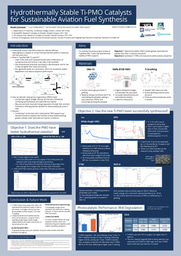
Dispersing titanium onto a mesoporous silica support addresses the aggregation and recovery problems, but plain silica is electronically inert and degrades quickly in response to high heat and humidity. My Laidlaw project investigates whether building an organic, benzene-bridged wall directly into the silica framework (a periodic mesoporous organosilica, or PMO) can enhance charge separation, as well as offer a water-resistant support to improve the longevity of the photocatalyst. Alongside the Ti-PMO synthesis, the hydrothermal stability of the PMO itself will be tested using in-situ XRD techniques.