Project Outline: Computational Analysis of Codon Optimized Transgenes for STXBP1 Encephalopathy
STXBP1 encephalopathy is a rare paediatric neurological disorder characterised by early-onset epilepsy, developmental delay, and movement disorders such as ataxia and dystonia. It affects approximately 1 in 26,000–30,000 live births worldwide. Biologically, the STXBP1 gene encodes the MUNC-18 protein, a syntaxin binidng protein involved in presynaptic vesicular fusion and priming. However, gene therapy has the potential to treat this condition by delivering a functional copy of the STXBP1 gene into a patient's cells.
A key step in developing such therapies is codon optimisation of the payload of interest, in which synonymous codons are substituted to improve gene and by extension, protein expression. While the amino acid sequence is functionally the same, codon optimisation may create unintentional cryptic splice sites. These sites may be recognised by the spliceosome, leading to aberrant RNA splicing and reducing or abolishing production of the intended therapeutic protein (in this case the MUNC-18 protein).
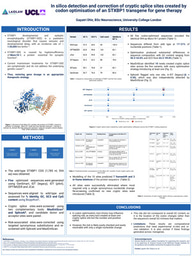
This project aims to develop an in silico computational workflow to identify and minimise this risk. First, multiple codon-optimised versions of the STXBP1 coding sequence will be generated using different optimisation algorithms and compared for sequence characteristics such as GC content and CpG frequency. Computational splice prediction tools, including SpliceAI and MaxEntScan, will then be used to identify potential cryptic splice donor and acceptor sites introduced by codon optimisation. High-confidence splice sites will be analysed to predict their effects on the resulting mRNA and MUNC-18 protein, including frameshifts, premature stop codons and loss of functional protein domains. Finally, synonymous codon substitutions will be introduced to remove these high-risk cryptic splice sites without changing the encoded protein. The modified sequences will then be re-analysed with the above-mentioned computational models to confirm that the splicing risk has been reduced. Overall, this workflow will also compare different codon optimisation methods to identify those that produce the safest therapeutic transgene designs for future use in other disease models.