Project Outline: Clinical Acceptability of Standardized Language Tests for Children Who Speak Cantonese
Introduction

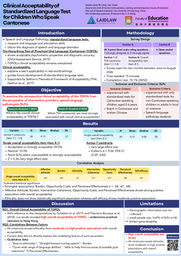
Standardized language tests are clinical tools in Hong Kong that measure oral language proficiency and articulation skills, and inform the diagnosis of speech and language disorders in Cantonese-speaking children. These tests are supported by robust normative data and show strong psychometric properties, yet their clinical acceptability among speech-language pathologists (SLPs), the primary test administrators, remains unexplored. Sekhon et al. (2017) propose the Theoretical Framework of Acceptability (TFA), which guides the assessment of the clinical acceptability of healthcare interventions.
Research

Using the TFA, this research project aims to investigate the retrospective clinical acceptability of one of the standardized language tests for Cantonese-speaking pre-school children from the perspectives of SLPs as intervention providers. Retrospective clinical acceptability focuses on authentic, lived experience rather than anticipated emotions. These outcomes guide future development of standardized language tests.
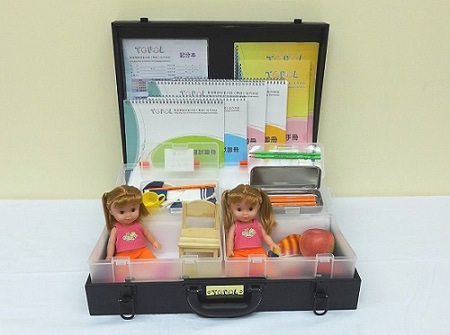
Since this study is part of a large project investigating the clinical acceptability of the three standardized language tests, our research focuses only on the clinical acceptability of the Hong Kong Test of Preschool Oral Language (Cantonese) (TOPOL; Child Assessment Service, 2019).
Two research questions were developed:
Research Question 1 (RQ1): What is the overall clinical acceptability of TOPOL?
Research Question 2 (RQ2): Which TFA construct(s) are most strongly associated with overall clinical acceptability?
Methodology
An online survey will be designed based on the seven constructs of the TFA. For each of three standardized tests, 28 questions required ratings and 6 questions were open-ended questions. The outcomes are intended to capture clinical acceptability and feedback from SLPs who work with Cantonese-speaking pre-school children and have experience with standardized language tests in Hong Kong.
Expected Outcomes
While TOPOL demonstrates acceptable psychometric properties and diagnostic accuracy (Child Assessment Service, 2019), it may be impractical in certain clinical settings due to its lengthy administration time (45-60 minutes) (Child Assessment Service, 2019), given that an assessment section lasts approximately 60 minutes for children in Hong Kong (Wong et al., 2023). Therefore, low clinical acceptability of the TOPOL may be expected for Affective Attitude, Burden and Self-Efficacy. In addition, most test items are delivered along with picture books. A lack of play-based assessment may be less attractive to preschool children, which may compromise Affective Attitude.