Project Outline: Between Locke and Montesquieu: Yan Jiaqi’s Political Writings in the Long 1980s and Chinese Democracy
Supervisor: Andrew J. Nathan, Class of 1919 Professor of Political Science at Columbia University
Introduction
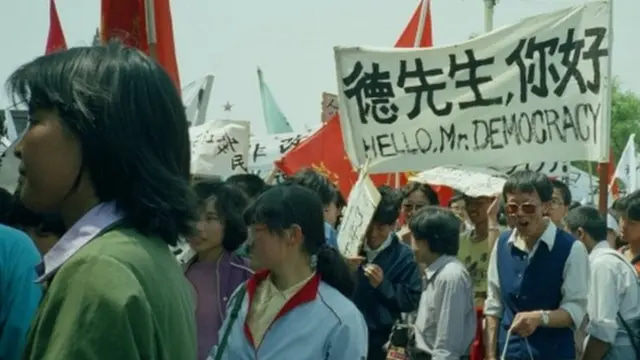
My research studies how China’s leading political scientist Yan Jiaqi theorized about democracy in the long 1980s (1978-1992), a decade of unprecedented intellectual openness in which scholars called for democratizing China, while party elites introduced piecemeal political reforms. As one of the most prolific yet overlooked democratic intellectuals in the 1980s, Yan’s works on democracy offer unique insights into China’s potential for democratization.
Background
I compare core elements of Yan’s democratic theory, specifically his treatment of minority rights and division of power, with that of key European democratic theorists such as Rousseau, Montesquieu, and Locke to understand the particularities of Chinese theories of democracy.
As such, I also address gaps in existing scholarship. To start with, Yan is rarely studied despite his preeminence. Those who did study Yan, such as Goldman, Bachman, and Mok, made decisively contributions; yet, their analyses were often oversimplistic as they compared Yan to a monolithic, unspecified “West.” This approach is not only guilty of Orientalism, but also obscures Yan’s agency in creatively reconstructing the works of Locke and Montesquieu. To augment previous research, my project does not compare Yan’s works to a generalized “West” but maps out cross-temporal conversations between individual interlocutors.
Research Questions
- How did Yan reconstruct and interpret the works of Western theorists such as Locke and Montesquieu? What did he emphasize or omit?
- What factors accounted for his under-representation of rights on one hand and his outsized fascination with the system of checks and balances on the other hand?
- How did Yan's democratic theory change before and after Tiananmen?
Objectives
- Compare Yan's theory of democracy to his Western interlocutors like Locke, Montesquieu, and Rousseau
- Investigate why Yan thinks the way he does by tracing the influence of China’s political realities, Marxism, and traditional Chinese political thought
- Probe how Yan's theory of democracy changed and developed in response to major Chinese political events
Methodology
To tackle these questions, I’ll conduct a literature review of both primary and secondary sources via Starr East Asian Library’s extensive collection. I seek to close-read the works of Yan and his intellectual influences to analyze similarities and differences. Meanwhile, I’ll review secondary sources to build on previous research about Chinese political theory.
Implications
Researching Yan’s democratic ideas has important implications for democratic theory and international politics. In terms of political theory, studying Yan offers a glimpse into the long-standing debate on the cross-cultural validity of democracy. Yan’s theory reveals that democracy is not exclusively Western, nor is it something autocrats can claim for themselves. Furthermore, concerning international politics, whether China remains autocratic or becomes democratic will fundamentally reshape the international order. On both these levels, it’s necessary to wrestle with the complex legacies of China’s 1980s, the decade of failed democratic reform, and specifically democratic theorists like Yan Jiaqi.

Hi! My name is Eleanor Cao, and I am a rising sophomore at Columbia University (Columbia College). I am interested in the intersection between political theory and intellectual history, with a special focus on modern Chinese thought and Taiwanese politics.
In my first summer as a Laidlaw scholar, I will be probing Chinese political scientist Yan Jiaqi's theory of democracy in the long 1980s (1978-1992).
Please chat with me about art & literature, cats, corvids, crochet, figure skating, and more!!
Please sign in
If you are a registered user on Laidlaw Scholars Network, please sign in