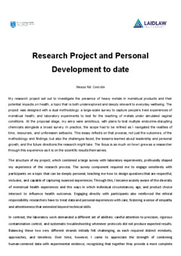
When I began the Laidlaw Programme, I had a fairly clear idea of what I thought a successful researcher and leader should look like. I associated leadership with confidence, control and the ability to take responsibility when things become difficult. I also placed enormous pressure on myself to produce work that would have an obvious and significant impact. Looking back, one of the most valuable outcomes of the Scholarship has been realising how incomplete this understanding was.
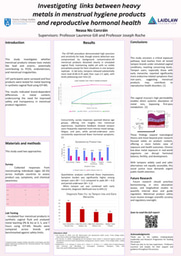
Through my research into heavy metals in period products and my leadership experience in Marseille, I have developed a much more nuanced understanding of what it means to lead. My research project began with an ambitious question: what is the potential impact of heavy metals in menstrual products? I designed a mixed-method project combining a large-scale survey with laboratory experiments examining metal leaching under synthetic vaginal conditions. I initially wanted to investigate a broad range of endocrine-disrupting chemicals across multiple products. However, the reality of experimental research quickly challenged my plans. Laboratory work was more technically demanding and time-consuming than I anticipated, and logistical problems, contamination issues and communication difficulties repeatedly disrupted my progress.
Initially, I saw these setbacks as failures. I felt that changing the project meant that I had not achieved what I had originally set out to do. However, I eventually realised that good research is not about rigidly following an original plan. It requires the curiosity to ask what the evidence is actually telling you, the courage to change direction, and the commitment to continue when progress is difficult.
I ultimately narrowed the scope of the project and placed greater emphasis on the survey component, while continuing the laboratory work where possible. This allowed me to develop much deeper skills in survey design, statistical analysis and interpretation. The experience taught me that ambition is valuable, but ambition without realistic planning can become counterproductive. I learned to distinguish between changing a project because I had failed and changing it because adaptation was the most responsible way to produce meaningful work.
The laboratory challenges also allowed me to become more independent. I had to advocate for my experiments, communicate with busy laboratory staff and persist when resources or support were difficult to access. At times, I struggled with confidence and found it difficult to stand up for my work. These experiences were uncomfortable, but they ultimately strengthened my resilience. I learned that courage is not necessarily feeling confident; sometimes it is continuing to act despite uncertainty or self-doubt.
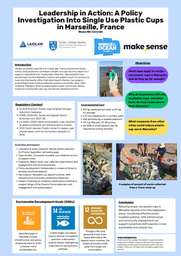
My experience in Marseille challenged my understanding of leadership in a different way. I arrived determined to make a transformative contribution to the problem of marine plastic pollution. I wanted our project to produce a solution significant enough to justify the scale of the problem. However, the more time I spent researching and engaging with the local community, the more I realised how unrealistic this expectation was.
Participating in beach clean-ups with Wings of the Ocean was particularly important. Removing a small amount of waste from a beach could feel insignificant when compared with the scale of plastic entering the Mediterranean. Yet these experiences showed me that meaningful environmental change rarely comes from one revolutionary intervention. Instead, it is built through many smaller and sustained contributions.
This changed how I thought about commitment. Commitment does not mean taking responsibility for solving an entire problem. It means recognising what contribution you can realistically make and doing it well. For our project, that meant producing a robust policy resource that Wings of the Ocean could use for advocacy and that future students could build upon. I learned that letting go of the need to "save the world" did not make my contribution less meaningful. In fact, it made it more achievable and sustainable.
Marseille also developed my global mindset. I arrived with strong assumptions about environmental protection and initially viewed reducing single-use plastics primarily through an environmental lens. However, observing cafés, bars and tourist areas showed me that disposable cups were connected to much broader social and economic realities. Businesses had to consider seasonal tourism, customer turnover, storage space and financial pressures.
This forced me to question my assumptions. I learned that a solution that appears obvious from one perspective may not be practical or appropriate in another context. Developing a global mindset therefore meant more than simply experiencing life in another country. It meant learning to listen before making judgements and understanding an issue through the experiences of the people directly affected by it.
This lesson also changed my understanding of ethical leadership. I previously thought that the strongest environmental recommendation would necessarily be the most ambitious one. Instead, I learned that responsible leadership requires balancing ambition with practicality, affordability and community acceptance. Our recommendations therefore focused on achievable interventions, including reusable cup schemes, awareness campaigns and improved refill infrastructure.
Perhaps the biggest change across both projects has been my understanding of collaboration. In Marseille, I initially tried to take responsibility for organising tasks, structuring the report and ensuring deadlines were met. While these skills were useful, I eventually recognised that leadership is not about personally controlling every aspect of a project. It is about creating the conditions for a group to succeed.
Similarly, my research taught me that I cannot control every variable. Experiments fail, timelines change and unexpected problems arise. Trying to eliminate uncertainty only created unnecessary pressure. I have become much more comfortable acknowledging that I will not always have the answer.
This has also changed how I view imperfection. I am naturally self-critical, and throughout both experiences I often measured myself against unrealistic expectations. I now understand that mistakes, uncertainty and redirection are not evidence that I am incapable, they are an inherent part of learning. I learned that I am more resilient that I previously gave myself credit for. I restructured my understanding of resilience, realising it is is not unwavering confidence, but instead the willingness to continue contributing when the outcome is uncertain.
Looking forward, I want to carry this understanding into future research and leadership. I still want to be ambitious, but I want that ambition to be grounded in realistic planning. I want to remain curious enough to challenge my assumptions, courageous enough to advocate for my ideas and acknowledge when I am wrong, and committed enough to continue when progress is slow.
The most important lesson I take from this programme is that leadership is not about solving problems alone. It is about listening, adapting and making thoughtful contributions to something larger than yourself. I began the programme believing that impact required doing something transformative. I now understand that lasting change is often built through many smaller, evidence-based contributions. I no longer feel responsible for saving the world alone. Instead, I recognise that lasting change depends on many people making thoughtful, evidence-based contributions over time. That is the kind of leader I hope to become.

Hi! My name is Neasa Nic Corcráin and I’m an Environmental Science and Engineering student at Trinity College Dublin.
My research project is titled “Investigating the link between heavy metals in menstrual hygiene products and hormonal reproductive health"
This research aims to explore how heavy metals commonly found in menstrual products, like lead and arsenic, may impact hormonal health in the short term. I’ll be testing a range of products in collaboration with an analytical laboratory, running a survey to assess self-reported hormonal symptoms, and analysing the data to understand potential risks. I’m also interested in how aware consumers are of these risks and hope the project will help advocate for safer product formulations, clearer labelling, and stronger regulations.
I look forward to meeting other members of the Laidlaw community, feel free to contact me!