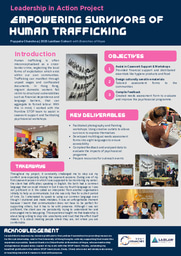
When I began my leadership project at Branches of Hope, I thought leadership meant having answers. Working with the STOP team at Branches of Hope, it taught me that leadership is about listening first and empowering others to lead. Looking back through the 3C framework and Laidlaw Values, I can see how this project shaped my understanding of what it means to lead ethically and act as a global citizen.
Leadership as Inclusion, Not Expertise
My leadership project challenged me to rethink what ethical leadership looks like in practice. Rather than positioning ourselves as experts delivering top-down solutions, we invited community members to take ownership of our workshops and outreach initiatives. Placing the community at the forefront honoured their capacity to shape their own well-being, increased their personal competence, and helped individuals achieve a sense of mastery over their own lives. Instead of assuming their story, we need to listen to them to gain a deeper understanding of systemic barriers, which allows us to create conditions for others to find their own dignity. Ethical leadership, I learned, is not about what I can do for others—it is about creating space for others to lead. This shift from "doing for the community" to "empowering the community" is the concrete embodiment of character growth: my leadership is no longer defined by what I can do, but by what I can enable others to do.
Collaboration Across Different Cultures
I worked with a diverse team from different corners of the world, including the Philippines and Australia. Each person brought distinct expertise and cultural lenses. Beyond discussing our respective cultures, I noticed how differently everyone approached problems, in which one member prioritised structural efficiency, while another would ideate beyond established ways to better support our clients' needs. When we encountered challenges, it was a combination of these ideas that helped us resolve setbacks and guide us forward. This experience helped me embrace disagreement as an opportunity for a more nuanced understanding of a topic. True collaboration requires the courage to challenge your own perspectives and the humility to recognise that your perspective is not the only way of seeing the world. That is a leadership capacity I will carry forward: the ability to hold difference without needing to resolve it into sameness.
Learning from Laidlaw Values
As the Annual Laidlaw Conference stressed last year, bravery is not the absence of fear but choosing to proceed even in conjunction with those fears. My leadership project tested this value in a quieter way than my research placement did. It asked me to show up consistently by listening to ask curious question of others stories, to work across cultural differences, and to trust that small steps could contribute to meaningful change.
As I complete my leadership project, I hope to carry these values into my personal and professional life. I want to approach problems with a learner's humility instead of expertise, and to stay as compassionate and open-minded as possible to perspectives that do not align with my own, even when it is difficult. I will continue serving my community, however small the steps, because I now know that meaningful change comes from starting with the courage to show up and commit to listening to others.
The 3C framework reminds me that values without character become empty talk and directionless. My leadership project taught me that these three dimensions are intertwined: the character to include others, the capacity to collaborate across differences.