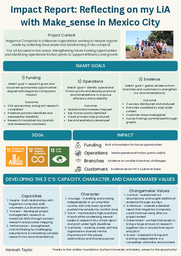
Five weeks ago, I arrived in Mexico City having joined the Make_sense Re_action for Impact programme a week late and knowing very little about what to expect. I left with a completed project for Hagamos Compsota, a much better understanding of working with a real organisation, and maybe most importantly, a new sense of independence and confidence. Looking back, the experience has been so much more than simply completing a project. It has challenged me professionally, personally and culturally and has given me a much clearer understanding of how I approach unfamiliar situations, work with others and solve complex problems.
Our project with Hagamos Composta focused on two main areas: supporting the organisation’s future funding, mainly through grants and corporate sponsorships, and identifying ways to improve its internal operations. When we began, there were many different directions we could have taken. We knew Hagamos Composta was doing important work tackling organic waste, but we needed to understand how the organisation actually operated before deciding where we could add value.
This became one of the biggest lessons of the project. We initially approached the organisation with a business-focused mindset, thinking about how we could improve efficiency and support growth. However, as we spent more time with the team and volunteers, we realised that any recommendations we made also needed to reflect Hagamos Composta’s values, resources and community. This required curiosity, one of the Laidlaw values that became particularly important throughout the project. Rather than assuming that we knew what the organisation needed, we continually asked questions and challenged our own assumptions.
One example of this was our customer and branch research. After several weeks working with Hagamos Composta, we realised that there were still important gaps in our understanding of its customer base and the different circumstances of its branches. We therefore distributed two surveys: one to branches to understand their size, operating environment and local context, and another through social media to understand the organisation’s customers. The responses challenged some of our assumptions. For example, respondents to the social media survey were all based in Mexico, suggesting that Hagamos Composta’s social media presence was reaching a more domestic audience than we had initially thought. The branch responses also showed that many locations collected fewer than 200 buckets a week, highlighting a large group of smaller branches facing similar challenges.
This experienced reinforced the importance of judgement from the Oxford Character Project virtues. Good recommendations cannot simply be based on what appears logical from the outside; they need to be informed by evidence and adapted to the people and organisation they are intended to support. Realising this relatively late in the project was an important learning experience. It showed me that being willing to recognise a gap in your knowledge and change your approach is just as important as having a good initial idea.
One of the areas of the project I am most proud of was the operational friction-point mapping. We identified a range of bottlenecks across Hagamos Composta’s operations, including communication breakdowns, limitations around collection and infrastructure, challenges associated with scaling and differences between branches. I then developed a visual process map to show where these friction points occurred and how they affected different parts of the organisation.
What began as a relatively broad problem became much easier to understand once we could visualise it. This was a valuable lesson in critical thinking and problem solving, but also in ambition. Rather than simply describing the problems we had found, we wanted to create something that Hagamos Composta could actually use after our project had finished.
The same applied to our funding work. I research corporate sponsorship opportunities and completed our CSR sponsorship document in Spanish, before asking our volunteers to review it. This was particularly useful because it allowed us to combine our own research with the knowledge of people who understood the Mexican context much better than we did.
The final stage of the project required a different skillset. We had accumulated a huge amount of information across our research, surveys, discussions and analysis, but our final report and pitch needed to be clear and concise. I found this process surprisingly challenging. One of my biggest achievements was helping to condense the content we had gathered over several weeks into the most important findings and recommendations. Presenting the final pitch to Hagamos Composta was therefore a particularly rewarding moment. The Hagamos Composta team were very positive about the final deliverables, saying that they would review the report in more detail and that it would be very useful to them in the long term.
This demonstrated determination, another Laidlaw value that became increasingly important as the project progressed. Producing the final report involved a significant amount of work in the last few days, and maintaining the quality of our recommendations while working towards a deadline required everyone to take responsibility for their contribution.
The project also changed my understanding of collaboration. At university, group work often involves dividing a task into separate sections and bringing them together at the end. This project felt very different: we were constantly discussing ideas, challenging each other’s assumptions and adapting our work based on conversations with Hagamos Composta and our volunteers.
The relationship we developed with the Hagamos Composta community was one of my favourite parts of the project. Visiting the composting site made this particularly clear. Seeing food waste arrive and be transformed into compost was interesting, but what stood out most was the people behind the process. The team were incredible committed and worked closely together towards a shared purpose. This made me realise that the success of an organisation is not just about its processes or finances, but also about the people and relationship that hold it together.
This links closely to the Oxford Character Project virtue of service. Our purpose was not simply to produce an impressive report but trying to create something that would be useful to an organisation doing important environmental work. This changed the way I thought about our recommendations. We had to ask not only if it was a good idea but also consider whether the idea was realistic for Hagamos Composta and whether it could actually help them. That distinction made the project feel much more meaningful.
While the project was a major part of my development, the experience outside of work was equally important. This was my first time travelling outside by myself and I arrived in Mexico with only basic Spanish. I had also joined the cohort a week late, meaning that everyone else had already met and started the projects when I arrive.
Initially, I was really out of my comfort zone but I quickly learnt that I was capable of adapting to unfamiliar situations. I navigated a completely new city, worked with people I had never met before and became comfortable communicating despite the language barrier. Over the five weeks, I became much more confident being independent and putting myself into situations where I did not necessarily know what to expect.
Living in Mexico City also gave me the opportunity to experience a culture very different from my own. From exploring the historic centre and archaeological sites to visiting local markets, travelling through different parts of the city by cable car, watching lucha libre and football, and simply spending evenings talking with the other scholars, I saw so many different sides of the city. One experience that particularly stayed with me was travelling by cable car from Xalpa to Santa Marta. Seeing areas that were so different from the neighbourhoods we usually spent time in gave me a much broader perspective of the city and the variety of experiences within it.
Spending time at Parque Las Estacas also reminded me of the environmental values underlying our project. Swimming through the natural springs and seeing such a beautiful environment first-hand reinforced the importance of protecting the natural world. It made the work Hagamos Composta is doing feel even more relevant as environmental sustainability became not solely an abstract issue but something that affects the places and communities around us.
One of the biggest surprises of the programme was how quickly the scholar group became such an important part of my experience. Living and working together meant spending lots of time with people with very different personalities, backgrounds and ways of working. I learnt to be comfortable with that variety and to appreciate the different perspectives that everyone brought to the group.
Some of my favourite memories have nothing to do with the project: late night conversations and games on the rooftop at Triver, spontaneous trips to Puebla and Cholula, our afternoon in Xochimilco, exploring markets, watching the World Cup, celebrating birthdays, karaoke, football at the Azteca and countless meals together. These experiences taught me so much about humanity and collaboration that can’t be taught through lessons and workshops.
I genuinely feel that I have made friends for life through this programme and those people are what I have already missed most about Mexico City. I will also miss the spontaneity of our time there through making plans at the last minute, discovering amazing new places and of course, the food.
If I had to identify the biggest changes in myself over the five weeks, they would be confidence, independence and adaptability. I am proud that I pushed myself to travel somewhere completely unfamiliar on my own, despite having very little Spanish and no previous experience of travelling independently.
Professionally, I leave with a much better understanding of how to approach an ambiguous problem. I have learnt that good problem-solving starts with curiosity, that recommendations need to be contextually based, that collaboration improves ideas and that judgement is required to balance ambition with practicality. These are lessons I will take into my degree, future projects and careers.
I leave Mexico City feeling proud of the work we produced for Hagamos Composta, grateful for everything I have learnt and definitely sad to leave the people and city that became such a big part of my life so quickly. Re_action for Impact has challenged me to be more curious, ambitious, determined and brace, while teaching me the importance of collaboration, judgement, service and humanity. Most importantly, it has shown me that stepping outside your comfort zone can lead to experiences that you could never have planned for yourself.
I hope that the work we produced continues to be useful to Hagamos Composta long after we have left Mexico, but I know that the lessons and relationships I have gained from these five weeks will stay with me for so much longer!!
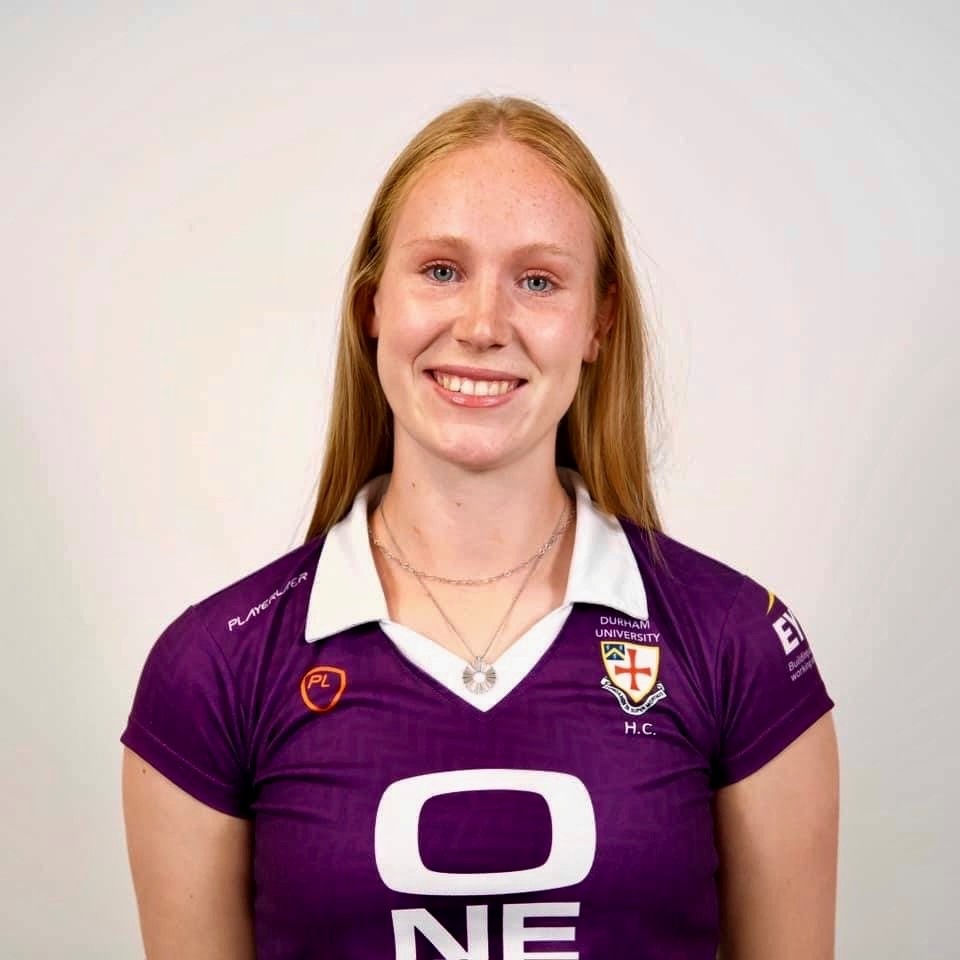
Hello! I'm Hannah, a second-year Geography student at Durham University.
I am delighted to have been accepted on to the Laidlaw Leadership and Research Programme as part of the 2025 cohort. My research last summer focussed on weight discrimination and weight discrimination training among fitness professionals. The project evaluated the nature and extent of weight discrimination within the UK fitness industry, with a specific focus on fitness professionals' roles in perpetuating or challenging such biases. Through both playing and coaching sports in deprived inner-city areas, I have directly experienced the physical, mental and social benefits of sports and fitness on individuals and communities so am passionate about reducing the barriers that prevent individuals from engaging in fitness environments. Furthermore, I have witnessed the negative impact of weight discrimination on young athletes, which motivates my interest in potentially creating a successful weight discrimination training programme for fitness professionals. This summer I am really excited to go to Mexico City with Makesense for my Leadership in Action project.
Outside of Laidlaw, I am part of Durham University Hockey and Netball Clubs and Collingwood College Boat Club. I also love to play the Piano and Cello, as well as being involved in Durham University Concert Band on the Oboe.