Mapping the End-of-Life: do actors delivering euthanasia and assisted suicide in Benelux interact?
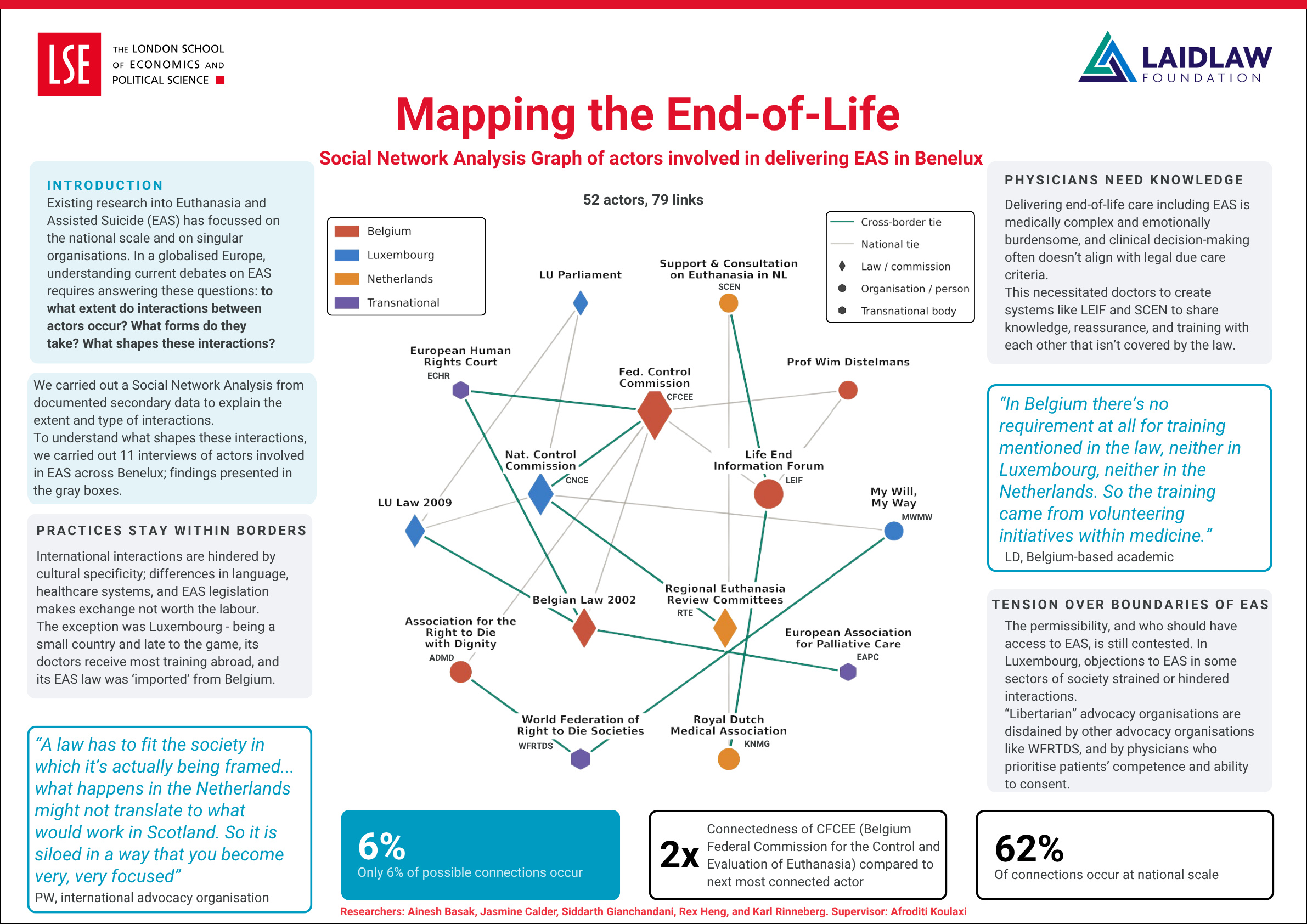
This summer, 5 of us tried to answer these questions: to what extent do interactions occur between actors involved in campaigning for, regulating, or delivering EAS in Benelux? What is the nature of these interactions, and what factors shape them?
We took a mixed-method approach, using social network analysis to get the macro-perspective by identifying all possible documented interactions between actors. We then used interviews with key actors including physicians, academics, and legislators across all 3 countries, to identify the factors shaping which interactions occurred, and why.
What did we find? Read our poster to find out!
In short:
- There are connections between actors, but only 5.9% of possible connections between the 52 actors we identified took place.
- 2/3rds of connections occurred within rather than between nations, though there was some transfer of knowledge and legislation
- Significant differences in healtchare systems, language, and culture made international collaborations less feasible, especially for Belgium and the Netherlands, but less so for Luxembourg
- However, across the network there were frequent ionformal exchanges of support and trainThing between physicians, necessitated by the complexity of delivering EAS - medically, legally, and morally.
- Though questions around who should have access to EAS are contested in all 3 countries, and this shapes how actors perceived one other, only some people felt that this strained interactions, and this was primarily in Luxembourg, where there is a degree of stigma around EAS as a whole

Hi everyone, I'm Jasmine, and I'm studying BA Geography at LSE. I'd like to consider myself as an at least partially competent social scientist, but my particular interests are in modern history, gender, and urban studies. I'll happily waffle on about any of those things, and I'm always excited to meet people with shared interests. Outside of academics, I enjoy ballet, marvel, disney music and playing with my dog.
I wanted to become a Laidlaw scholar because I enjoy doing research, and I wanted to see if I could take my burgeoning skills outside of university to make a difference (an utter cliché, I know). I'm hoping to do that this summer with my LiA working for Variety, a UK-based charity that looks to support children with disabilities from disadvantaged backgrounds. I will be running a research project investigating where there are gaps in the capacity of these children to access assistive technology, and what we can do about it. If you're interested, if you have any ideas or knowledge, send me a message or an email!