LiA: Week Two Reflection
This week was eventful, insightful, and thought-provoking.
Bridging Borders and Building Solutions: My Second Week in Mexico City
The transition from academic theory to ground level impact is rarely a linear path. As I wrap up my second week here in Mexico City as part of the Laidlaw Scholars program, I find myself reflecting on the unique blend of exhilaration, logistical hurdles, and profound cultural immersion that defines this experience. What started as a whirlwind arrival has, over the last seven days, transformed into a focused, deliberate mission. We are no longer just visitors navigating the vibrant streets of CDMX; we are active participants in an ecosystem of social innovation.
Settling into the Rhythm of the Capital
By the beginning of this second week, the initial haze of traveler fatigue had finally lifted, replaced by a genuine sense of settling into the local rhythm. Mexico City is a sprawling, sensory rich metropolis that demands your full attention. Navigating the metrobús and learning the intricate layout of our local neighborhood has become second nature. There is a specific comfort in recognizing the morning vendors, understanding the flow of the afternoon traffic, and finding the quiet corners of the city to decompress after a day of intensive fieldwork.
Settling in, however, is about more than just logistics, it is about psychological alignment. I have found that my brain has finally switched into immersion mode. During my first week, I was perpetually exhausted by the effort of processing constant stimuli. Now, the background hum of the city feels less like noise and more like a soundtrack to our work. This stability has been vital, as it has provided the mental bandwidth required to dive deeper into the complexities of the projects we are tasked with delivering.
Navigating Communication and Team Dynamics
No international project of this scale is without its frictions, and our second week was, in many ways, defined by the challenge of managing expectations with our partner charity and NGO stakeholders.
To be candid, our initial communication was not the smoothest. We encountered early barriers involving misalignment on project timelines and specific deliverables. There were moments of frustration where it felt like we were pulling in one direction while our partners were looking toward a different horizon. The ambiguity regarding expectations led to a few long, contemplative team meetings where we had to recalibrate our approach.
We learned quickly that in the NGO sector, communication is as much about cultural nuance as it is about explicit language. It is not just about sending an email; it is about understanding the internal pressures, resource constraints, and operational speeds of the organizations we are supporting. After a series of frank, professional dialogues with our counterparts, the fog has lifted. We feel a little more clear now. We have established more frequent check ins and clearer documentation of responsibilities, which has significantly lowered the collective blood pressure of the team. This process has been a masterclass in diplomacy and project management, skills that no lecture hall could ever truly replicate.
Designing Solutions with Makesense
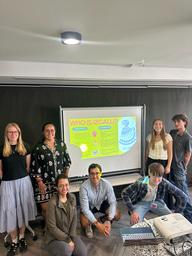
A major highlight of this week was our engagement with Makesense. Their approach to social entrepreneurship is refreshing, challenging the traditional top down methods of problem solving. We participated in several insight days centered entirely on Design Thinking, and the impact was immediate.
Design Thinking is often discussed in abstract terms, but seeing it applied to the real world issues of CDMX was transformative. The methodology forced us to empathize deeply with the end users of our projects, moving away from our own assumptions and toward the lived realities of the people we are trying to serve. We spent hours mapping out user journeys and iterating on potential solutions that are not just theoretically sound, but locally viable.
The Makesense philosophy, which prioritizes collective intelligence and human centered design, has fundamentally changed how we view our project milestones. It has empowered us to pivot when a solution feels forced and to double down when we hit a genuine insight. It is not just about finishing the work; it is about ensuring that the work is resonant and sustainable.
The Power of Local Insight
One of the most rewarding aspects of this week was meeting with our team of volunteers. We were joined by two local volunteers, both of whom brought an entirely new dimension to our project: one with a deep background in IT and the other in administration.
Their presence was a turning point. We had been looking at our objectives through a specific, perhaps narrow, academic lens, but our new teammates immediately highlighted the technical and bureaucratic bottlenecks that we had overlooked. Their practical knowledge of how to navigate local systems, and their ability to troubleshoot technical hurdles on the fly, has been invaluable. It was a humbling reminder that regardless of how much research we do, local expertise is the heartbeat of any successful intervention. Seeing the project through their eyes has made the work feel significantly more grounded and achievable.
The Immersion Effect
On a personal level, I am particularly proud of my progress with Spanish. While I arrived with a functional grasp of the language, there is a massive gulf between classroom Spanish and Mexico City Spanish.
The sheer necessity of constant immersion has forced me to push through the barrier of feeling self conscious. Whether I am haggling over project details in a meeting, navigating a complex administrative task, or simply grabbing coffee and chatting with the locals, the language is no longer just a subject I study, it is a tool I use to exist. My vocabulary has expanded rapidly, specifically regarding the professional terminology related to our NGO work. While I am still far from fluent, the ability to express complex thoughts and build rapport without relying on a translator has been one of the most fulfilling milestones of the trip so far.
Building the Network
The program is finally feeling complete. This week, we greeted two more scholars to the cohort, bringing our group to its full capacity. The dynamic has shifted instantly; having the full team present has re energized our discussions and allowed us to distribute our workloads more effectively. There is a palpable sense of momentum now that we are all under one roof, sharing our findings from different project streams and supporting one another through the challenges of life abroad.
Looking Ahead: Foodie Friday and Las Sabinas
As we close out the week, we have plenty to look forward to. This Friday, we are participating in Foodie Friday, an initiative organized by Makesense. It is a wonderful way to foster community, break down the professional wall, and bond over the legendary local cuisine. Given the intensity of the work, this moment of communal relaxation is highly anticipated.
Most importantly, our focus shifts toward the weekend. On Saturday, we have a scheduled meeting with Las Sabinas, a local charity that performs vital work tackling domestic and sexual violence. This is perhaps the most significant and sensitive part of our project to date. We know that the challenges they face are immense and that our role is to act as a supportive, empathetic partner. We are approaching this meeting with a great deal of humility and a deep sense of responsibility.
As I look back on this second week, the exhaustion is tempered by a sense of genuine progress. We are learning, we are adapting, and, most importantly, we are connecting. Mexico City is teaching us that social change is rarely about the grand gesture; it is about the daily grind of building relationships, listening to local voices, and iterating until the solution fits the problem. I cannot wait to see what the next week brings.
Thank you so much Keni and Aide - you are the best and have made my time in CDMX amazing.

Hi! My name is Liam Jones and I am a Laidlaw Scholar from the 25/26 cohort. I am an undergraduate student reading Modern Languages and Cultures at Durham University, St. Cuthbert's Society College. I study French, Arabic, and Persian too! I am interested in international affairs, peacekeeping, and linguistics.
During my first year, I completed a research project in French musicology throughout my 6-week research summer, which was thrilling and I managed to learn a lot about French linguistics, as well as the evolution of the French language, and music too - including competency using music software which I had never had the chance to do before.
I am from Nairobi, Kenya, but I now live in Loughborough in the UK.