It has been a good few weeks since I got back from Vancouver, and having some distance has given me the opportunity to reflect on my time there. In the moment, those six weeks felt like one continuous thing happening to me. Looking back now, I can see how much of what I learned came from the parts I had not planned for.
I spent my summer with the Translational Genetics Research Collaborative (TGRC) at BC Children's Hospital Research Institute, supervised by Dr Jehannine Austin and working throughout with my course-mate (and close friend) Anna. The core team was small and close-knit, with only six people. I had gone out braced to be the undergraduate making tea in the corner, but we were handed real deliverables in week one and ended up with two projects. The first was a decision support tool to help people considering polygenic score testing make an informed, values-based decision before they receive a result. The second was designing focus groups with adolescents affected by depression, feeding into a larger study on talking to young people about the causes of mental health conditions.
The decision support tool
I loved this project because it brought together biological and social science, which is the part of Human Sciences I find most interesting. It also felt grounded in real life as it was going to be used by actual people rather than filed somewhere. The importance of this project was made clear to me on reading a study by Peck et al. (2022), which found that over 60% of people who sought out their own polygenic risk scores reported a negative emotional reaction and around 5% scored above the threshold for potential PTSD. Only a quarter answered all the understanding questions correctly, and poorer understanding was associated with worse psychological impact. That association is what the tool acts on. Helping someone know what they are signing up for, before a result arrives that they were not ready for, felt like work worth doing on the days when I was staring at the same paragraph for the fourth time!
Two decisions feel like our most concrete contributions. The first is the section on what a polygenic score is not, which tackles the most common misreading, that a 95th percentile score means a 95% chance of developing the condition and thus equals a life-changing diagnosis (spoiler: it doesn't). The second is emphasising that scores are less reliable for people who are not of European descent. Duncan et al. (2019) found the large majority of polygenic score studies used only European-ancestry participants, and Martin et al. (2019) argue that deploying these scores clinically as they stand risks widening health disparities rather than narrowing them. That argument usually lives in methods sections, and putting it near the top of something a person reads before consenting to a test turns it from a critique of the field into information they can act on. It is also where the work meets the SDG target 3.4 on non-communicable disease and mental health, as well as SDG 10, since telling non-European users their result is less reliable is a small move towards equity at the point the decision is made.
The tool takes a ‘cautious’ approach and aims to give a balanced picture rather than strongly encouraging or discouraging testing. Given how little most scores change anyone's clinical care, we erred on the side of caution and made that judgement explicit on the page rather than leaving readers to work it out. Family planning showed what that meant in practice. The literature includes a participant who wished he had known his genetic risk for bipolar disorder before his son was born. That is a real reason people seek these scores, so it belonged in the values section. However, the evidence also suggests that a score is a poor basis for such a decision, since scores can vary substantially even between close relatives. We therefore included that motivation but immediately explained its limitations, and advised users against giving family planning much weight in their decision. In that sense, the decision aid does sometimes tell a user that one of their reasons is not a good reason. Writing it taught me that the choice is never between having a position and not having one. It is between stating that position explicitly, where a user can disagree with it, and letting it sit unmarked in the wording of everything else.
We completed the tool content and handed it over, and the team is in talks about making it into a website, which may then be used in a study assessing its clinical utility. This will likely take time to develop, but I feel proud that something we wrote may help others navigate a difficult health decision.
The focus group design
The second project asks how best to talk to young people about the causes of mental health conditions so that those conversations support empowerment and hope. Our task was to design anchor questions and probes for three of the four topic blocks, covering causal and protective factors, language that supports hope, and what adults should do with what young people tell them. Being asked to join this one was the moment the placement stopped feeling like an internship, and I felt very lucky to contribute as a source of so-called 'youth insight'.
In a meeting with our supervisor, we were posed with the question of whether a researcher should correct a participant who holds a clearly inaccurate belief about what caused their condition. The genetic counselling answer was mostly no, since what a person believes shapes how they act, and if that belief helps them identify something they can change and, in doing so, feel better, factual accuracy may matter less than what the belief enables them to do. I found it interesting that anthropology might also lead you to leave the belief alone, but because the belief is itself worth understanding. How someone explains their own illness can tell you about their lived experience and what they think has gone wrong with them. I hadn’t really thought before about how two disciplines could arrive at the same practical response while being interested in completely different things about it, and it made me more aware of what each discipline notices when listening to the same person.
We dropped a third project, an ethical analysis of polygenic embryo screening, because joining the focus group study part-way through changed what was achievable in six weeks. Putting those hours into the tool was right, but it was a preference as well as a judgement. Asked at the start which project to keep, I would probably have chosen the theoretical one, since that is the kind of work I am used to and assumed I preferred. Doing the applied project is what changed my mind. Watching the tool turn into something a person could sit down and use made it much harder to argue for the paper.
Crutches, rest and working with Anna
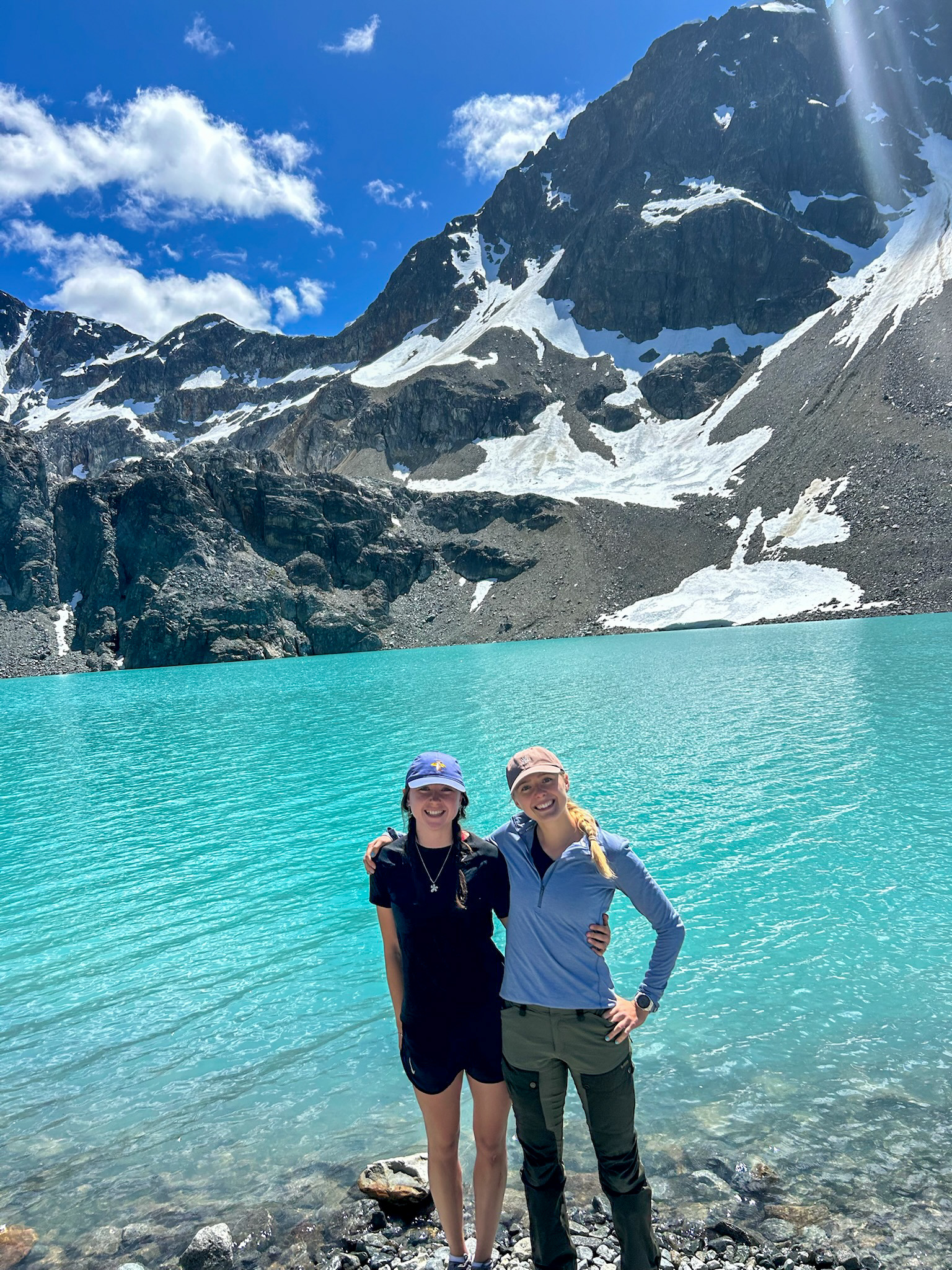
Three of my six weeks were on crutches, after a (rather large) rock came down on a hike in the mountains and broke my ankle. We stepped away from the tool for a while and came back with fresh eyes, and only then saw that whole sections were repetitive and confusing, so we rewrote a great deal of it. Our supervisors told us they were impressed, which was startling given how few hours we had actually put in. I had been treating rest as something earned by hours worked, when here it was a condition of the work being any good. The team made that possible, and it is a big part of their work culture. I had read about it in their team culture statement before starting but didn’t really believe it until I experienced it. Every Wednesday, everyone goes through their progress and talks about what has personally been difficult. they then work out together how to help, closing with each person naming one thing they are proud of or one thing they did that week for their own wellbeing. It is a small ritual that does a lot of quiet work, since it keeps everyone aware of what everyone else is carrying, and I think that awareness is where the trust comes from rather than the other way around. I had not seen that modelled before and will be looking for it everywhere now.
Working with Anna was the other thing that made it work. We split tasks along whatever each of us was better at, almost without discussing it, because a year of sharing a wall and every class means you already know how the other one thinks. That said, I don’t think we are really built for office jobs, or a 9-5 for that matter. We somehow hacked the system and found a way to both have fun AND still get the work done. Outside yoga at lunchtime is a definite non-negotiable from now on. On the days we did go into the office, it was also quite entertaining looking over to intermittently find Anna reading her laptop upside down in a handstand. Or for that matter doing handstands basically whenever the opportunity arose in general. There was truly never a dull moment.
Final thoughts
I arrived with a fair amount of uncertainty about what our work would involve, very aware of being an undergraduate among clinicians and researchers, and the most useful surprise was finding that Human Sciences was directly applicable. Patient-facing genetics material asks you to keep the biology and the social context in view at once, which is more or less what the degree trains you to do, and I had not expected my undergraduate work to be so immediately usable.
The rest of what I learned came less tidily. Breaking my ankle three weeks in meant learning to be looked after and adapting to a different pace, and I was slightly overwhelmed by the kindness of near strangers. One hiker I barely knew drove out to collect us from the emergency clinic in the middle of the night (a four-hour round trip!) and another turned up at my door with flowers and a very thoughtful 'British care package'. I also discovered that there is always a guitar in a mountain hut (epic), that the entire beach applauds the sunset (a tradition I will be starting at home), and that I am not remotely good at sitting still (this I probably knew already but can usually hide it better). I went out intending to make the most of it and, maybe in a slightly different way to the one I had pictured, I think we did.
Enormous thanks to J9 and the whole TGRC team for the time, trust and genuine care they gave us, for treating us as part of the team from week one, and for building the kind of working culture I will be measuring others against for a long time. I feel so incredibly grateful for the experiences I was able to have as a result of their kindness. Thanks to the UBC gang for carrying me down a mountain for 5 hours, and the Pemberton SAR team for the incredible (though unexpected) helicopter ride through the mountains. Thanks also to Anna, without whom the summer would have been half as productive and considerably less fun!
References
Duncan, L., Shen, H., Gelaye, B., Meijsen, J., Ressler, K., Feldman, M., Peterson, R. and Domingue, B. (2019) 'Analysis of polygenic risk score usage and performance in diverse human populations', Nature Communications, 10, 3328. doi: 10.1038/s41467-019-11112-0.
Martin, A.R., Kanai, M., Kamatani, Y., Okada, Y., Neale, B.M. and Daly, M.J. (2019) 'Clinical use of current polygenic risk scores may exacerbate health disparities', Nature Genetics, 51(4), pp. 584–591. doi: 10.1038/s41588-019-0379-x.
Peck, L., Borle, K., Folkersen, L. and Austin, J. (2022) 'Why do people seek out polygenic risk scores for complex disorders, and how do they understand and react to results?', European Journal of Human Genetics, 30(1), pp. 81–87. doi: 10.1038/s41431-021-00929-3.
I am a first year student reading Human Sciences at St Catherine's College Oxford and am a Laidlaw research scholar in association with the SDG Impact Lab for 2025