LiA: Facilitating Access to Justice in Local Communities
When I began planning my Leadership in Action project as a Laidlaw Scholar, I knew I wanted to return to a place that had already shaped how I think about law. In my first year at UCL I volunteered with the South London Refugee Association (SLRA) and discovered how meaningful legal support can be when offered with patience and humanity. I loved the community there and wanted to go back, this time with more confidence and responsibility. Alongside SLRA, I also joined UCL’s Integrated Legal Advice Clinic (iLAC) to see other areas of social welfare law. Having grown up in India, where access to justice is deeply uneven, I was drawn to settings where law meets vulnerability and where people often feel invisible in the system.
My Role and Day-to-Day Work
At SLRA I worked on the youth team, helping young refugees and asylum seekers aged about sixteen to twenty five. My work included:
-
Drafting applications for travel documents and discretionary leave to remain (DLR), ensuring evidence was complete and clearly presented.
-
Communicating with clients to collect missing documents and explaining what each form or piece of evidence was for.
-
Signposting people to English classes, training programmes and mental health support.
-
Helping young people write CVs so they could apply for jobs or training.
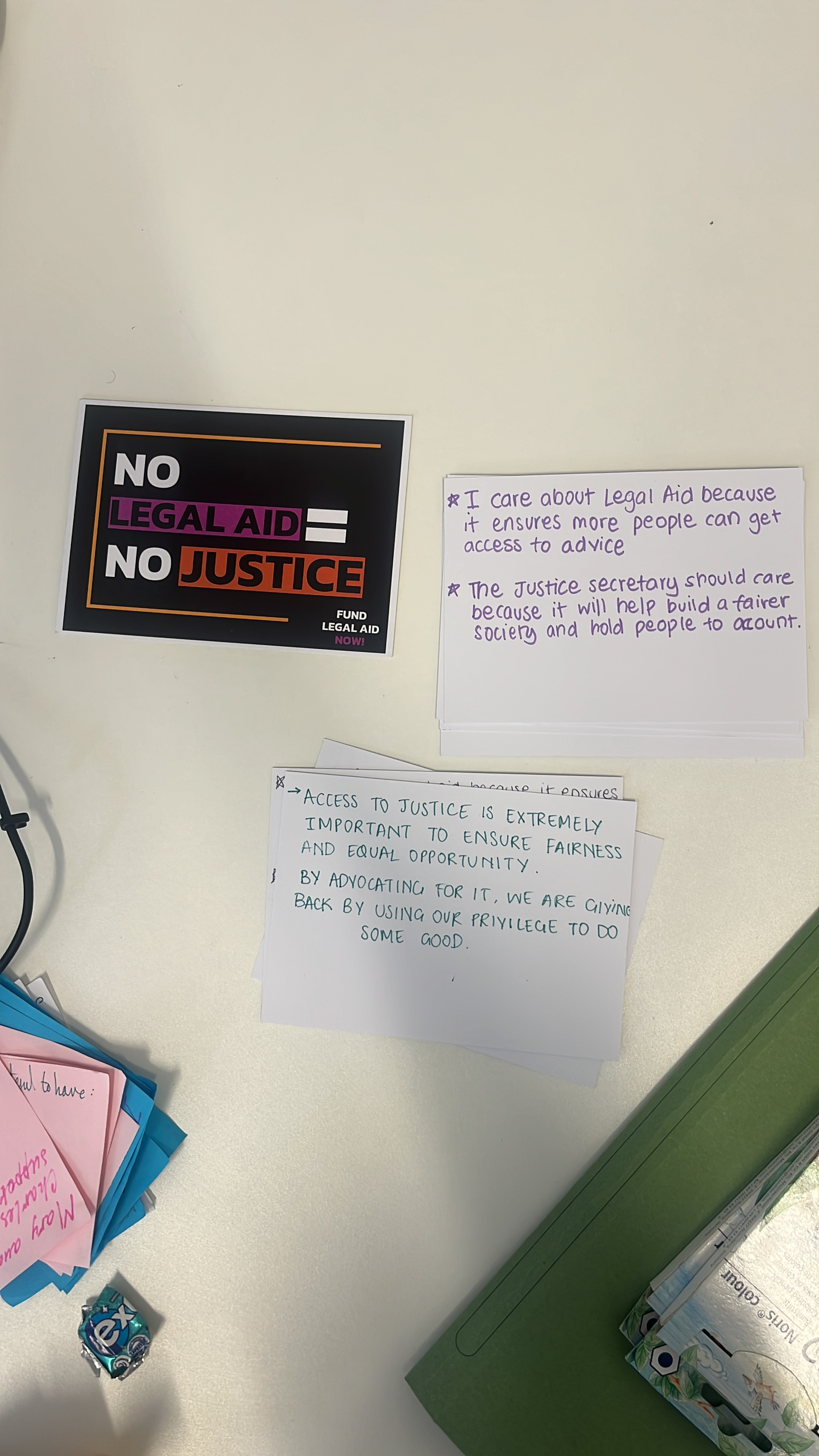
I also worked on a legal aid campaign connected to the London Legal Walk. SLRA wanted to use the event to raise awareness about the crisis in legal aid and to gather practitioner feedback for a submission to the Legal Aid Agency (LAA). My role was behind the scenes. I helped design a clearer way to present and promote the survey, prepared short messages and follow-ups for staff and volunteers who attended the walk, and afterwards I organised and coded the responses so the team could use them effectively in policy work. By making the survey more focused and by supporting those on the ground with clear talking points, I helped increase engagement and turned the event’s energy into useful policy evidence.
At iLAC I assisted with housing and welfare cases. I helped gather evidence for housing disrepair claims and supported clients completing complex forms for Universal Credit and disability benefits. This gave me a wider view of how immigration status, housing security and welfare entitlements intersect.
Leadership in Action
Although my title was volunteer, the summer taught me that leadership is often about taking initiative quietly and using your judgement when no one has asked you to step up.
One moment came when a young client’s travel document application risked missing an important deadline. The supervising solicitor was juggling many urgent matters. I reviewed the Home Office guidance, drafted a compassionate grounds escalation letter and suggested we submit it with supporting evidence. The solicitor agreed and the case was prioritised. I learned that leadership can mean noticing an issue and quietly proposing a practical solution.
I also had to adapt my communication. At first I used legal jargon because I wanted to be precise, but many clients spoke limited English or were processing trauma. Gradually I learned to use simpler language, break steps into clear actions and pause to check understanding. This shift felt small but it built trust and gave clients more control.
Challenges and Growth
The work was emotionally challenging. I heard stories of family separation, dangerous journeys and long waits for asylum decisions. At first I felt responsible for delays and bureaucratic failures. With guidance from staff I learned that caring deeply does not mean taking on guilt for what is beyond my control. Support can mean staying steady, explaining clearly and following up where possible, even when the system moves slowly.
Working in resource constrained settings was also difficult. SLRA’s lawyers managed heavy caseloads with little legal aid funding. I learned that being organised and preparing clear drafts could make a real difference by freeing their time for complex legal work.
I also grew in cultural humility and trauma awareness. I learned not to push for details when someone seemed withdrawn and to let clients set the pace of a meeting. Sometimes the most important thing was creating a space where they felt safe and respected.
Seeing both SLRA and iLAC taught me how interconnected legal problems are. An insecure immigration status can lead to homelessness or loss of welfare. Housing problems can make asylum processes harder. This systemic view changed how I think about law’s reach and its limits.
Impact
Individually, I helped move forward several applications for travel documents and driving licenses. I supported young people to create CVs that some later used to secure work or training. My supervisors said the way I prepared drafts and organised evidence helped them focus on higher level legal arguments.
On a broader level, my work on the London Legal Walk campaign meant SLRA submitted a stronger set of first hand practitioner stories to the Legal Aid Agency. These responses helped illustrate the real impact of legal aid cuts on vulnerable clients. Contributing to this kind of advocacy felt meaningful because it tackled the deeper structural issues behind many of the individual cases I saw.
Lessons on Leadership
This project changed how I understand leadership.
-
Leadership can come from the middle. You do not need a formal title to take initiative or suggest solutions.
-
Listening is a powerful form of leadership. Often the most valuable thing I did was to hear people’s stories and respect their pace.
-
How you frame an idea matters. A well explained purpose can motivate others to act.
-
Quiet efficiency creates impact. Preparing clear drafts and organising information can multiply what a small legal team can achieve.
Future Relevance
I plan to pursue a career in commercial law, with particular interest in intellectual property, competition and international arbitration. This may seem far from refugee casework, but the summer shaped how I want to practise. I want to remain socially aware, contribute meaningfully to pro bono work and understand how legal systems affect vulnerable people. The skills I developed, such as clear client communication, drafting under pressure, adapting to cultural contexts and persuading busy professionals to engage, are highly transferable to complex commercial work. Most of all, I learned that leadership is not about a title but about initiative, empathy and enabling others to succeed. I hope to bring these qualities to my future practice.
Conclusion
Returning to SLRA for my Leadership in Action project was both challenging and rewarding. It gave me a deeper understanding of access to justice, sharpened my problem solving skills and strengthened my confidence to lead quietly and effectively. Growing up in India taught me that legal systems can feel distant and unequal. This summer showed me how much difference committed individuals and well used legal knowledge can make. As I move forward into a legal career, I want to carry this awareness and the practical lessons I learned into every space I work in.