Leadership in Action Medellin Colombia Blog Post #1
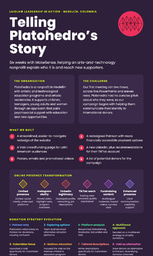
I arrived in Medellin this week to participate in the makessense_americas reaction for impact 2026 program. I met the twelve other Laidlaw scholars in the program, and the four other scholars who I would be working with at the nonprofit Platohedro. Our project’s goal is to expand the international reach of Platohedro, improve their communications, and implement a fundraising strategy campaign. This week is our immersion week, so we toured the three nonprofit organizations where we will be working. First, we toured Picacho con Futuro, which is a nonprofit organization in Communa 6 (district 6), that has a collection of programs to support women and children in the neighborhood. They attempt to improve their community’s economic conditions and to introduce them to new opportunities. We also toured Platohedro, which also has various programs to introduce art, culture, and technology to the Communa 10 community and offer them alternatives to violence. They also sponsor various artistic residencies. Finally, we toured fundacion SORA in Communa 13, another community support nonprofit. Communa 13 was once one of the most dangerous neighborhoods of the city, but now Communa 13 has a thriving tourist-centered economy. However, it still maintains an underserved population of women and children that Fundacion SORA attempts to serve through their programs.
In this first week, I was able to learn more about the history and cultural context of the city of Medellin. According to one of the employees of Picacho con Futuro, in 1900, the city of Medellin had a population of around 50,000. Now, the population of the Medellin metropolitan area has grown to 4 million residents. The garment manufacturing industry and the violence from Colombia’s civil war led rural inhabitants to move to the city, expanding the population dramatically. These immigrants built new neighborhoods, moving further and further out from the center of the valley, and even building houses on the mountains surrounding the city. Even today, more residents are moving to Medellin and illegally building their houses on the hills surrounding the city. An important problem in these new precarious neighborhoods is the prevalence of armed groups. Citizens, and especially new citizens, do not know if the government or if armed groups control specific areas of land, especially on the hills surrounding the city. Thus, the inhabitants of poorer areas of Medellin live with uncertainty, facing the danger from floods, from armed groups, and from the illegality of their homes. However, nonprofits such as Picacho con Futuro attempt to offer some relief from the precarity that the poorer inhabitants of Medellin may face.
I am grateful to have this opportunity to work for a nonprofit in this city, and to learn more about the history and culture of Medellin.