Forgetting Goals: The Extraordinary Startop School of Ng’ombe, Zambia
Forgetting Goals: The Extraordinary Startop School of Ng’ombe, Zambia
In April, my Laidlaw cohort wrote our three SMART goals for our Leadership in Action projects. These had to “represent the most important outcomes … [we were] working towards” in our summer abroad. The only issue was that I had no idea what I was working towards.
Part of the LIA is stepping into uncertainty, whether environmental or occupational. However, my uncertainty went slightly deeper in my second summer. Startop School had little online presence, and information was scarce. I did not know how many classes I would be teaching, what subjects I would take, or even what resources I would have access to when I flew out. I was simply told to “come and see, then [I would] … know”. Moreover, quantitative success seemed harder to measure in a school environment where assessment structures were uncertain. Yet here I was asked to predict: “Set Goals” while “Staying Flexible”.
Consequently, my goals felt artificial; my attempt to lead through service felt disingenuous. I was feigning an understanding of what I could do and what was needed in an environment I did not understand. Even now, I have only had a cursory glimpse into these children’s lives and a school where walls separated the world I inhabited from their reality. How then, before even that sliver, could I set goals?
So, what did I write? My first SMART goal was to develop a story reader designed to aid comprehension and build children’s critical thinking skills. The notion that this would link to my Summer One research on pedagogical literature lingered only because nothing had challenged that assumption.
My second goal was to make a music syllabus alongside one of my fellow scholars. Taking two violins, we planned to teach some of the teachers and create a plan for the children. It was a nice idea; it had a good sentiment. But we did not know whether this would be a burden on the school. Thankfully, it was not, but only because we made the necessary changes.
The final goal was my safety net: “to help provide general education and contribute to the school’s goals”. This meant nothing and simultaneously everything. It was vague and uninformative, yet it delayed any commitment. It crucially bought me time to see, and thus, to serve.
Ultimately, what becomes your project is not your idea of contribution. You see what is needed and you make that your response. I could not figure that out from some warm classroom in Scotland with running water and insulation. Where I was going, that was not the reality. In the process of seeing, I did not so much forget my goals as adapt them. They changed as a necessary reflex. Thus, reviewing my goals is not an accurate reflection of reality; it is how I was forced to adapt them to ultimately serve that is.
Coming from Britain, I was ill-prepared for Ng’ombe. Driving down Zambezi Road, casinos and luxury houses line the left side of the road; then you turn right. The road is dirt, the doors are cloth, and people are burning rubbish to stay warm. Suddenly you see some children kicking a ball. They laugh with their whole bodies, and the joy it produces is infectious. I smile. At first, I feel strange about that. You know it is naïve, but also not. Happiness is not fake where it exists; neither is hardship.
Turning into the school, you realise it is the Sakala family's home: a converted shop they owned, with rooms off the main body of the house they gave up for the community. On our rest day, before we join the school, we see the everyday solutions and our luxuries. The place is spotless; I do not know what I expected.
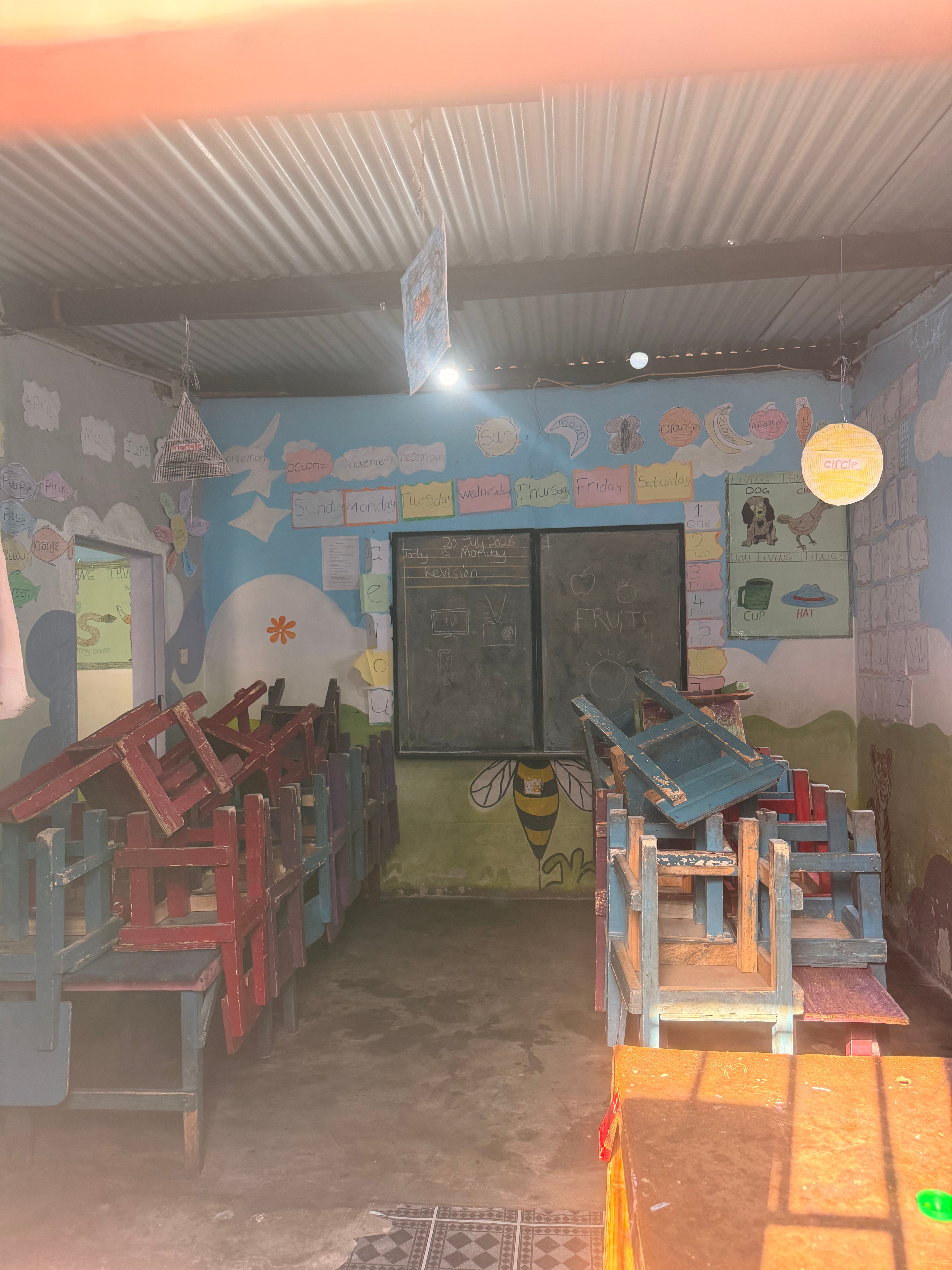
Then we begin. I am primarily the Grade 6 teacher, teaching them for 11 of my 22 hours. I teach them English, Maths, and Social Studies. To the Grade 3s, computing. To the Grade 1s, drawing. The Grade 6s are taught out in the courtyard; there is no room inside – some metal sheets protect them from the sun. Meanwhile, the Grade 1s, 2s, and 3s share a large classroom, with desks facing in different directions. Some 70 children are in that room. I learned this is a small number. At the public school where Mercy also works, she teaches 133 students in a single class.
The children are children. You have the ones who live for full marks, the ones who know what they can get away with, and the ones who sow chaos. But they all watch the hose from which they drink water; seeing running water is a novelty. You feel bad telling them to go back to class when they sneak out to watch it. You feel worse when the council turn the water off, and there is none to drink. You think of the goals you made in a warm classroom in Scotland, and they don’t quite work.
My first goal had been to produce a reader, knowing it was complete when it was in my hands, having worked through it in class with students as a proof of concept. Firstly, you cannot trial on children’s learning time. You have a duty to always teach to the best of your ability, to use methods you know work; that is not trial and error for a reader. Secondly, the school already had comprehension texts, meaning it would have contributed nothing to the school’s resources. Yet a fellow scholar and I noticed something that was missing: a grammar reader.
Most of the children in the upper grades had been attending this school for less than two years. Most had not learnt to read or write before that point. Yet, these Grade 5-6 readers expected these children to have years of consistent education behind them. Thus, at no point did they recap the foundational building blocks of language: what a noun was, what a verb was, or when to use a capital letter. Consequently, we set ourselves to making a ground-up grammar syllabus, with set lessons and questions to weave into standard lesson schedules.
We based the structure on our own pedagogical experience and Mercy’s recommendations: first, a teacher explanation; then a worked example the teacher would do on the board; next, three tiers of questions; and a set of recap Qs for the following lesson. Applying these in our own lessons, we saw our learners improve, particularly in capitalisation and conjunctions when re-reviewing earlier weeks’ work. By the time they took their English exams in week 6, they lost at most 5 of 30 marks, and one girl even achieved full marks. Ultimately, breaking language and conventions into bite-sized chunks, with a robust, repeated learning structure, seemingly helped build their confidence and competence.
While this first goal was forgotten, in many ways its spirit continued into this grammar book. It was the desire to provide a needed learning resource. That was what we achieved with a grammar book for Grades 5 and 6. Instead of deciding the product from afar, we developed it within the space, responding to the school's needs and making that the goal. In that, I learnt that one could predict and adapt; they do not run contrary to each other; they simply require a negotiation. To discuss leadership traits, I believe the necessity here was ‘calm leadership’; things change, and that cannot overwhelm you. That was something Ng’ombe fostered: calmness when uncertainty prevailed, but the need to continue remained.
The second goal was to jointly create a music syllabus for the students and teach some of the teachers to play the violin with a fellow scholar. In the end, this became Grace’s project. It fundamentally did not need two people, and if we had followed that plan, the school's manpower would have been reduced.
The school had six teachers; it needed ten. When we arrived, we often were teaching two years simultaneously – for me, this was typically grades 2 and 3. So, as Mercy explained, adding people to a task that didn't require it was a waste and an ineffective use of energy. It was better spent on focused instruction where years were taught individually.
This did not mean I failed to teach the arts or lost the desire for a broad curriculum. Instead, I focused on teaching dance – still an arts project, but one that divided teachers among the classes. For an hour and a half each week, the children learned ballet. Jumping and plies developed their balance and strength. I do not know how to quantify the success of what this goal became. There was no exam. But the children laughed and smiled.
One boy, Mercy had mentioned, had a particularly tough home life. For my first two weeks, I barely saw him smile. In dance, he laughed, and in the end, he was more ready to tell a joke in the other classes I took him for as well. This did not change his grades. But that does not mean it lacked value; it speaks to the values in education beyond test scores. Experiences such as this reminded me of the importance of compassion in leadership; pushing children to get one mark higher is not always what they, as people, need – sometimes it is to be given a space to smile.
My third goal was to simply observe and support the school’s wants. Before leaving for Zambia, we did not know what we were walking into, so this safety net felt necessary. In the end, it was one of the most fruitful goals. It made ‘listening’ the intention, and through discussions with Mercy, we articulated it in many small ways.
One such case was the need for toilet passes. Children would often sneak out of class because of reduced staffing and claim a teacher had told them to go to the toilet. Consequently, Grace and I spent an evening laminating cardboard with cello tape to make passes for each year. That simple solution, at least while we were there, made all the difference. The children knew there was a barrier and that they would be checked, disincentivising the attempts. It also made it clear to teachers whether a child was being truthful. Leadership is often thought of in large set pieces, but here, Grace and I noticed a small tension point and set out to try to resolve it. There is value in that attention.
Another matter was publicity. While the school had a website, it was very minimal. So, we made a promotional video. All four scholars took part in the planning, but we knew it was crucial that it be their voices, not ours. We were visitors: this was their lives. Consequently, we interviewed parents, teachers, and children, culminating in an informative video told by them. Controlling your own story is vital, and that’s what we tried to do here. The whole experience was a lesson in ethical leadership; it was felt in every interaction. It was a place where you were a temporary fixture, with its own customs and norms. Slotting into that process was a needed part, facilitating service, rather than trying to impose.
Ultimately, each of these outcomes came from a flexible goal: listening and responding. While the most nebulous of the three goals, it produced the most productive outcomes. It centred on flexibility and discussion with individuals who truly knew what was necessary. That was its asset.
In the end, most of my goals changed, but so did my attitude towards them. I had initially assumed that uninformed goals would impede this responsiveness. However, I came to realise that the most important aspect of the goals was their intention: to help. Through the process, I came to understand that they would be negotiated and adapted, but that this was not a failure, instead being a necessary and normal part of leadership through service. Thus, the suggestion of forgetting in the title is not quite accurate. I thought I would forget; I thought that would be the most helpful thing. Instead, I now see that the force behind them stayed.
Ultimately, I was pleased that each goal produced something: a resource, a strategy, a smile. When I set goals going forward, I will keep in mind not only the potential need for change, but also the different ways to measure success. Zambia was a place like nowhere I have been. I ate different food, experienced a different home life, and met truly amazing people. Writing goals on a piece of paper is one thing; remembering the humans they could affect is another.

Hello! I’m Henry, a second-year student at the University of St Andrews. Originally from Lancashire, I moved to Scotland in 2023 to pursue an undergraduate degree in modern history. Now entering my third year, my interests primarily revolve around late modernity, covering themes of empire, oppression, and propaganda.
For my Laidlaw research, I am focusing on youth targeted propaganda in Nazi Germany. Specifically, I am analysing the techniques used in the children’s literature of the Third Reich to skew the youth’s morality, comparing this to themes found in the contemporary U.S.. With the recent resurgence of far-right politics, I feel it is crucial to analyse the means and manner of indoctrination, particularly those centred on the youth.
I look forward to connecting with you all and reading about your projects!