The Laidlaw programme has been an incredibly valuable addition to my undergraduate experience. Starting the programme in my first year, I had never undertaken independent research or considered the possibility of working abroad. Not only did the programme enable me to seize opportunities that I previously did not believe were feasible, but it also provided me with crucial development throughout every step of the journey.
My First Laidlaw Summer
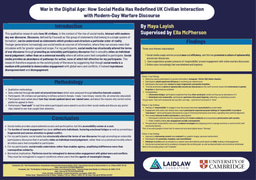
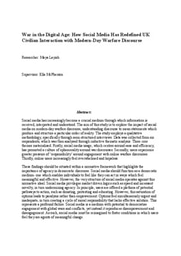
In my initial research summer, I wrote a 6,000-word report titled ‘War in the Digital Age: How Social Media Has Redefined UK Civilian Interaction with Modern-Day Warfare Discourse’. Within my research, I was interested in how digital platforms shape public understanding of conflict, influence the spread of information (and misinformation), and blur the boundaries between civilian and state narratives in times of war. Working on this six-week research project taught me important lessons. The challenges I overcame in this period shaped the research and leadership skills I have today. From finding a supervisor, to conducting academic interviews on a heavy topic, to completing the project within a six-week timeframe, my initial summer taught me how to adapt to new and unknown academic situations with greater strength and wisdom. My research forced me to face new pressures and to adjust expectations accordingly.
My Leadership Development
My personal leadership journey was also supported by the programme through tangible leadership training. The Oxford Character Project was the first time I had seen leadership be treated as a discipline that required teaching and intellectualising. I attended six webinars where I collaborated with other scholars in breakout rooms, discussing character and leadership.
It showed me that good character is something we all possess; we all have the agency to enact change, whether within ourselves or directed at the world around us. This trained me in how to build and maintain a strong sense of purpose, as well as how to recognise it in others.
My Leadership in Action
When embarking on my Leadership in Action, I wanted to challenge and develop my sense of purpose by translating the academic insights I gained from research into real-world policy development and advocacy. I can say with certainty that my summer spent in Melbourne, Australia, did just that.
Moving to Australia posed a new challenge: budgeting with a different currency (and cost of living), tackling jet lag, manoeuvring cultural differences, and adapting to a four-degree Australian winter from a thirty-degree English summer. It was here that I realised that ethical leadership means overcoming obstacles whilst staying true to my purpose. My work in Australia reminded me that everyday challenges tested the values and character that I had been taught, and that they were important hurdles that I could overcome with perseverance. I learnt to embody the Changemaker values: bravery when travelling to new environments like Australia, and determination to overcome the fears and pressures along the way.
I worked for Electronic Frontiers Australia (EFA), where I created public-facing articles and co-drafted a thirty-three-page digital policy positions document to educate Australian internet users on their digital rights. I expanded on my capacities and skills by learning and writing simultaneously. As I learnt how Australian legislation works, I drafted policy documents, and as I listened to the concerns of everyday Australians, I wrote educational articles on pressing issues.
It was at EFA that I observed ethical leadership in practice: an organisation that makes digital rights issues accessible to the public, as individuals cannot meaningfully engage with debates about their rights without understanding the technologies and legislation affecting them. My sense of purpose grew when I moved beyond theoretical analysis to contribute tangible outputs. I learnt the importance of transparency and accountability around knowledge. I saw the importance of examining not only what technology is capable of doing, but also the legal and political structures that govern its use.
Conclusion
Through the Laidlaw programme I have been able to better understand what ethical leadership means to me and how to embody it moving forward. I now fully recognise the importance of democratising information and of having organisations that meaningfully engage with the public and educate them on their rights. I will use my leadership skills to embody this and continue to fight for the right to transparency, whether that be in my future career or through volunteering. This experience has left me assured that I will continue to work for and volunteer with organisations that contribute meaningfully to our society.
I will carry the skills I have learnt through the programme throughout my life. I have gained character through working, and leadership skills through independent research and travel. The Laidlaw Foundation has certainly put my have put my values and character into practice in ways I would never have expected. I am very grateful for this experience.