1) What are you most excited about as you start your Laidlaw research summer?
Starting my Laidlaw summer, I am most excited to really dig into the data. I am looking at collections of historical newspapers from the 20th century and in an archive that is extraordinarily detailed and nuanced. Ordinarily—either for school or for work—I have a relatively limited amount of time to examine the data, but Laidlaw gives me ample time to turn every page and read each potential source for additional information. I am excited about the opportunity to be genuinely thorough in my work!
2) This week, the discussions we held about research cut across the disciplines. How does the interdisciplinary nature of this program, the fact that students are focusing on such a diverse range of projects, help you think about your project and/or your academic interests more broadly?
Hearing from other Laidlaw scholars about their own research has been super useful for shaping my understanding of research more broadly and for contextualizing my own research this summer. Although my project is almost entirely qualitative analysis, the Laidlaw ecosystem is a continuous reminder of other methods of research, and in particular it motivates me to incorporate some quantitative analysis. Even if that might not work in my current project, the interdisciplinary nature is always reminding me about how I could expand my research in the future, and how (if) it could be applicable in other fields. For instance, combining my qualitative analysis of political machinery with, say, quantitative election data, could allow me to make stronger claims about how political partie change and why.
3) As you begin your individual research projects this week, do you anticipate any challenges in getting started? If so, what are they?
The biggest challenge that I anticipate is figuring out when a specific part of the project is done, such that I am comfortable moving to the next section. My analysis of Vermont’s political history goes chronologically; I am looking year by year. In say, 1968, there are a huge amount of potential sources I could look at, and in theory I could spend all 6 weeks just in that year, but that is not what I planned. So for me the hardest part will likely be deciding when a given year is ‘done’ and when I can move on feeling satisfied that I have looked through the archive as thoroughly as time allows.

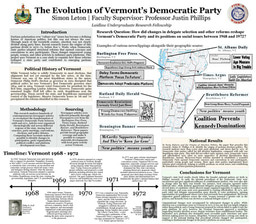
I am a rising junior at Columbia studying Political Science and Statistics. My research this summer is focused on understanding partisan political polarization around culture war issues, and primarily on the origins of this polarization in the United States. Specifically, I am working with Professor Justin Phillips to comeplete a case study on the evolution of the Vermont Democratic Party in the 1960s and 70s, and especially on how policies around reproductive rights and evolved during this era.