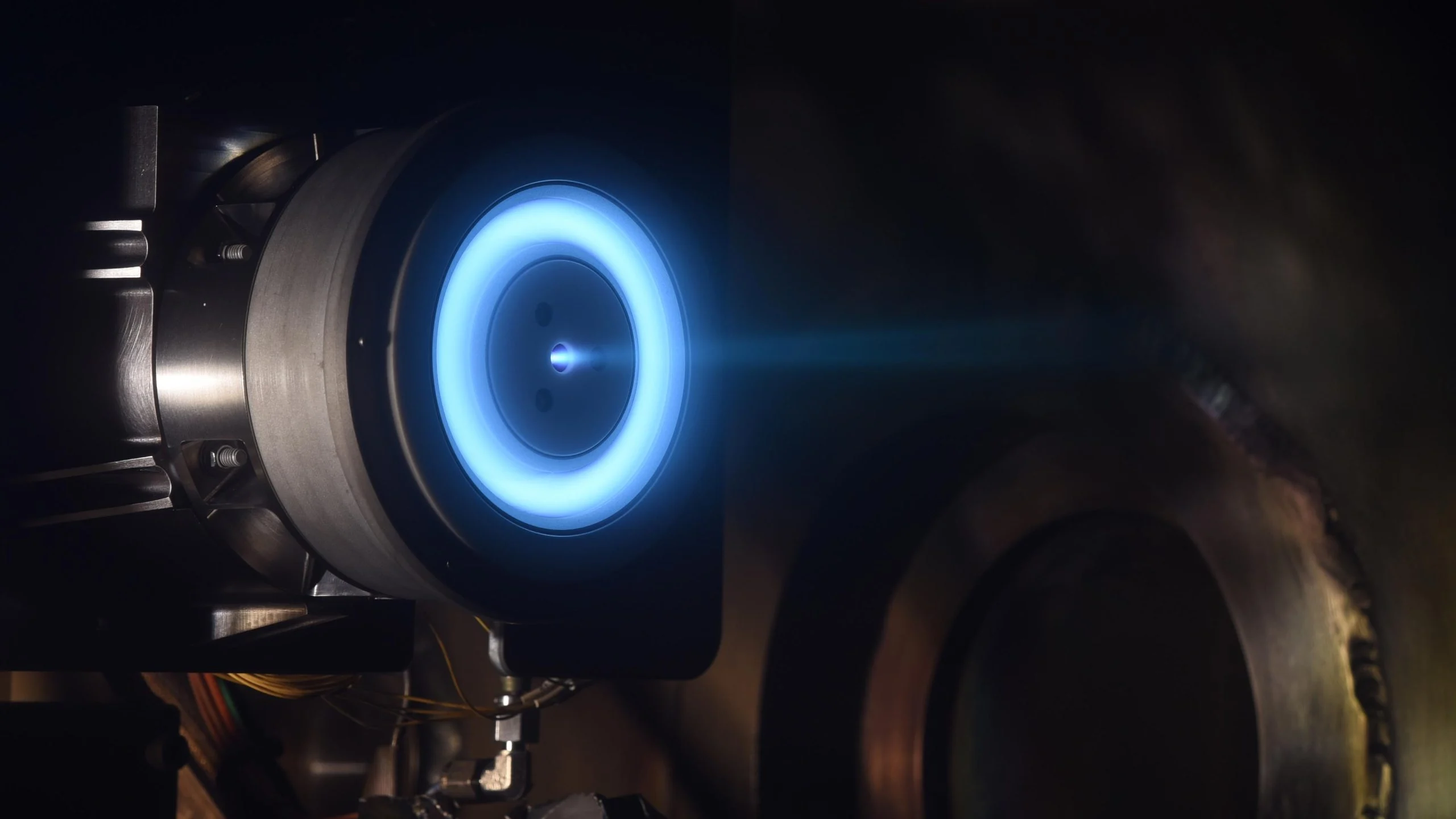
My Laidlaw research project focuses on magnetic shielding topologies for water-fuelled Hall-effect thrusters, carried out with Imperial College London’s Plasma Propulsion Laboratory under the supervision of Dr Aaron Knoll.
Hall-effect thrusters are electric propulsion systems used on satellites and spacecraft. Unlike conventional chemical rockets, they use electricity to accelerate charged particles and produce thrust. However, over time, these energetic particles can erode the internal walls of the thruster, reducing its operational lifetime.
The aim of my project is to investigate how magnetic shielding can help address this problem. By carefully shaping the magnetic field inside the thruster, it may be possible to guide the plasma away from the walls, reduce erosion, and extend the lifetime of the propulsion system.
A key part of the project is its focus on water as a propellant. Water is safer, more accessible, and potentially more sustainable than many conventional propellants. It is also especially relevant for future space missions, where water could be extracted from the Moon, asteroids, or other bodies rather than transported entirely from Earth.
Through this research, I hope to contribute to the development of electric propulsion systems that are more durable, efficient, and sustainable. Alongside my work at Imperial, I will also be carrying out related research at the Space Propulsion Laboratory at MIT, continuing to explore the role of plasma physics and electric propulsion in future space technologies.
I am looking forward to developing this project through the Laidlaw programme and learning from the research and perspectives of the wider scholar community.


Please sign in
If you are a registered user on Laidlaw Scholars Network, please sign in