Since my first year, I have been extremely involved in UofT student life. By the end of my third year, I was a VP or an active participant in five commerce clubs that year. I truly believed I had reached my peak university experience and performance there, and there were no real soft skills I could have developed further. In my head, if I became a peer leader at 14, then certain leadership skills should have come to me naturally, and there was nothing to work on. I also immigrated to a different country, miles and an ocean away from my home, when I was 16, so another assumption of mine was that my global mindset might also be pretty well developed. Is it finally time to stop bragging and say how wrong I was to assume that?
All these points lead us to talk now about my biggest takeaway from the programme: personal growth is non-linear but exponential in its nature. There is no ceiling to self-improvement, whether it is in a professional or social setting. Being surrounded by 25 extraordinary scholars at UofT during the Saturday leadership sessions first, and discussing a work-life balance with a scholar from Brown University during the annual conference in the States, sounds surreal to me even now: a fever dream that was turned into reality as a payoff to hard work and endless sleepless nights of writing the research proposal first and then conducting this research itself.
Speaking of research, not only did I improve my knowledge in statistics and environmental legislation and initiatives in Europe, I also conducted interviews with industry professionals who have been in the field of my study for more than a decade. Was I scared to reach out to them because I had a fear of rejection? Absolutely. However, did any of them say no to me? Surprise: yes, some of them did. Did it ruin my research flow and overall experience? And the answer is a hard no. I reached out to many professionals not even for the purpose of keeping their opinions for the record, but rather to gain deeper expertise in the topic that I cared about quite deeply - whether that was a five-minute coffee break or a proper two-hour conversation. Another takeaway here: it really does not matter how many years of expertise you have in one thing or another. If you stay curious and genuinely interested in the topic, like-minded people will always be drawn to you, and the knowledge gap would not feel like something to be embarrassed about, but rather another opportunity to ask the right questions to get unexpected answers. It is rewarding when your Laidlaw cohort comes up to you during the symposium, where all of you presented your findings, with words of admiration and appreciation for your work. All these people put so much effort into their own work, so receiving these kind words from them was not flattery; it was a moment of mutual respect between two people who had never done individual research of such scale, and now took a step back to congratulate each other and reflect on the journey that got us here. I also taught myself how to break down more difficult topics and too industry-specific terms into easier ones, so that anyone who has absolutely zero knowledge of what ecocide is could not only understand my research, but also be interested enough to go home and research that topic a little bit on their own. In my business classes, we were taught how to market a product, and maybe we should look at research the same way - we are still marketing a product in a way; the internal motive is what differs the two, though. The first marketing strategy is led by increasing profits, while the second is led by increasing awareness and knowledge among the masses.
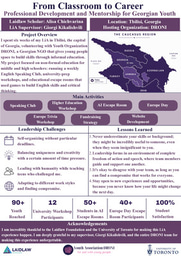
Laidlaw gave me an opportunity to do things I did not have time, courage, or resources to execute previously. Who would have thought that for my first Summer in the program I would be living in Poland while also volunteering in Georgia during my Summer II LiA experience?
Being the youngest in the room became a norm rather than an exception. For example, one time I coincidentally attended a legal conference on human rights advocacy changes in the European legal environment for multiple days in Warsaw during my research summer. First of all, I am not even a lawyer. Second of all, most of the participants there were famous judges, lawyers, workers, and owners of legal clinics worldwide, etc. I cannot even explain how valuable this experience was. For a second-year university student, being in one room with these people is already impressive enough, but pitching my research and getting their feedback from a legal perspective was something I will remember and cherish forever. Additionally, not even once did I feel imposter syndrome while being the youngest volunteer at the NGO DRONI during my LiA. My thoughts and creative ideas as a young university student were welcomed, heard, and appreciated.
It was always easier for me to understand other people than to understand myself: my own needs, wishes, and wants. The Laidlaw experience overall, but especially my Leadership-in-Action, changed that quite drastically. Oxford Character Project sessions showed me that our life experiences are very unique. There are no people in the world who are the same. Even going through the same life circumstances does not mean that we would approach these challenges in the same way, which makes these experiences so nuanced. As I mentioned in some of my previous reports, LiA in Georgia gave me a completely different perspective on life. I was too rushed to live through my planned ideal life. In the past few years, I put myself in a cage filled with expectations of other people for me, which I later started thinking were my own. During my LiA, I finally felt alive again. I did reconsider my priorities a lot. I believe I needed the time off to come back to things I love doing: teaching, learning new languages, being surrounded by extremely intelligent individuals from around the globe, mentoring, travelling, etc. Before the start of my LiA, I thought I would be helping teenagers out, and it turned out that they helped me.