Digital Strategy Placement
Climate Charity's Digital Strategy Rebuilt and Enhanced
https://drive.google.com/file/d/1eDXZkZ6AJt_a-omrj2xcFvU-tu-ggKQ_/view?usp=sharing
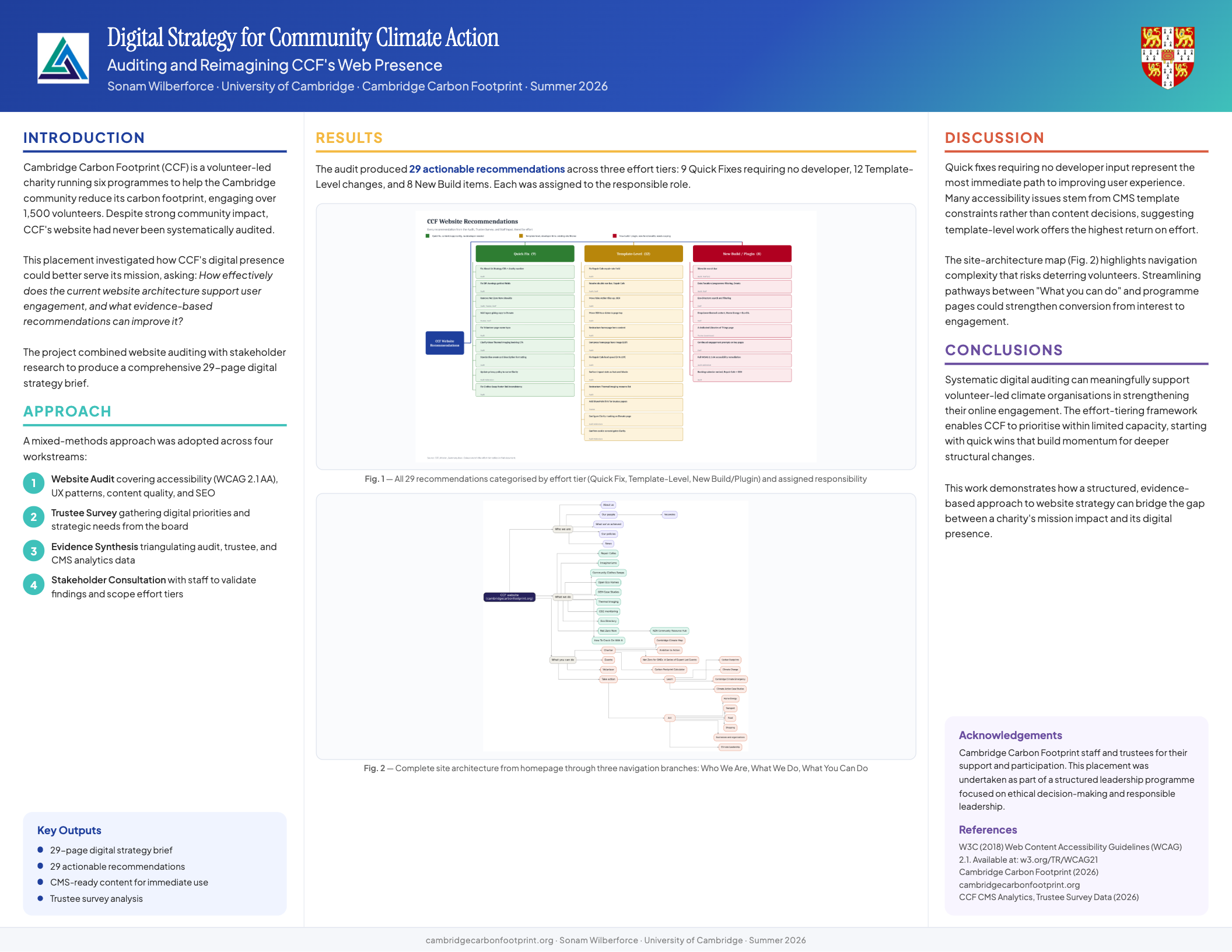
I spent six weeks working with Cambridge Carbon Footprint, a volunteer-led charity that helps thousands of people across Cambridgeshire cut their carbon footprint through community programmes like Repair Cafes, home energy advice, and climate education. My project set out to answer a simple but overlooked question: was the charity's website actually helping people take action, or quietly getting in their way? I wanted to find out because a charity's website is often the first, and sometimes the only, encounter someone has with its work, and if that experience falls short, real-world impact is lost before it even begins.
I got hands-on with the problem. I audited the site page by page, combing through user behaviour data to see where visitors dropped off, got stuck, or left confused. I surveyed the charity's trustees to understand their strategic priorities, then pulled everything together into a single evidence base. From there, I designed and prototyped a redesigned site architecture and a set of bold new page concepts, iterating repeatedly with staff feedback until the direction felt right.
The biggest challenge was balancing ambition with reality: a small charity with a handful of staff cannot rebuild its whole website overnight. I solved this by tiering every recommendation by effort, so quick wins could happen immediately while bigger changes had a clear, costed path forward.
The result was a 29-page digital strategy brief containing 29 concrete recommendations, ready-to-use content, and interactive prototypes the charity can hand straight to a developer, giving a small team an outsized way to grow its impact.