Cities as Systems: What Berlin and Washington D.C. Taught Me About Leadership
Last summer, I spent hours walking through Berlin with a camera. I photographed bike lanes, transit stops, public spaces, new construction, and the small design choices that are easy to miss when you are simply trying to get somewhere. This summer looked very different. Instead of studying streets from the sidewalk, I often sat in meetings in Washington, D.C., listening to conversations about WMATA, infrastructure projects, bus routes, workforce trends, and public investment. Yet I kept returning to the same question in both cities: Who is able to benefit from the way a city is designed?
That question has become the thread connecting my experience as a Laidlaw Scholar. Before the program, I understood housing, transportation, sustainability, and economic development as related policy areas, but I still tended to examine them one at a time. Berlin made their relationship impossible to ignore. Housing determines how far someone lives from work. Transportation determines whether that distance is manageable. Urban design influences whether walking or cycling feels practical and safe. Environmental policies affect where and how a city grows, while that growth can either expand opportunity or push people out. No policy existed only within the category I had assigned to it.
My research in Berlin asked me to slow down and observe before reaching conclusions. Going into neighborhoods and documenting what I saw gave me a different kind of evidence from what I could find in a report. A map could show that a transit stop existed, but it could not always tell me whether the route felt accessible, whether the surrounding street invited pedestrians, or whether nearby residents could afford to remain there. I began to understand that research is not only about collecting more information. It is also about noticing which information is missing.
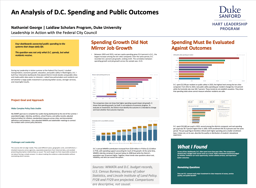
When I arrived at the Federal City Council for my Leadership-in-Practice summer, I brought that habit of looking for connections with me. FCC works across sectors to address major challenges facing Washington, D.C. My work focused primarily on transportation and infrastructure, though it regularly crossed into economic development, workforce policy, education, public safety, and taxation. I researched how D.C. compared with other cities, developed data primers, coded dashboards, and contributed to a long-term public investment brief that combined economic data, legislation, and stakeholder perspectives.
The most valuable part of the summer was seeing how decisions move from research into practice. In meetings with WMATA, government officials, community organizations, and regional stakeholders, transportation was never discussed as an isolated technical problem. A bus-line expansion could change whether someone could accept a job across the city. A major infrastructure project could bring investment to one neighborhood while creating disruption or displacement in another. Service reliability could affect hourly workers differently from people with flexible schedules. The data mattered, but so did the experiences behind it.
This created one of the central challenges of my summer: learning to be useful when there was no single correct answer. My academic instincts often pushed me to keep researching until I felt certain. Civic work rarely offers that luxury. Leaders must make choices amid budget limits, deadlines, competing interests, and incomplete information. I watched people disagree not because one side cared and the other did not, but because they defined urgency, fairness, or acceptable risk differently. That experience made leadership feel more complicated, but also more honest.
Laidlaw’s 3C model helped me make sense of that complexity. I once placed the greatest emphasis on capacities—the ability to analyze data, write clearly, manage a project, or communicate an argument. Those abilities allowed me to contribute at FCC, but they could not tell me what deserved attention or how I should respond when priorities conflicted. Change maker values supplied direction, while character shaped the choices made along the way. Curiosity encouraged me to ask another question. Humility reminded me that technical knowledge did not outweigh community experience. Integrity required me to be transparent about the limits of my evidence.
The gateway course and Laidlaw Colloquium gave me opportunities to practice those habits before I needed them professionally. Conversations about entering communities responsibly made me more conscious of the difference between working for people and working with them. Hearing other scholars approach problems through different disciplines also exposed the limits of my own framework. I learned that collaboration is not simply dividing tasks among people. At its best, it changes the question being asked.
What inspired me most was discovering that careful observation can itself be a form of leadership. In Berlin, observation meant taking a photograph and asking what a street revealed about access, sustainability, or belonging. In Washington, it meant listening closely enough during a transportation meeting to recognize that a discussion about routes and ridership was also a discussion about employment, education, and dignity. In both cases, paying attention expanded my understanding of who was affected.
I now think of global citizenship less as having knowledge about many places and more as developing an ethical way of moving through them. It requires recognizing that ideas do not transfer perfectly across borders, that local context matters, and that people should not be reduced to case studies or data points. Berlin and Washington face different histories and constraints, but each taught me to see a city as a network of human choices rather than a collection of separate policies.
Going forward, I want to continue exploring the intersection of urban policy, transportation, sustainability, and economic opportunity. I also want to become more comfortable making decisions without pretending to possess certainty. Laidlaw has strengthened my capacity to research and communicate, but its deeper impact has been on how I define responsible leadership. I want to ask better questions, recognize connections that are easy to overlook, and remain accountable to the people whose daily lives give policy its meaning.