Blurring the Lines Between Research and Reality
It was a cloudy day in June that I embarked upon my research project investigating the wellbeing of postgraduate-taught (PGT) students. As I sat in St Mary’s Library surrounded by many PGT students, I couldn’t help but think that I was currently living a life similar to theirs (minus the master's degree and year-long course). The idea of spending the next 6 weeks researching independently was a scary one, but being surrounded in a room full of scholars in the same position brought me much comfort.
During my first week of research, I remember feeling clearly out of my depth. Before I could even think about investigating PGT wellbeing, I firstly had to learn the differences between a PGT and a postgraduate research (PGR) degree. Furthermore, being only in the second year of my undergraduate degree, I had no idea how different undergraduate and postgraduate degrees actually were. It wasn’t until my second week of research, when I spoke to PGT students about their own wellbeing experiences, that I realised how naive I truly was. PGT students were only at university for a year; therefore, they simply did not have time to advocate for themselves or raise concerns about their wellbeing, unlike undergraduate students, who have 4 years to do so. Having such an open conversation with PGT students was incredibly eye-opening and strengthened my motivation and direction to support and advocate for those students who couldn't.
After this insightful experience, I began to explore current student wellbeing research, which led me to develop a series of recommendations for universities and for the wider education system itself. It wasn’t until a conversation with other scholars that I realised that my own student wellbeing research was also relevant to the experiences of Laidlaw scholars at the time.
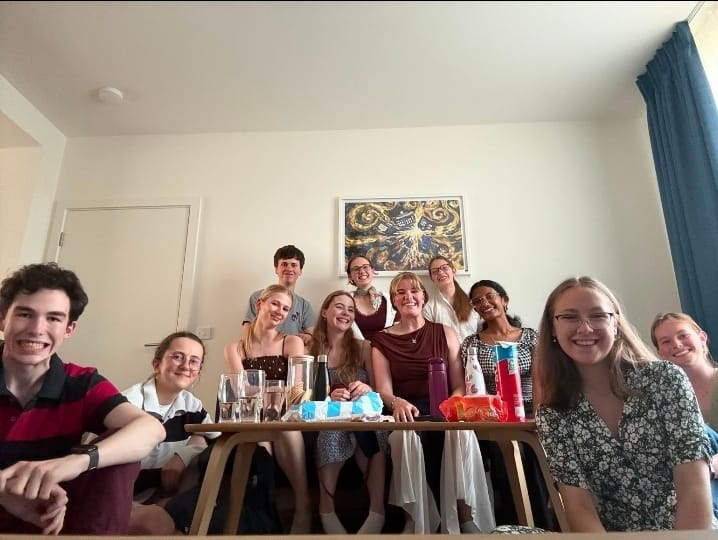
Working in a smaller cohort of 25 scholars in a small town where the majority of the student population had left for the summer, taught me about the importance of socialisation. Within my research, I had concluded that social connection was something that postgraduate taught students often lacked due to the short timescale and lack of contact hours that many faced. Both of these challenges were faced by our scholar cohort, and thus, as I researched further, I found myself socialising more and more to increase my social connectedness in alignment with my research. The scholars and I took many trips to neighbouring seaside towns, the deer park and the local ceilidh.

As researchers, many of us get so absorbed in studying that we become disconnected from our research and forget its purpose and impact. By reviewing your work as if you were a member of your target audience, I’ve learnt that, often, you can learn a thing or two about your own life from your research.

Hello, my name is Hannah Treagus, I'm a current 3rd year psychology student at The University of St Andrews. My research project titled "Exploring the Impact of Wellbeing Intervention Strategies on Master’s Students: Valuing the Student Voice" is focused on exploring and advocating for the underrepresented voice of postgraduate taught (PGT) students. I'll be working with a group of postgraduate students to create a student-led intervention that can hopefully be utilised globally as a wellbeing tool.
I have a significant interest in Educational Psychology but would love to connect with scholars of any discipline.
I also love travel, photography, baking and horse riding in my free time and am always up for a chat!