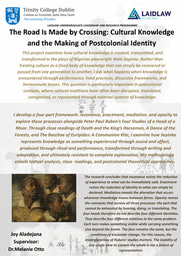
The Road Is Made by Crossing: Cultural Knowledge and the Making of Postcolonial Identity
Preview
Knowing “Otherwise”: Cultural Knowledge, Performance, and Transformation in Wole Soyinka’s Drama
This project examines how cultural knowledge is created, transmitted, and transformed in the plays of Nigerian playwright Wole Soyinka. Rather than treating culture as a fixed body of knowledge that can simply be recovered or passed from one generation to another, I ask what happens when knowledge is encountered through performance, lived practices, discursive frameworks, and hermeneutic lenses. This question is particularly important in postcolonial contexts, where cultural traditions have often been disrupted, translated, categorised, or represented through external systems of knowledge.
I develop a four-part framework: resonance, enactment, mediation, and opacity to explore these processes. Through close readings of Death and the King’s Horseman, A Dance of the Forests, and The Bacchae of Euripides: A Communion Rite, I examine how Soyinka represents knowledge as something experienced through sound and affect, produced through ritual and performance, transformed through writing and adaptation, and ultimately resistant to complete explanation.
I found that the hybrid colonial knowledge of Europe and West African in these plays cannot be understood as a stable object that exists independently of those who encounter it. Instead, knowledge emerges through relationships and acts of participation, while attempts to recover an authentic cultural past can risk reducing the complexity and changeability of culture itself. Soyinka’s plays therefore suggest that cultural continuity does not require cultural preservation in an unchanged form; transformation can itself be a mode of continuity.
The next stage of this research will consider how this framework might be applied beyond Soyinka, particularly to other forms of cultural transmission and postcolonial literary and performance practices.